| Risultati della ricerca nelle immagini - "Propeller" |

Propeller-PIA12790-1.jpgSaturnian "Propeller": Earhart57 visiteA propeller-shaped structure created by an unseen moon is brightly illuminated on the Sunlit Side of Saturn's Rings in this image obtained by NASA's Cassini Spacecraft.
The moon, which is too small to be seen, is at the center of the Propeller Structure visible in the upper left of the image, near the Encke Gap of the A-Ring. The A-Ring is the outermost of Saturn's Main Rings.
The moon is likely about 1 Km (a little moere than half a mile) across. Disturbed ring material to the upper left and lower right of the moon reflects Sunlight brightly and appears like a white airplane propeller.
Several density waves are also visible in the Ring. A spiral density wave is a spiral-shaped accumulation of particles that tightly winds many times around the Planet. It is the result of gravitational tugs by individual moons whose orbits are in resonance with the particles' orbits at a specific distance from Saturn.
A Propeller's appearance changes with viewing geometry, and this image shows the way a Propeller looks when viewed from the sunlit side of the Rings. Contrasts can reverse when the structure is observed on the dark side of the Rings: for example, the bright structure of this Propeller corresponds to the dark portion at the center of the propeller seen in PIA12791 which was imaged from the unilluminated side of the Rings.
This image is part of a growing catalogue of "Propeller Moons" that, despite being too small to be seen, enhance their visibility by creating larger disturbances in the surrounding fabric of Saturn's Rings. Cassini scientists now have tracked several of these individual Propeller Moons embedded in Saturn's disk over several years.
These images are important because they represent the first time scientists have been able to track the orbits of objects in space that are embedded in a disk of material. Continued monitoring of these objects may lead to direct observations of the interaction between a disk of material and embedded moons. Such interactions help scientists understand fundamental principles of how Solar Systems formed from disks of matter. Indeed, Cassini scientists have seen changes in the orbits of these moons, although they don't yet know exactly what causes these changes.
Imaging scientists nicknamed the Propeller shown here "Earhart" after the early American aviatrix Amelia Earhart. The Propeller Structure is about 5 Km (a little more than 3 miles) in the radial dimension (the dimension moving outward from Saturn which is far out of frame to the lower right of this image). It is about 60 Km (approx. 35 miles) in the azimuthal (longitudinal) dimension.
This same Propeller can be seen casting a shadow around the time of the Planet's Equinox in PIA11672. See PIA07791 and PIA07792 to learn more about Propeller shapes and to see smaller Propellers.
Scale in the original image was about 2 Km (about 1,3 miles) per pixel. The image has been rotated and contrast-enhanced to aid visibility.
This view looks toward the Southern, sunlit side of the Rings from about 81° below the Ring-Plane. The image was taken in Visible Light with the Cassini Spacecraft narrow-angle camera on April 11, 2008. The view was obtained at a distance of approx. 364.000 Km (such as about 226.000 miles) from Saturn and at a Sun-Saturn-Spacecraft, or Phase, Angle of 82°.MareKromium
|
|

Propeller-PIA12790-2.jpgSaturnian "Propeller": Blériot57 visiteNASA's Cassini Spacecraft captured a Propeller-shaped Disturbance in one of Saturn's Rings created by a moon that is too small to be seen here.
The moon, likely about 1 Km (a little more than half a mile) across, is invisible at the center of the image. However, it is larger than many other "Propeller" moons and has cleared ring material from the dark wing-like structures to its left and right in the image. Disturbed ring material closer to the moon reflects Sunlight brightly and appears like a white airplane propeller. This Propeller appears in the A-Ring, which is the outermost of Saturn's Main Rings.
Taken in 2006, this image is part of a growing catalogue of "Propeller Moons" that, despite being too small to be seen, enhance their visibility by creating larger disturbances in the surrounding fabric of Saturn's Rings. Cassini scientists now have tracked several of these individual Propeller Moons embedded in Saturn's disk over several years.
These images are important because they represent the first time scientists have been able to track the orbits of objects in space that are embedded in a disk of material. Continued monitoring of these objects may lead to direct observations of the interaction between a disk of material and embedded moons. Such interactions help scientists understand fundamental principles of how Solar Systems formed from disks of matter. Indeed, Cassini scientists have seen changes in the orbits of these moons, although they don't yet know exactly what causes these changes.
Imaging scientists nicknamed the Propeller shown here "Bleriot" after a French aviator named Louis Bleriot.
The Propeller's structure is about 5 Km (approx. 3 miles) in the radial dimension -- the dimension moving directly outward from Saturn. The dark wings appear approx. 1100 Km (about 700 miles) in the azimuthal (longitudinal) dimension, while the central propeller structure is roughly 110 Km (about 70 miles) long.
See PIA12792 to watch a movie of "Bleriot." PIA11672 shows the giant propeller "Earhart" named after another aviator, Amelia Earhart. See PIA07791 and PIA07792 to learn more about propeller shapes and to see smaller propellers.
This image has been re-projected so that orbiting material moves to the right and Saturn is down. The Propeller was seen at the edge of the camera's field of view when the image was taken, so some data were missing; the blank space at the top of the image was filled in with a gray color. Scale in the original image was approx. 2 Km (about 1,3 miles) per pixel. Image scale in this re-projected view is about 1 Km (a little more than half a mile) per pixel.
This view looks toward the Southern, Sunlit side of the Rings from about 30° below the Ring-Plane. The image was taken in Visible Light with the Cassini Spacecraft narrow-angle camera on Dec. 15, 2006. The view was acquired at a distance of approx. 463.000 Km (about 288.000 miles) from Saturn and at a Sun-Saturn-Spacecraft, or Phase, Angle of 15°.MareKromium
|
|

Propellers-000-PIA07792.jpgThe "Propellers" of the Rings (1) - HR55 visiteThis collection of 3 Cassini images provides context for understanding the location and scale of some "propeller-shaped features" observed within Saturn's A-Ring.
Careful analysis of the HR images taken by Cassini's cameras as the spacecraft slipped into Saturn orbit revealed the 4 faint, propeller-shaped double-streaks in an otherwise bland part of the mid A-Ring. Imaging scientists believe the "propellers" provide the first direct observation of the dynamical effects of moonlets which are approx. 100 mt (such as about 300 feet) in diameter.
The propeller moonlets represent a so far unseen size-class of particles orbiting within the Rings.
The 2nd panel provides broad context within the Rings, and shows the B-Ring, the Cassini Division, the A-Ring and the F-Ring. Image scale in the radial, or outward from Saturn, direction is about 45 Km (about 28 miles) per pixel; because the Rings are viewed at an angle, the image scale in the longitudinal - or circumferential - direction is several times greater.
|
|

Propellers-001-PIA07792.jpgThe "Propellers" of the Rings (2) - HR55 visiteThis image is a closer view of the A-Ring, showing the radial locations where "Propeller Features" were spotted. The view is approx. 1.800 Km across (such as about 1.100 miles), from top to bottom, and includes a large density wave at the bottom (caused by the moons Janus and Epimetheus), as well as two smaller density waves.
The footprints of the Propellers are between density waves, in bland, quiescent regions of the Ring.
The Propellers appear as double dashes in the two close-up discovery images and they have been circled. The unseen moonlets, each roughly the size of a football field, lie in the center of each structure. These two images were taken during Saturn orbit insertion on July 1, 2004, and are presented here at one-half scale. Resolution in the original images was 52 mt (about 171 feet) per pixel.
The horizontal lines in the image represent electronic noise and do not correspond to any actual Ring features.
|
|

Propellers-002-PIA07790.jpgThe "Propellers" of the Rings (3) - HR55 visiteThe Propellers are about 5 Km (approx. 3 miles) long from tip to tip, and the radial offset (the "leading" dash is slightly closer to Saturn) is about 300 mt (about 1000 feet).
The Propellers structures are unchanged as they orbit around Saturn.
In that way, they are much like the wave pattern that trails after a speedboat as it skims across a smooth lake. Such a pattern is hard to discern in a choppy sea (---> mare increspato). In much the same way, scientists think other effects may be preventing Cassini from seeing the Propellers except in very bland parts of the Rings.
|
|

Propellers-003-PIA07791.jpgThe "Propellers" of the Rings (4) - HR (detail mgnf)55 visiteThis magnified view illustrates the general orientation of the Propellers in Saturn's Rings, as they orbit around the Planet.
The two dashes of the Propeller are oriented in the direction of orbital motion. The "leading" dash is also slightly closer to Saturn; this "radial offset" is about 300 mt (about 1000 feet). The unseen moonlet lies in the center of the structure.
The grainy appearance of the image is due to magnification and the fact that the Propellers are very faint - just visible above the level of the back-ground noise. Consequently, the image enhancement procedures used to create this detail mgnf, have also enhanced the noise.
|
|
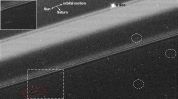
The_Rings-PIA10079.jpgSaturnian "Propellers" (context frame)59 visiteThe Cassini spacecraft captures 8 new propeller-like features within Saturn's A-Ring in what may be the propeller "hot zone" of Saturn's Rings.
Propeller features form around small moonlets that are not massive enough to clear out ring material, but are still able to pull smaller ring particles into a shape reminiscent of an airplane propeller. Scientists believe that propellers represent moonlet wakes, which are denser than the surrounding ring material and appear bright in the images.
Propellers were first discovered in Cassini images taken during Saturn orbit insertion in 2004. This new image is from a more extensive study of the full A-Ring and provides evidence that these features are not distributed evenly as previously thought, but are instead grouped in a 3000 Km-wide (about 1860 mile) Propeller Belt.
The largest propeller seen here is noted in the white dashed box, and it indicates the presence of a 150-meter (490-foot) moonlet. The size is inferred from the radial separation of the propeller wings. The propeller is seen in another image and is shown in the upper left box.
The reappearance of the propellers clearly demonstrates their orbital motion.MareKromium
|
|
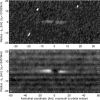
The_Rings-PIA10080.jpgSaturnian "Propellers" (extra-detail mgnf)58 visiteThis set of Cassini spacecraft images shows a close-up view of 2 propeller structures in Saturn's A-Ring. These images are part of a large view that captures eight new propeller-like features in what may be the propeller "hot zone" of Saturn's Rings. Propellers were first discovered in Cassini images taken during Saturn orbit insertion in 2004.
Propellers form around small moonlets that are not massive enough to clear out ring material, but are still able to push the ring particles into a shape reminiscent of an airplane propeller.
These pictures show 2 new propellers close up (one centered on each image). These images were put together from images in the Planetary Data System, a web site which archives and distributes scientific data from NASA planetary missions.
The image on the top shows a propeller induced by a 150-meter (490-foot) moonlet.
Smaller bright spots in the image are artifacts. The image on the bottom shows another propeller located just outside of the Encke Gap. Fine horizontal stripes seen in the image are wakes induced by the moon Pan.
In the top clear-filter image, taken during a stellar occultation on Aug. 20, 2005, the Cassini spacecraft narrow-angle camera observed the unlit side of the Rings, with a phase angle of 126°. The images were taken at 1 minute intervals with 0,05" exposure time. Image resolution is 1 Km (0,6 miles) per pixel.
The bottom clear-filter image was taken few hours later with 2" exposure time. Image resolution is roughly 1,5 Km (a little less than 1 mile) per pixel. MareKromium
|
|
| 8 immagini su 1 pagina(e) |
|





