| Risultati della ricerca nelle immagini - "Proctor" |

Craters-Proctor_Crater-20090615a-PCF-LXTT.jpgDunes in Proctor Crater (Natural Colors; credits for the additional process. and color.: Dr Paolo C. Fienga - Lunar Explorer Italia)64 visiteCoord. 48,1° South Lat. and 30,2° East Long.MareKromium
|
|
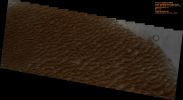
Craters-Proctor_Crater-20090922a.jpgProctor Crater (Natural Colors; credits: Lunar Explorer Italia)82 visitenessun commentoMareKromium
|
|
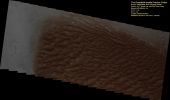
Craters-Proctor_Crater-20091015a.jpgProctor Crater (Natural Colors; credits: Lunar Explorer Italia)75 visitenessun commentoMareKromium
|
|

Craters-Proctor_Crater-Dunefield-PIA13916-PCF-LXTT.jpgProctor Crater's Dunefield (Natural Colors; credits for the additional process. and color.: Dr Paolo C. Fienga - Lunexit Team)227 visitenessun commentoMareKromium
|
|

Craters-Proctor_Crater-PIA13076.jpgProctor's Dunes (Possible Natural Colors; credits for the additional process. and color.: Dr Paolo C. Fienga - Lunexit Team)102 visiteThis observation shows the edge of a dark Dunefield on the Floor of Proctor Crater, an about 150 Km (approx. 93 miles) diameter crater in the Southern Highlands of Mars.
This subimage is a close-up view of the dark dunes. These dunes are most likely composed of basaltic sand that has collected on the bottom of the crater. Superimposed on their surface are smaller secondary dunes which are commonly seen on terrestrial dunes of this size. Near the crests of the dark dunes are bright patches of frost. Dark spots within the frost patches are areas where defrosting is occurring.
Many smaller and brighter bed forms, most likely small dunes or granule ripples, cover the substrate between the larger dark dunes as well as most of the Floor of Proctor Crater. In many locations, large boulders are seen on the same surfaces as the bright bed forms.
The dark dunes stratigraphically overlie the small bright bed forms indicating that the darker dunes formed more recently.
However in several areas, the dark dunes appear to influence the orientation of the small bright dunes, possibly by wind flowing around the larger dunes, suggesting that both dark and bright bed forms are coeval.MareKromium
|
|

Craters-Proctor_Crater-PIA17421-PCF-LXTT-IPF.jpgProctor Crater's Dunefield (Absolute Natural Colors; credits for the additional process. and color.: Dr Paolo C. Fienga/Lunar Explorer Italia/IPF)69 visiteIn this VIS image, taken by the NASA - Mars Odyssey Orbiter on July 4th, 2013, and during its 51.257th orbit around the Red Planet, we can see part of the very large Dunefield that is located located on the Floor of Proctor Crater (a large Impact Crater found in the Noachis Quadrangle of Mars, at about 48° South Latitude and 330,5° West Longitude).
Proctor Crater is approx. 168 Km (such as about 104,3 miles) in diameter and it was so named after Dr Richard A. Proctor, a British Astronomer (who was born in Chelsea - London, UK, on March, 23rd, 1837 and died in New York - USA - on September, 12th, 1888). Proctor Crater contains an approx. 35 x 65 Km (such as about 21,7 x 40,36 miles) Dark Dunefield that was one of the first Sand Dunefields ever recognized on Mars - note: this discovery was based on the NASA - Mariner 9 Spacecraft's images. Just out of curiosity, Proctor's Dunes are still being monitored by several Spacecrafts now orbiting the Red Planet (including the NASA- Mars Reconnaissance Orbiter) with the aim of identifying the changes (if any) which might have occurred - over time - in the shape of the Dunefield itself.
Latitude (centered): 47,4158° South
Longitude (centered): 30,9423° East
Instrument: VIS
This frame (taken from an Original Mars Odyssey Orbiter b/w and Map-Projected frame published on the NASA - Planetary Photojournal with the ID n. PIA 17421) has been additionally processed, magnified, contrast enhanced, Gamma corrected and then colorized in Absolute Natural Colors (such as the colors that a human eye would actually perceive if someone were onboard the NASA - Mars Odyssey Orbiter and then looked down, towards the Surface of Mars), by using an original technique created - and, in time, dramatically improved - by the Lunar Explorer Italia Team.MareKromium
|
|

Dunefield-Proctor_Crater-PIA14145-PCF-LXTT.jpgDunefield in Proctor Crater (Enhanced Natural Colors; credits: Dr Paolo C. Fienga - Lunexit Team)217 visitenessun commentoMareKromium
|
|

ESP_011909_1320_RED_abrowse.jpgSand Dunes and Ripples in Proctor Crater (Natural Colors; credits: Lunar Explorer Italia)100 visiteMars Local Time: 16:00 (middle afternoon)
Coord. (centered): 47,8° South Lat. and 30,7° East Long.
Spacecraft altitude: 253,2 Km (such as about 158,3 miles)
Original image scale range: 50,7 cm/pixel (with 1 x 1 binning) so objects ~ 1,52 mt across are resolved
Map projected scale: 50 cm/pixel
Map projection: EQUIRECTANGULAR
Emission Angle: 3,2°
Phase Angle: 59,1°
Solar Incidence Angle: 62° (meaning that the Sun is about 28° above the Local Horizon)
Solar Longitude: 206,7° (Northern Autumn)
Credits: NASA/JPL/University of Arizona
Additional process. and coloring: Lunar Explorer ItaliaMareKromium
|
|
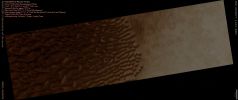
PSP_004077_1325_RED_abrowse-PCF-LXTT.jpgLarge Dunefield inside Proctor Crater (Absolute Natural Colors; credits for the additional process. and color.: Dr Paolo C. Fienga - Lunexit Team)96 visiteImage PSP_004077_1325 shows the edge of a Dark Dunefield on the Floor of Proctor Crater, an about 150 Km diameter Crater located in the Southern Highlands of Mars.
The Dark Dunes are composed of Basaltic Sand that has collected on the bottom of the Crater. Dark Dune "Slip Faces" - such as the steeper (---> più ripido) sides of the Dunes - are located on the Eastern side of the Dunes and are believed to have formed in response to Fall and Winter Westerly Winds caused by geostrophic forces (winds balanced by Coriolis and pressure gradient forces).
Superimposed on their Surface are smaller Secondary Dunes that are commonly seen on terrestrial Dunes of this size.
Many smaller and brighter bedforms, most likely small Dunes or granule Ripples, cover the substrate between the larger Dark Dunes as well as most of the Floor of Proctor Crater. The Dark Dunes overlie the small bright bedforms indicating that they formed more recently.
In several areas, however, the dark dunes appear to influence the orientation of the small bright Dunes, possibly by Wind flowing around the larger ones, suggesting that both dark and bright bedforms are coeval.
The Dunes in Proctor Crater may still be active today, moving in response to Martian Winds. MareKromium
|
|
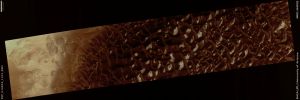
PSP_010854_1325_RED_abrowse.jpgProctor Crater Dunes (Natural Colors; credits: Lunar Explorer Italia)92 visiteIn the winter the dunes in Proctor Crater are covered with seasonal carbon dioxide frost (dry ice). In the spring, the frost gradually evaporates but lingers in protected regions. In this color image bright ice deposits in sheltered areas highlight the ripples on the dunes.
These dunes were imaged during the first year of MRO’s mission. Images taken now in the second Martian spring can be compared to the previous year to study interannual variability.
Mars Local Time: 15:59 (middle afternoon)
Coord. (centered): 47,2° South Lat. and 34,0° East Long.
Spacecraft altitude: 254,5 Km (such as about 159,1 miles)
Original image scale range: 50,9 cm/pixel (with 1 x 1 binning) so objects ~1,53 mt across are resolved
Map projected scale: 50 cm/pixel
Map projection: EQUIRECTANGULAR
Emission Angle: 8,2°
Phase Angle: 70,3°
Solar Incidence Angle: 77° (meaning that the Sun is about 13° above the Local Horizon)
Solar Longitude: 160,1° (Northern Summer)
Credits: NASA/JPL/University of Arizona
Additional process. and coloring: Lunar Explorer ItaliaMareKromium
|
|

Proctor_Crater_Dunes-Psp_001558_1325_red-PCF-LXTT.jpgThe Frozen "Pseudo-Dunes" of Proctor Crater (Enhanced Natural Colors; credits: Dr Paolo C. Fienga - Lunexit Team)111 visitenessun commentoMareKromium
|
|
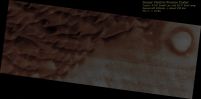
Psp_002455_1320_red-PCF-LXTT.jpgDunes in Proctor Crater (Absolute Natural Colors; credits for the additional process. and color.: Dr Paolo C. Fienga - Lunexit Team)127 visiteThis image shows the edge of a Dark Dunefield on the Floor of Proctor Crater, an approx. 150 Km diameter Impact Crater located in the Southern Highlands of Mars.
Many smaller and brighter "Bed-Forms", most likely small dunes or Granule Ripples, cover the substrate between the larger Dark Dunes as well as most of the Floor of Proctor Crater. In many locations, large (Erratic) Boulders are seen on the same surfaces as the bright Bed-Forms.
The Dark Dunes stratigraphically overlie the small bright Bed-Forms, indicating that the Dark Dunes formed more recently. However in several areas, the Dark Dunes appear to influence the orientation of the small Bright Dunes, possibly by wind flowing around the larger ones, suggesting that both Dark and Bright Bed-Forms are coeval.MareKromium
|
|
| 12 immagini su 1 pagina(e) |
|








