| Risultati della ricerca nelle immagini - "Probe" |

APOLLO 12 AS 12-48-7100.jpgAS 12-48-7100 - Surveyor III!81 visiteCaption NASA originale:"Surveyor III and the LM. The TV camera is the vertical cylinder to the right of the solar-panel mast and the scoop can be seen extended out to the right. The Surveyor landed on a slope and bounced and slid a short way before coming to rest. Visual evidence comes from the left-hand footpad, which is dug into the soil, and the foreground footpad, which made 2 distinct imprints nearer us before coming to rest. The Surveyor III scoop was designed by Caltech Prof. of Engin.ing R. Scott".
|
|

APOLLO 12 AS 12-48-7110.jpgAS 12-48-7110 - Surveyor III!126 visite
|
|

APOLLO 12 AS 12-48-7121.jpgAS 12-48-7121 - Surveyor III!80 visiteCaption NASA originale:"Alan Bean took this excellent photograph of the Surveyor III spacecraft from a distance of about 15 feet.
Block Crater is at the upper left".
|
|

APOLLO 12 AS 12-48-7129.jpgAS 12-48-7129 - The "scoop" of Surveyor III82 visiteCaption NASA originale:"Surveyor III trenches. Note the steep walls on the impressions made by the scoop. The small, square shaped imprint was probably made with the tip of the scoop as part of a load-bearing experiment".
|
|

APOLLO 12 AS 12-48-7138.jpgAS 12-48-7138 - Surveyor III!85 visiteThe "battery pack" of Surveyor III.
|
|

Carina-Calibration-PIA07773.jpgCarina Nebula, from Cassini74 visiteCassini briefly turned its gaze from Saturn and His Rings and Moons to marvel at the Carina Nebula, a brilliant region 8.000 LY from our Solar System and more than 200 LY across. Nearly every point of light in this image is a star in our galaxy, the Milky Way.
The nebula is a region of gas and dust made to glow by the ultraviolet light bursting from bright, hot and extremely massive young stars within. Darker regions in the scene are not devoid of stars; rather, they are areas where dense clouds of dust block the light from background stars.
This image and others like it are taken by the spacecraft from time to time for calibration purposes. Calibration images rarely contain such incredible sights. This one affirms Cassini's position as the farthest, working astronomical observatory ever established around our sun - our "eyes on the cosmos", a billion miles from Earth.
The image was taken using the Cassini wide-angle camera on May 14, 2005. The view is a 68-second, clear-filter exposure.
|
|

Huygens-IMG001253-br500.jpgThe "Huygens Probe", "camera artifacts" and 4 "known" stars92 visiteShown in white boxes are known stars; the probe is the brightest item on the lower right. The other dots are artifacts of the camera. Although only a few pixels across, this image is helping navigators reconstruct the probe's trajectory and pinpoint its position relative to Cassini. This information so far shows that the probe and Cassini are right on the mark and well within the predicted trajectory accuracy. This information is important to help establish the required geometry between the probe and the orbiter for radio communications during the probe descent on January 14. The Huygens probe, built and managed by ESA, will remain dormant until the onboard timer wakes it up just before the probe reaches Titan's upper atmosphere. Then it will begin a dramatic plunge through Titan's murky atmosphere, tasting its chemical makeup and composition as it descends to touch down on its surface. The data gathered during this 2,5 hours descent will be transmitted from the probe to the Cassini orbiter. Afterward, Cassini will point its antenna to Earth and relay the data through NASA's Deep Space Network to JPL and on to the European Space Agency's Space Operations Center in Darmstadt, Germany, which serves as the operations center for the Huygens probe mission.
|
|

Huygens-IMG001254-br500.jpgThe "Huygens Probe" - detail mgnf157 visiteCaption NASA originale: "The European Space Agency's Huygens Probe appears shining as it coasts away from Cassini in this close-up of an image taken on Dec. 26, 2004, just two days after it successfully detached from the Cassini spacecraft.
Shown here side-by-side is a close-up of the Huygens probe. The image on the left shows the relative size of the probe. The bright spots in both images are probably due to light reflecting off the blanketing material that covers the probe".
|
|

NGC-3532-3372-PIA12067.jpgNGC 3532 and NGC 337279 visite"...Multa experiendo fiunt quae segnitibus ardua videntur..."
(Tacito)
"...Tentando e ritentando vennero compiute imprese che gli indolenti credevano impossibili..." (trad. libera)MareKromium
|
|

PHOE-SOL049-13039-13040-13041-2-comp.jpgPhoenix Scoop Inverted Showing Rasp (credits: NASA/JPL/Univ. of Arizona - Dx - and Dr Barca & Lunexit - Sx)73 visiteCaption NASA:"This image taken by the Surface Stereo Imager on Sol 49, or the 49th Martian Day of the mission (July 14, 2008), shows the silver colored rasp protruding from NASA's Phoenix Mars Lander's Robotic Arm Scoop.
The Scoop is inverted and the rasp is pointing up. Shown with its forks pointing toward the ground is the Thermal and Electrical Conductivity Probe, at the lower right.
The Robotic Arm Camera is pointed toward the ground".MareKromium
|
|
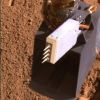
PHOE-SOL099-PIA11073.jpgPhoenix Conductivity Probe after Extraction - Sol 99 (natural colors; credits: NASA)96 visiteCaption NASA:"NASA's Phoenix Mars Lander inserted the 4 needles of its Thermal and Conductivity Probe into Martian soil during the 98th Sol of the mission and left it in place until Sol 99 (Sept. 4, 2008).
The Surface Stereo Imager on Phoenix took this image on the morning of Sol 99 after the probe was lifted away from the soil. This imaging served as a check of whether soil had stuck to the needles.
The Thermal and Conductivity Probe measures how fast heat and electricity move from one needle to an adjacent one through the soil or air between the needles. Conductivity readings can be indicators about water vapor, water ice and liquid water.
The probe is part of Phoenix's Microscopy, Electrochemistry and Conductivity suite of instruments".MareKromium
|
|

Phobos2-C_Fobos_14.jpgPhobos, from Phobos-2: the "Mysterious Encounter"221 visitenessun commento
|
|
| 17 immagini su 2 pagina(e) |
1 |
|








