| Risultati della ricerca nelle immagini - "Pollack" |
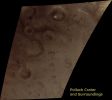
CR-h0330_0000_nd3-PCF-LXTT.jpgFrame h0330_0000_nd3 - Pollack Crater and Surroundings (Natural Colors; credits for the additional process. and color.: Dr Paolo C. Fienga - Lunexit Team)198 visitenessun commentoMareKromium
|
|

Craters-Pollack_Crater-00.jpgThe "White Rock" inside Pollack Crater (NASA/JPL/MSSS)98 visiteCaption NASA originale:"White Rock" is a ridged mound that was first seen and informally named "White Rock" in pictures from the Mariner 9 orbiter in 1972. In black-and-white photos, the feature appears much brighter than its surrounding terrain, giving the impression that the material is white. Later analyses of Mariner 9, Viking and MGS data showed that the feature isn't actually white: it is somewhat red and reflects only about 20-25% of the sunlight that falls upon it (a white surface would reflect 100%). Located in Pollack Crater, a 95 Km wide impact basin at 7.9°S, 334.7°W, White Rock is the light-red/orange feature with the rectangular white box drawn on it in the context view. The light-toned material that gives White Rock its name forms steep cliffs with valleys between them covered by dark, windblown, rippled sand".
|
|
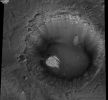
Craters-Pollack_Crater-H1201_0001_ND3_crop_wide-0.jpgPollack Crater and "White Rock" (RAW Frame; credits: ESA - Mars Express)74 visitenessun commentoMareKromium
|
|
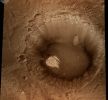
Craters-Pollack_Crater-H1201_0001_ND3_crop_wide-3.jpgPollack Crater and "White Rock" (Natural Colors - Tri-Chromatic Version; credits for the additional process. and color.: Dr Paolo C. Fienga - Lunexit Team)70 visitenessun commentoMareKromium
|
|

Craters-Pollack_Crater-H1201_0001_ND3_crop_wide-PCF-LXTT-3.jpgPollack Crater and "White Rock" (Absolute Natural Colors; credits for the additional process. and color.: Dr Paolo C. Fienga - Lunexit Team)262 visitePollack Crater is located in the "Sinus Sabaeus Quadrangle! of Mars, at approx. 7,9° South Lat. and 334,8° West Long. Pollack Crater is about 96 Km in diameter and it was named after Dr James B. Pollack, an American physicist (1938 –1994).
Pollack Crater contains a large Light-toned Deposit (known as "White Rock" or "Pollack's White Fingers") that was once thought to be a Salt Deposit. Truth is that nobody knows, so far, the real nature of White Rock and the reason of its bright color - even though some people - Scientists and Professional Researchers - say that White Rock "only APPEARS white, but it is not", and the reason why of this appearence is in the fact that its surroundings are exceptionally dark.
On the other hand, we believe, as Lunar Explorer Italia Team, that such a "theory" is incredibly lame and does not deserve to ba called and known as a "theory" at all.
MareKromium
|
|

Craters-Pollack_Crater-White_Rock_MO_1238-PCF-LXTT.jpgWhite Rock (Natural Colors; credits for the additional process. and color.: Dr Paolo C. Fienga - Lunexit Team)241 visitenessun commentoMareKromium
|
|

Craters-Pollack_Crater_and_White_Rock-20020419a-PCF-LXTT.jpgPollack Crater and "White Rock" (Slightly Saturated Absolute Natural Colors; credits for the additional process. and color.: Dr Paolo C. Fienga - Lunexit Team)64 visiteCaption NASA:"White Rock is the unofficial name for this unusual landform which was first observed during the Mariner 9 Mission in the early 70's. As later analysis of additional data sets would show, White Rock is neither white nor dense rock. Its apparent brightness arises from the fact that the material surrounding it is so dark. Images from the Mars Global Surveyor MOC camera revealed dark sand dunes surrounding White Rock and on the floor of the troughs within it.
Some of these dunes are just apparent in the THEMIS image. Although there was speculation that the material composing White Rock could be salts from an ancient dry lakebed, spectral data from the MGS TES instrument did not support this claim. Instead, the White Rock deposit may be the erosional remnant of a previously more continuous occurrence of air fall sediments, either volcanic ash or windblown dust.
The THEMIS image offers new evidence for the idea that the original deposit covered a larger area.
Approximately 10 Km to the South-East of the main deposit are some tiny knobs of similarly bright material preserved on the floor of a small crater. Given that the eolian erosion of the main White Rock deposit has produced isolated knobs at its edges, it is reasonable to suspect that the more distant outliers are the remnants of a once continuous deposit that stretched at least to this location.
The fact that so little remains of the larger deposit suggests that the material is very easily eroded and simply blows away".MareKromium
|
|

O-Mariner9-72-Pollack_Crater_and_White-Rock.jpgPollack Crater and "White Rock" from Mariner 9 (RAW Frame - credits: NASA)73 visite"...It was interesting to browse through the Mariner 9 data set to locate these images, because evidently the Mariner 9 Team wasn't sure to make of these strange bright deposits.
The first one I posted was described as "white rock" in a comment on the image, and that name has stuck. But another image's descriptive comment read "curious ice patches".
Another totally misidentified not only the nature but the location of the photo, describing it as "Polar Cap".
Comments on images of other places in the Mariner 9 Catalog generally reflect the fact that Mars had not yet been systematically surveyed by an orbiter, so the scientists often weren't quite sure what they were looking at, and even when it was clear there were craters, those craters had mostly not yet been named.
I came across comments like "peculiar filametary structure" and "possible craters" and "streaky detail" and "cloud?" and "multitude of surface detail" and "odd fork-shaped bright pattern."
It's fun to browse through that table and imagine surveying Mars, with a spacecraft stationed at the Planet for the first time, made all the more dramatic by its initial obscuration by a dust storm that slowly cleared.
Mariner 9 is one of the more challenging data sets to work with because it's just so old. However, everything you need to access it, find images, view them, and convert them to more familiar formats is readily available online. First of all, the data itself can be found by browsing the data volumes at the PDS Imaging Node, and you can learn a little bit about the data at the National Space Science Data Center. To figure out what's what and to try to track down images of specific areas, you can download this spreadsheet (XLS format, zipped, 7.5 MB) containing an index to all the images.
The images are all in a format that won't be familiar to most of you, but like most spacecraft data you can convert a folder full of images to PNG format using my favorite amateur-produced software, Björn Jónsson's IMG2PNG. However, if you're only working with a couple of images, I'd recommend a different amateur-produced piece of software for converting the images, Piotr Masek's MarinerView, because MarinerView can be used to correct the Mariner 9 images (one at a time) for the little white specks of noise that are spattered across every one.
I'm slowly working on tracking down images of "White Rock" taken by every mission. First Mariner 9, then the Viking orbiters, then Mars Global Surveyor's MOC, then Mars Odyssey THEMIS, then Mars Express HRSC, and, finally, I should be able to produce Mars Reconnaissance Orbiter views from three different instruments: HiRISE, CTX, and CRISM. Stay tuned for further installments...".
Emily Lakdawalla (Planetary Society)MareKromium
|
|
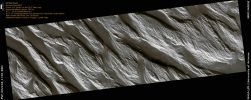
PSP_002244_1720_RED_abrowse.jpgWhite Rock (Saturated Natural Colors; credits for the additional process. and color.: Dr Paolo C. Fienga - Lunexit Team)76 visiteThis image shows a portion of a relatively bright landform named "White Rock" on the Floor of Pollack Crater, in the Sinus Sabaeus Region of Mars.
Data from the Mars Global Surveyor Thermal Emission Spectrometer (TES) indicates that this landform is not anomalously bright, relative to other bright Martian Regions. Further, the apparent brightness seen here is due to contrast with other materials on the Crater Floor.
Dunes and Ripples are visible in the dark material between the bright ridges. Their orientations appear to be influenced by wind directionally channeled by the ridges.
Material appears to have been shed from the white landform and deposited on the darker bedforms indicating that the light-toned outcrops break down into fine materials.
Its high albedo and location in a topographic basin have led to suggestions that White Rock is an erosional remnant of an ancient lacustrine evaporate deposit. Other interpretations include an eroded accumulation of compacted or weakly cemented aeolian sediment.MareKromium
|
|

PSP_002244_1720_red.jpgWhite Rock (Enhanced Absolute Natural Colors; credits for the additional process. and color.: Dr Paolo C. Fienga - Lunexit Team)67 visiteThis image shows a portion of a relatively bright landform named "White Rock" on the floor of Pollack Crater in the Sinus Sabaeus Region of Mars.
Data from the Mars Global Surveyor Thermal Emission Spectrometer (TES) indicates that this landform is not anomalously bright, relative to other bright Martian Regions. Further, the apparent brightness seen here is due to contrast with other materials on the crater floor.
Dunes and ripples are visible in the dark material between the bright ridges. Their orientations appear to be influenced by wind directionally channeled by the ridges. Material appears to have been shed from the white landform and deposited on the darker bedforms indicating that the light-toned outcrops break down into fine materials.
Its high albedo and location in a topographic basin have led to suggestions that White Rock is an erosional remnant of an ancient lacustrine evaporate deposit.
Other interpretations include an eroded accumulation of compacted or weakly cemented aeolian sediment.
|
|
|
|
| 10 immagini su 1 pagina(e) |
|








