| Risultati della ricerca nelle immagini - "Plains" |

APOLLO_15_-_AS_15-94-12741.jpgAS 15-94-12741 - Lunar Plains, North-East of Tsiolkovskiy67 visiteImage Collection: 70mm Hasselblad
Mission: 15
Magazine: 94
Magazine Letter: S
Latitude: 18,0° South
Longitude: 133° East
Film Type: 3414
Film Width: 70 mm
Film Color: black & white
Feature(s): TSIOLKOVSKIY, NORTHEAST OFMareKromium
|
|

Craters-Unnamed_Crater-North_Polar_Regions-MGS-1.jpgUnnamed Crater in the Northern Plains (Original NASA/MGS/MSSS b/w Frame)81 visitenessun commento
|
|
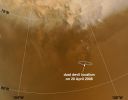
D-Vastitas-PIA10634.jpgPhoenix Landing Site, from MRO66 visiteNASA's Phoenix Mars Lander is scheduled to land on the Martian Northern Plains near 68° North Lat. and 127° West Long. on May 25, 2008. In preparation for the landing, NASA's Mars Reconnaissance Orbiter has been monitoring weather in the Region around the Landing Site. On April 20, 2008, the orbiter's Mars Color Imager camera captured this view of a large region of Northern Mars that includes the landing target area in the lower right quadrant.
This version of the image indicates the location of the landing ellipse, about 100 Km(approx. 60 miles) long. The Context Camera on the MRO took an image of the Landing Area at the same time the Mars Color Imager took this image.
A dot within the Landing Ellipse marks the location of two active DD visible in the Context Camera image, PIA10633.
When the Mars Color Imager acquired this image, the season in Mars' Northern Hemisphere was late Spring. A few weeks earlier, the Phoenix Landing Site was still covered with seasonal frost left over from the previous winter.MareKromium
|
|

E-PIA10633.jpgDust Devils and Frozen Craters at Phoenix Landing Site (MULTISPECTRUM; credits: Lunexit)68 visiteNASA's Phoenix Mars Lander is scheduled to land on the Martian Northern Plains near 68° North Lat. and 127° West Long. on May 25, 2008. In preparation for the landing, NASA's Mars Reconnaissance Orbiter has been monitoring weather in the Region around the Landing Site.
On April 20, 2008, the orbiter's Context Camera captured this view showing two active DD within the Phoenix Landing Ellipse.
This is a subframe covering an area about 26 Km (approx. 16 miles) on each side (...). It shows two Dust Devils and their shadows. Based on measurement of the shadows cast by the DD, one of the vortices towered about 590 meters (about 1930 feet) with a dust plume extending 920 meters (about 3020 feet) above the surface. The other reached about 390 meters (1280 feet) high, with a dust plume extending to 790 meters (2590 feet). The resolution here is 6 meters (19,7 feet) per pixel.
When the Context Camera acquired this image, the season in Mars' Northern Hemisphere was late Spring. A few weeks earlier, the Phoenix Landing Site was still covered with seasonal frost left over from the previous Winter. White patches in small craters near the center of the picture are areas where the Winter frost remained, even as late as April 20, 2008.
As Spring gives way to Summer, DD are likely to occur more frequently, as local temperatures rise. These two DD observed in late April are among the first of the season. The cameras on the Phoenix Lander might be able to spot additional Dust Devils after the spacecraft arrives, as the Mars Exploration Rover Spirit has been able to do at its Southern Hemisphere Landing Site.
Dust Devils are whirling vortices that have picked up dust from the ground. Such vortices can occur even when no dust is present, but then they are not visible to the cameras onboard the Mars Reconnaissance Orbiter. Such vortices commonly form as hot air rises from the surface on an otherwise generally calm day with little or no breeze. Dust Devils will travel across the surface on the gentle breezes that do occur. Sometimes, DD have been observed by cameras orbiting Mars to create streaks on the ground as they disrupt and pick up dust, though no streaks are observed in this image.
The Mars Orbiter Camera onboard NASA's Mars Global Surveyor orbiter observed Dust Devils — and streaks created by them — throughout its 1997 to 2006 mission. During that time, scientists at Malin Space Science Systems observed more than 12.000 active Dust Devils. They were seen over the full range of elevations and nearly all latitudes on Mars. Dust Devil Streaks were found in Mars Orbiter Camera images as far North as the edge of the North Polar Residual Cap and the dune fields that surround the Region.
However, the northernmost active DD captured by that camera was at 62,2° North Latitude, which is further South than the Phoenix Landing Site.
Another camera on the Mars Reconnaissance Orbiter, the Mars Color Imager, captured a simultaneous, wider-field, color view of the area included in this Context Camera image. That view can be seen at PIA10634.MareKromium
|
|

ESP_019526_2220_RED_abrowse.jpgNorhern Plains, S/W of Galaxias Colles (Absolute Natural Colors; credits for the additional process. and color.: Dr Paolo C. Fienga - Lunexit Team:)82 visitenessun commentoMareKromium
|
|

ESP_019533_2310_RED_abrowse.jpgNorhern Plains (Absolute Natural Colors; credits for the additional process. and color.: Dr Paolo C. Fienga - Lunexit Team:)96 visitenessun commentoMareKromium
|
|

ESP_019541_2325_RED_abrowse.jpgNorhern Plains (Absolute Natural Colors; credits for the additional process. and color.: Dr Paolo C. Fienga - Lunexit Team:)114 visitenessun commentoMareKromium
|
|

ESP_019565_2355_RED_abrowse-PCF-LXTT.jpgNorthern Plains (Absolute Natural Colors; credits for the additional process. and color.: Dr Paolo C. Fienga - Lunexit Team:)126 visitenessun commentoMareKromium
|
|

ESP_019589_2340_RED_abrowse-GB-PCF-LXTT-0.jpgNorhern Plains (Absolute Natural Colors; credits for the additional process. and color.: Dr Paolo C. Fienga - Lunexit Team:)130 visitenessun commentoMareKromium
|
|

ESP_020061_1720_RED_abrowse-PCF-LXTT.jpgBright and Dark Plains (Absolute Natural Colors; additional process. and color.: Dr Paolo C. Fienga - Lunexit Team)134 visiteThis HiRISE image shows a mixture of bright and dark Terrain along the plains just West of Ganges Chasma.
The concentration of these bright patches adjacent to an old Impact Crater suggests that the bright patches could represent Ejecta from when the crater formed.
This would be an interesting discovery because it would mean that a different unit underlies the Surface we now see. Alternatively, much of the Plains in this Region seem to have a dark surficial cover (probably aeolian debris). Where this darker debris has been removed by the wind, the underlying brighter substrate would be exposed.
Mineralogic information from the CRISM instrument would be very useful for determining if the bright patches contain minerals indicative of water - such as Clays - or if they are Basalts (produced from Volcanic Eruptions).MareKromium
|
|

ORIGINAL NASA - APOLLO 15 - AS 15-90-12264.jpgAS 15-90-12264 - The limb of a smooth hill (1)68 visite
|
|

ORIGINAL NASA - APOLLO 15 - AS 15-90-12265.jpgAS 15-90-12265 - The limb of a smooth hill (2)70 visite
|
|
| 45 immagini su 4 pagina(e) |
1 |
 |
|








