| Risultati della ricerca nelle immagini - "Pits" |

A_Pair_of_Small_Pit_Craters_(PSP_009488_1745)-1.jpgA Pair of Collapse Pits94 visiteThe pair of Pit Craters visible here are the smallest anomalous Pits known to exist at this time. These have either vertical or sub-vertical interior Walls (not visible from a nearly overhead viewing perspective), and each Pit is deep enough that Sunlight does not hit the floor when the Sun is at the Zenith.
Unfortunately, the only Thermal-InfraRed camera currently orbiting Mars cannot resolve features this small, so the temperature characteristics of these Pits must remain unknown for now, underscoring the need for a high-resolution thermal instrument on future missions.
Intriguingly, when Pit Craters on Earth have similar characteristics to the pair shown here, they often have Cave entrances in their bases connecting to large underground networks.
Current investigations are determining whether the anomalous Martian Pits may be shown to contain such entrances.MareKromium
|
|

Collapse_features-Pits-East_Tharsis-PCF-LXTT.jpgCollapse Pits, East of Tharsis Region (Absolute Natural Colors; additional process.: Dr Paolo C. Fienga - Lunexit Team)94 visitenessun commentoMareKromium
|
|

Craters-Unnamed_Crater-Layered_Outcrop-Thaumasia_Region-00.jpgLayered Rocky Outcrops (Original NASA/MGS/MSSS b/w Frame)65 visiteCaption NASA originale:"This MGS-MOC image shows light-toned, layered rock outcrops in the central pit of an impact crater in the Thaumasia Planum Region of Mars. The outcrops were tilted and broken-up by the extreme energy of the impact that formed the crater in which they occur. These are layers of rock that were brought up by the impact from horizontal beds that lie below the floor of the crater".
Location near: 21,7° South Lat. and 69,4° West Long.
Image width: ~3 Km (~1,9 mi)
Illumination from: upper left
Season: Southern Summer
Nota: difficile pensare, per spiegare i rilievi catturati in questo frame, ad una costruzione logica più improbabile di quella proposta dalla NASA...
|
|

ESP_011677_1655_RED_abrowse.jpgPit Crater Chain (Natural Colors; credits: Lunar Explorer Italia)77 visiteThis image shows a series of Collapse Craters called Pit Chain; of course, the Chain itself is NOT formed by Impact Craters.
There are a few potential ways that these are formed. The Pit Craters are believed to form by the collapse of Lava Tubes or Magma Chambers. They could also form when the crust of Mars gets pulled apart by extensional forces from a growing volcano Magma Chamber. This leaves structurally weak areas that have a greater chance of collapsing when the area (Lava Tubes or Magma Chamber) no longer contains molten lava or is drained from the chamber.
There is evidence that Mars is not the only Planet that has features like these. Earth also has similar Pit Chains that have formed in Iceland. This Chain was formed on a known fault line and the Pits formed when the Region experienced an earthquake.
This process may be similar to the way the Martian Pit Chains were formed. If "Marsquakes" are the cause of the formation of Pit Chains, this will support the idea that there is still geologic (tectonic) activity occurring on Mars.
The Pit Chains that have been found on Earth are considerably smaller than similar features that are found on Mars. Earth’s are smaller due to higher gravity and weathering makes them smaller and at some point completely erasing them from sight. But Mars has no system to create erosion; therefore the Chains on Mars are better preserved.MareKromium
|
|

ESP_013144_2075_RED_abrowse.jpgCollapse Features on the Flank of Elysium Mons (Natural Colors; credits: Lunar Explorer Italia)83 visiteThis image is of the Flanks of the "Shield Volcano" Elysium Mons. The volcano is considered to be the youngest within the Elysium Mons Province, which also contains the volcanoes Hecates Tholus and Albor Tholus.
Of course, "young" is a relative term. The last eruption of Elysium Mons could well have been a billion years or more ago.
This image shows a series of flat bottomed valleys along the flanks of Elysium Mons. There is considerable debate on exactly how these valleys form. In Hawaii, the classic example of Shield Volcanoes on Earth, similar valleys are carved by prodigious rainfall. While some rain may have fallen in the earliest epochs of Mars' Geologic History, the lack of small drainage networks shows that these Martian Channels were not carved by rain. However, Mudflows and Lava Flows could potentially erode the sides of the Volcano.
An important hint for the origin of the Valleys comes from the Chain of Pits visible in the Northern part of the image. These Pits form as the ground is pulled apart by Marsquakes. Thus it seems that many of these Valleys are first formed by movement along Faults. Then Mud and/or Lava Flows widen the sides of the Valley and give it a flat floor.MareKromium
|
|

ESP_014380_1775-PSP_009913_1910.jpgCollapse Features in Cerberus Fossae and Tharsis (Image-mosaic; credits: Dr M. Faccin)77 visitenessun commentoMareKromium
|
|
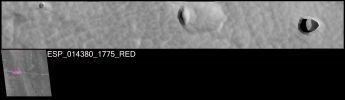
ESP_014380_1775_RED_abrowse-07.jpgA "New Collapse" is on the way? (by Dr M. Faccin)63 visiteSulla medesima "Linea" che congiunge il Pozzo da Collasso - esaminato nei giorni scorsi - con altre Surface Features le quali lasciano intuire la presenza di ulteriori avvallamenti e varie depressioni del suolo più o meno pronunciate (ossìa, come suggerisce il nostro Geologo, Dr La Fratta, si tratta della "Linea che potrebbe definire l'esistenza di un Lava-Tube sotterraneo" il cui soffitto, per vari motivi, sta cedendo), il Dr Faccin ha individuato quello che riteniamo essere un Collapse Pit "in fieri", e cioè "in divenire".
In altre parole, il Gruppo di Ricerca Lunexit ritiene di aver individuato un ulteriore avvalamento della superficie il quale non solo sembra indicare e confermare l'esistenza di una cavità sotterranea continua e di dimensioni veramente estese (come suggerito dal Dr La Fratta), ma è anche possibile che esso rappresenti - fisicamente - la Fase Geologica immediatamente anteriore alla verificazione di un fenomeno di subsidenza di notevoli proporzioni (ergo, è fortemente probabile che quanto stiamo osservando sia una regione superficiale che, da qui a poco tempo - in termini Geologici, come ovvio -, evidenzierà la formazione di un Pozzo da Collasso).
Grandi Complimenti al Dr Faccin per l'"Occhio" ed un interrogativo (la cui risposta la lasciamo alle Generazioni future): chissà se, quando qualche Astronauta si troverà a passeggiare in questa zona, il Collapse Pit in fieri che stiamo osservando oggi si sarà già "completaente espresso", oppure se i Visitatori Terrestri dovranno stare MOLTO ATTENTI a dove parcheggiare i loro mezzi e quindi a dove mettere i piedi...MareKromium
|
|

ESP_014383_1910_RED_abrowse.jpgCollapse Features in Cerberus Fossae (Natural Colors; credits: Lunexit)68 visitenessun commentoMareKromium
|
|
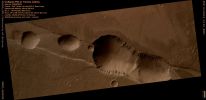
ESP_014432_2110_RED_abrowse.jpgCollapse Pits in Tractus Catena (Natural Colors; credits: Lunexit)83 visitenessun commentoMareKromium
|
|

ESP_019997_1975_RED_abrowse-01.jpgCollapse Pit (Natural Colors; credits for the additional process. and color.: Dr Paolo C. Fienga - Lunexit Team)128 visitenessun commentoMareKromium
|
|

ESP_019997_1975_RED_abrowse-02.jpgCollapse Pit (Natural Colors; credits for the additional process. and color.: Dr Paolo C. Fienga - Lunexit Team)140 visitenessun commentoMareKromium
|
|

PSP_003292_2025.jpgCollapse Pits (natural colors + MULTISPECTRUM; credits: Dr M. Faccin e Lunexit)76 visitenessun commentoMareKromium
|
|
| 30 immagini su 3 pagina(e) |
1 |
|








