| Risultati della ricerca nelle immagini - "Pit" |

A_Pair_of_Small_Pit_Craters_(PSP_009488_1745)-1.jpgA Pair of Collapse Pits92 visiteThe pair of Pit Craters visible here are the smallest anomalous Pits known to exist at this time. These have either vertical or sub-vertical interior Walls (not visible from a nearly overhead viewing perspective), and each Pit is deep enough that Sunlight does not hit the floor when the Sun is at the Zenith.
Unfortunately, the only Thermal-InfraRed camera currently orbiting Mars cannot resolve features this small, so the temperature characteristics of these Pits must remain unknown for now, underscoring the need for a high-resolution thermal instrument on future missions.
Intriguingly, when Pit Craters on Earth have similar characteristics to the pair shown here, they often have Cave entrances in their bases connecting to large underground networks.
Current investigations are determining whether the anomalous Martian Pits may be shown to contain such entrances.MareKromium
|
|

A_Pair_of_Small_Pit_Craters_(PSP_009488_1745)-2.jpgCollapse Pit84 visitePit Craters exist in volcanic regions across Mars, and form when surface materials collapse into large underground cavities. Such Pits are generally bowl-shaped, filled with sediment, and are relatively shallow when compared with their diameters.
Recently, a small number of anomalous pit craters were identified with strikingly different visible and thermal characteristics such as: sheer cliff walls; deep interiors that can extend out-of-sight beneath the Surface and temperature fluctuations that behave unlike any known feature on Mars.MareKromium
|
|
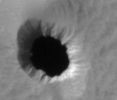
A_Pair_of_Small_Pit_Craters_(PSP_009488_1745)-3.jpgCollapse Pit83 visiteThe ability to detect and explore Martian Caves is of intense interest to many disciplines in Planetary Science. Caves may expose entire sets of stratigraphic layers, providing windows into Mars' Geologic and Atmospheric histories.
Cave environments can also protect organic life from extremely harsh conditions on the Martian Surface, and may provide future human explorers with secure habitats. Accordingly, Caves are considered among the most promising locations to find preserved evidence of past or present microbial life.
Furthermore, the challenges associated with Mars Cave exploration may inspire a range new technologies, such as advanced robotics and target-specific landing capabilities.MareKromium
|
|

Ascraeus_Mons-PIA13209.jpgPortion of the N/W Flank of Ascraeus Mons (Enhanced and Saturated Natural Colors; credits for the additional process. and color.: Dr Paolo C. Fienga - Lunexit Team)73 visitenessun commentoMareKromium
|
|

Chain_of_Pits_on_Arsia_Mons_(PSP_005414_1735)-1.jpgCollapse Pit on Arsia Mons82 visitenessun commentoMareKromium
|
|

Chain_of_Pits_on_Arsia_Mons_(PSP_005414_1735)-2.jpgCollapse Pit on Arsia Mons (Natural Colors; credits: Lunar Explorer Italia)80 visitenessun commentoMareKromium
|
|

Collapse_Pit_in_Tractus_Fossae_(ESP_011386_2065)-1.jpgCollapse Pit in Tractus Fossae83 visiteThis HiRISE image shows a Collapse Pit in Tractus Fossae, a Region of large ridges and troughs created by tectonic activity.
The "Fossae" occur on the Tharsis Volcanic Rise, a giant Region of enhanced volcanic activity that includes the three large volcanoes Ascraeus Mons, Pavonis Mons and Arsia Mons.
The Pit in this image has very steep walls, and so only a narrow arc is illuminated by Sunlight. The rest of the Pit is in dark shadow. However, a stretched version of the image shows details of the pit floor, due to a small amount of scattered Sunlight.
Pits like this form by collapse into underground voids, such as those left by propagating magma-filled dikes. They may sometimes have overhanging walls, although in this case the walls can be seen and appear nearly vertical. Some similar features are found on Earth: Devils Throat, in Hawaii, is one example. Other similar examples have been imaged on Mars as well.MareKromium
|
|

Collapse_Pit_in_Tractus_Fossae_(ESP_011386_2065)-2.jpgCollapse Pit in Tractus Fossae (stretched version)82 visitenessun commentoMareKromium
|
|

Collapse_features-Pits-East_Tharsis-PCF-LXTT.jpgCollapse Pits, East of Tharsis Region (Absolute Natural Colors; additional process.: Dr Paolo C. Fienga - Lunexit Team)94 visitenessun commentoMareKromium
|
|

Craters-Unnamed_Crater-Layered_Outcrop-Thaumasia_Region-00.jpgLayered Rocky Outcrops (Original NASA/MGS/MSSS b/w Frame)65 visiteCaption NASA originale:"This MGS-MOC image shows light-toned, layered rock outcrops in the central pit of an impact crater in the Thaumasia Planum Region of Mars. The outcrops were tilted and broken-up by the extreme energy of the impact that formed the crater in which they occur. These are layers of rock that were brought up by the impact from horizontal beds that lie below the floor of the crater".
Location near: 21,7° South Lat. and 69,4° West Long.
Image width: ~3 Km (~1,9 mi)
Illumination from: upper left
Season: Southern Summer
Nota: difficile pensare, per spiegare i rilievi catturati in questo frame, ad una costruzione logica più improbabile di quella proposta dalla NASA...
|
|

ESP_011386_2065_RED_abrowse.jpgCollapse Pit in Tractus Fossae (Enhanced and Darkened Natural Colors; credits for the additional process. and color.: Dr Paolo C. Fienga - Lunar Explorer Italia)72 visiteMars Local Time: 15:46 (middle afternoon)
Coord. (centered): 26,1° North Lat. and 259,4° East Long.
Spacecraft altitude: 281,9 Km (such as about 176,2 miles)
Original image scale range: 28,2 cm/pixel (with 1 x 1 binning) so objects ~ 85 cm across are resolved
Map projected scale: 25 cm/pixel
Map projection: EQUIRECTANGULAR
Emission Angle: 6,7°
Phase Angle: 54,4°
Solar Incidence Angle: 61° (meaning that the Sun is about 29° above the Local Horizon)
Solar Longitude: 182,8° (Northern Autumn)
Credits: NASA/JPL/University of Arizona
Additional process. and coloring: Lunar Explorer ItaliaMareKromium
|
|

ESP_011386_2065_cut.jpgCollapse Pit in Tractus Fossae (edm - Vertical View - Natural Colors; credits: Lunar Explorer Italia)71 visiteThis HiRISE image shows a collapse pit in Tractus Fossae, a Region of large Ridges and Troughs created by Tectonic Activity.
The Fossae occur on the Tharsis Volcanic Rise, a giant region of enhanced volcanic activity that includes the 3 large volcanoes Ascraeus Mons, Pavonis Mons and Arsia Mons.
The Pit in this image has very steep walls, and so only a narrow arc is illuminated by Sunlight. The rest of the Pit is in dark shadow.
However, a stretched version of the image shows details of the pit floor, due to a small amount of scattered Sunlight.
Pits like this form by collapse into underground voids, such as those left by propagating magma-filled dikes.
They may sometimes have overhanging walls, although in this case the walls can be seen and appear nearly vertical. Some similar features are found on Earth: Devil’s Throat, in Hawaii, is one example.
Other similar examples have been imaged on Mars as well.MareKromium
|
|
| 95 immagini su 8 pagina(e) |
1 |
 |
|
|
|
|
|








