| Risultati della ricerca nelle immagini - "Pedestal" |

Craters-Unnamed_Crater-PIA07202-PCF-LXTT.jpgUnnamed Crater with Pedestal (Absolute Natural Colors; credits for the additional process. and color.: Dr Paolo C. Fienga - Lunar Explorer Italia)245 visiteThis Mars Global Surveyor (MGS) Mars Orbiter Camera (MOC) image shows an Unnamed Impact Crater, a little over 2 Km (> 1,2 mi) in diameter, located in Noachis Terra near 50,4° South and 14,3° West. The Crater's Bouldery Ejecta Blanket has protected underlying material from being eroded away by wind, leaving the Ejecta up on a low Pedestal. This picture covers an area about 3 Km (approx. 1,9 miles) across, and is illuminated by sunlight from the lower left.MareKromium
|
|
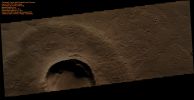
Craters-Unnamed_Crater_with_Grooves-PCF-LXTT.jpgUnnamed "Pedestal Crater" (possible Natural Colors; credits for the additional process. and color.: Dr Paolo C. Fienga - Lunexit Team)90 visitenessun commentoMareKromium
|
|

Craters-Unnamed_Crater_with_Pedestal-Amazonis-PIA13886-PCF-LXTT.jpgUnnamed "Pedestal Crater" in Amazonis Planitia (Natural Colors; credits for the additional process. and color.: Dr Paolo C. Fienga - Lunexit Team)260 visitenessun commentoMareKromium
|
|

Craters-Unnamed_Crater_with_Pedestal-MGS.jpgUNnamed "Pedestal Crater"64 visiteCaption NASA originale:"This MGS-MOC image shows a "pancake" or "pedestal" crater on the Martian Northern Plains. The rocky ejecta from the crater protected the underlying material from being stripped away by wind, leaving the ejecta standing higher than the surrounding terrain. The rocks in the ejecta are not too clearly seen today, especially at the 6 mt (~20 feet) per pixel scale of this image, in part because they have been covered up by later, mantling material".
Location near: 60,0° North; 265,6° West
Image width: ~3 Km (~1,9 mi)
Illumination from: lower left
Season: Northern Spring
|
|

Craters-Unnamed_Crater_with_Pedestal-PIA08029.jpgUnnamed Pedestal Crater in Promethei Terra (Original NASA/MGS/MSSS b/w Frame)64 visiteCaption NASA originale:"This MGS-MOC image shows a Pedestal Crater in the Promethei Terra Region. The Ejecta from an impact crater is usually rocky. The rocks in the Ejecta help shield the Terrain beneath the Ejecta from being eroded away by Wind. Thus, over time, some Craters appear to be raised on Pedestals defined by their Ejecta Blankets, because Wind has stripped away tons and tons of surrounding material".
Location near: 65,4° South Lat. and 264,7° West Long.
Image width: ~3 Km (~1,9 mi)
Illumination from: upper left
Season: Southern Autumn
Nota: un altro (relativamente) famoso cratere con (o su) piedistallo si trova su Venere ed è conosciuto con il nome di Cratere Adivar.
|
|

Craters-Unnamed_Craters-AP-PIA17856-PCF-LXTT-IPF.jpgCraters in Southern Amazonis Planitia (Absolute Natural Colors - Credits for the additional process. and color.: Dr Paolo C. Fienga/Lunar Explorer Italia/Italian Planetary Foundation)87 visiteIn this VIS image, taken by the NASA - Mars Odyssey Orbiter on November, 20th, 2013, and during its 52.949th orbit around the Red Planet, we can see two Impact Craters - with a compact Ejecta Blanket - that stand out above the surrounding Surface (these Craters are technically defined as "Pedestal Craters") and one - slightly bigger than the first two - Impact Crater that has been almost completely buried, most likely, by a Flow of Volcanic Material (you can see that only the small upper portion of the Outer Rim of this Crater can still be seen, with two small Buttes located to the North/East).
The Ejecta Blanket of the two Pedestal Craters has remained in place, while the surrounding Material was, in time, removed by the action of powerful Winds and, as a matter of fact, here, in this (Southern Side) of the Martian Region known as "Amazonis Planitia", an extensive phenomenon of Wind-related Erosion is quite common. Amazonis Planitia is one of the smoothest Volcanic Plains that can be found on Mars and it is located between the Tharsis and Elysium Volcanic Provinces, to the West of Olympus Mons, in the Amazonis and Memnonia Quadrangles.
This Martian Region is centered at 24�,8°� North Latitude and 196�° East Longitude and, just out of curiosity, the Plain's Topography exhibits extremely smooth Surface Features at several different lengths of scale.
Latitude (centered): 6,131�° North
Longitude (centered): 194,416�° East
Instrument: VIS
This image (which is an Original Mars Odyssey Orbiter b/w and Map-Projected frame published on the NASA - Planetary Photojournal with the ID n. PIA 17856) has been additionally processed, magnified, contrast enhanced, Gamma corrected and then colorized in Absolute Natural Colors (such as the colors that a human eye would actually perceive if someone were onboard the NASA - Mars Odyssey Orbiter and then looked down, towards the Surface of Mars), by using an original technique created - and, in time, dramatically improved - by the Lunar Explorer Italia Team.MareKromium
|
|
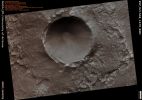
ESP_021568_1470_RED_abrowse-PCF-LXTT.jpgUnnamed Southern Crater with Pedestal (Absolute Natural Colors; credits for the additional process. and color.: Dr Paolo C. Fienga - Lunexit Team)184 visitenessun commentoMareKromium
|
|
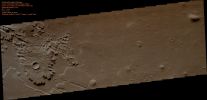
Erosional_Features-PIA13334.jpgErosional Surface Features near Gordii Dorsum (Natural Colors; credits for the additional process. and color.: Dr Paolo C. Fienga - Lunexit Team)85 visitenessun commentoMareKromium
|
|
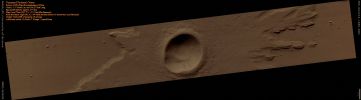
PSP_003253_1880_RED_abrowse-00.jpgUnnamed Crater with "Pedestal" (CTX Frame - Natural Colors; credits for the additional process. and color.: Dr Paolo C. Fienga - Lunexit Team)79 visitenessun commentoMareKromium
|
|
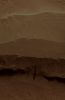
PSP_003253_1880_RED_abrowse-01.jpgUnnamed Crater with "Pedestal": the "Steps" (EDM - Natural Colors; credits for the additional process. and color.: Dr Paolo C. Fienga - Lunexit Team)94 visitenessun commentoMareKromium
|
|
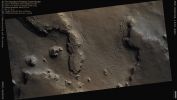
PSP_008508_1870_RED_abrowse.jpgPeri-Equatorial Pedestal Crater's Margin (Absolute Natural Colors; credits for the additional process. and color.: Dr Paolo C. Fienga - Lunar Explorer Italia)212 visitenessun commentoMareKromium
|
|
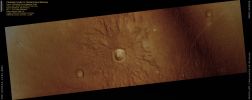
Psp_009654_2245_red.jpgPedestal Crater in Deuteronilus Mensae (natural colors; credits: Lunexit)79 visiteThis crater with spectacular ejecta is located in the Northern Mid-Latitudes in the Deuteronilus Mensae, located near the dichotomy boundary, where the Southern Highlands transition into the Northern Lowlands.
The crater has raised, fluidized ejecta. Scientists think that fluidized ejecta forms when an impact occurs into ice-rich material. The interior of the crater shows some material, particularly on the West wall, that has detached and is flowing into the crater center. This suggests the presence of ground ice.MareKromium
|
|
| 18 immagini su 2 pagina(e) |
1 |
|








