| Risultati della ricerca nelle immagini - "Peak" |

Cassiopeia_A-PIA11748.jpgSNR Cassiopeia "A"73 visiteFor the first time, a multiwavelength three-dimensional reconstruction of a SuperNova Remnant has been created. This stunning visualization of Cassiopeia A, or Cas A, the result of an explosion approximately 330 years ago, uses data from several telescopes: X-ray data from NASA's Chandra X-ray Observatory, InfraRed data from NASA's Spitzer Space Telescope and optical data from the National Optical Astronomy Observatory 4-meter telescope at Kitt Peak, Ariz., and the Michigan-Dartmouth-MIT 2.4-meter telescope, also at Kitt Peak. In this visualization, the green region is mostly Iron observed in X-rays. The yellow region is a combination of Argon and Silicon seen in X-rays, optical, and infrared — including jets of Silicon — plus outer debris seen in the optical. The red region is cold debris seen in the infrared. Finally, the blue reveals the outer blast wave, most prominently detected in X-rays.
Most of the material shown in this visualization is debris from the explosion that has been heated by a shock moving inwards. The red material interior to the yellow/orange ring has not yet encountered the inward moving shock and so has not yet been heated. These unshocked debris were known to exist because they absorb background radio light, but they were only recently discovered in infrared emission with Spitzer. The blue region is composed of gas surrounding the explosion that was heated when it was struck by the outgoing blast wave, as clearly seen in Chandra images.
To create this visualization, scientists took advantage of both a previously known phenomenon — the Doppler effect — and a new technology that bridges astronomy and medicine. When elements created inside a supernova, such as Iron, Silicon and Argon, are heated they emit light at certain wavelengths. Material moving towards the observer will have shorter wavelengths and material moving away will have longer wavelengths. Since the amount of the wavelength shift is related to the speed of motion, one can determine how fast the debris are moving in either direction.
Because Cas A is the result of an explosion, the stellar debris is expanding radially outwards from the explosion center. Using simple geometry, the scientists were able to construct a 3-D model using all of this information. A program called 3-D Slicer — modified for astronomical use by the Astronomical Medicine Project at Harvard University in Cambridge, Mass. — was used to display and manipulate the 3-D model. Commercial software was then used to create the 3-D fly-through.
The blue filaments defining the blast wave were not mapped using the Doppler Effect because they emit a different kind of light —synchrotron radiation — that does not emit light at discrete wavelengths, but rather in a broad continuum. The blue filaments are only a representation of the actual filaments observed at the blast wave.
This visualization shows that there are two main components to this supernova remnant: a spherical component in the outer parts of the remnant and a flattened (disk-like) component in the inner region. The spherical component consists of the outer layer of the star that exploded, probably made of helium and carbon. These layers drove a spherical blast wave into the diffuse gas surrounding the star.
The flattened component — that astronomers were unable to map into 3-D prior to these Spitzer observations — consists of the inner layers of the star. It is made from various heavier elements, not all shown in the visualization, such as Oxygen, Neon, Silicon, Sulphur, Argon and Iron.
High-velocity plumes, or jets, of this material are shooting out from the explosion in the plane of the disk-like component mentioned above. Plumes of Silicon appear in the North/East and South/West, while those of Iron are seen in the South/East and North. These jets were already known and Doppler velocity measurements have been made for these structures, but their orientation and position with respect to the rest of the debris field had never been mapped before now.
This new insight into the structure of Cas A gained from this 3-D visualization is important for astronomers who build models of supernova explosions. Now, they must consider that the outer layers of the star come off spherically, but the inner layers come out more disk-like with high-velocity jets in multiple directions.MareKromium
|
|
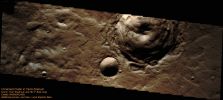
Craters-Unnamed_Crater-Terra_Sirenum-20090318a-PCF-LXTT.jpgHighly Degraded Unnamed Crater in Terra Sirenum (Natural Colors; credits: Dr Paolo C. Fienga - Lunar Explorer Italia)64 visitenessun commentoMareKromium
|
|

ESP_013726_1475_RED_abrowse.jpgGullies and Flow Features on an Unnamed Crater Wall (Natural Colors; credits: Lunexit)75 visiteThis HiRISE image shows a sample of the variety and complexity of processes that may occur on the walls of Martian Craters, well after the impact crater formed.
At the very top of the image is the high Crater Rim; at the bottom of the image is the Crater's Central Peak - a dome of material rising above the surrounding Crater Floor uplifted during the impact event. Reaching down the Walls of the crater are windy and crooked troughs, or Gullies. Some of these Gullies may have formed with the help of liquid water, melted from ice or snowpack on the Crater Walls or from groundwater within the Walls. Also notable is the long tongue-like lobe stretching down the middle of the image, with a darker, rounded snout, and prominent parallel grooves on its surface. These characteristics, together with faint cracks on its surface, suggest that this lobe may have formed by movement of ice-rich material from up on the Crater Wall down to the floor.
Because surface features on this lobe, as well as most Gullies, do not appear sharp and pristine, and wind-blown dunes have blown up on the front snout of the lobe, and because there are several small craters on the lobe's surface, the movement of ice-rich material, and possibly water, have probably not occurred very recently.
MareKromium
|
|

ESP_014176_1810_RED_abrowse.jpgCentral Uplift of an Unnamed Impact Crater (Natural Colors; credits: Lunexit)72 visitenessun commentoMareKromium
|
|
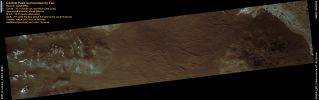
ESP_014320_1465_RED_abrowse.jpgCentral Peak surrounded by Fan (Natural Colors; credits: Lunexit)75 visitenessun commentoMareKromium
|
|
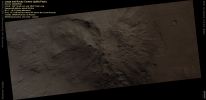
ESP_014410_1470_RED_abrowse.jpgUnnamed Crater with Rocky central Uplift (Natural Colors; credits: Lunexit)67 visitenessun commentoMareKromium
|
|
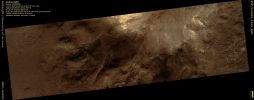
ESP_014439_1505_RED_abrowse.jpgCentral Uplift (Natural Colors; credits: Lunexit)66 visitenessun commentoMareKromium
|
|
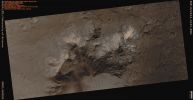
ESP_022614_1635_RED_abrowse.jpgCentral Peak of an Unnamed Crater in Tyrrhena Terra (Absolute Natural Colors; credits for the additional process. and color.: Dr Paolo C. Fienga - Lunexit Team) 183 visitenessun commentoMareKromium
|
|

ESP_023674_1590_RED_abrowse-PCF-LXTT-00.jpgColorful Central Peak in an Unnamed Crater (CTX Frame - Absolute Natural Colors; credits for the additional process. and color.: Dr Paolo C. Fienga - Lunexit Team)179 visiteMars Local Time: 14:11 (Early Afternoon)
Coord. (centered): 20,5° South Lat. and 306,4° East Long.
Spacecraft altitude: 259,1 Km (such as about 162,0 miles)
Original image scale range: 51,8 cm/pixel (with 2 x 2 binning) so objects ~ 1 mt and 56 cm across are resolved
Map projected scale: 50 cm/pixel
Map projection: EQUIRECTANGULAR
Emission Angle: 7,2°
Sun-Mars-Spacecraft (or "Phase") Angle: 41,5°
Solar Incidence Angle: 35° (meaning that the Sun is about 55° above the Local Horizon)
Solar Longitude: 345,0° (Northern Winter)
Credits: NASA/JPL/University of Arizona
Additional process. and coloring: Dr Paolo C. Fienga - Lunar Explorer ItaliaMareKromium
|
|

ESP_023674_1590_RED_abrowse-PCF-LXTT-01.jpgColorful Central Peak in an Unnamed Crater (EDM - Absolute Natural Colors; credits for the additional process. and color.: Dr Paolo C. Fienga - Lunexit Team)227 visiteMars Local Time: 14:11 (Early Afternoon)
Coord. (centered): 20,5° South Lat. and 306,4° East Long.
Spacecraft altitude: 259,1 Km (such as about 162,0 miles)
Original image scale range: 51,8 cm/pixel (with 2 x 2 binning) so objects ~ 1 mt and 56 cm across are resolved
Map projected scale: 50 cm/pixel
Map projection: EQUIRECTANGULAR
Emission Angle: 7,2°
Sun-Mars-Spacecraft (or "Phase") Angle: 41,5°
Solar Incidence Angle: 35° (meaning that the Sun is about 55° above the Local Horizon)
Solar Longitude: 345,0° (Northern Winter)
Credits: NASA/JPL/University of Arizona
Additional process. and coloring: Dr Paolo C. Fienga - Lunar Explorer ItaliaMareKromium
|
|

NGC-4038_and_NGC-4039-0.jpgNGC 4038 and 4039 - The "Antennae Galaxies"68 visite"...Ars longa, Vita brevis (est)..."
(Seneca)
"...La via dell'Arte (intesa come Scienza e Conoscenza) è eterna; la Vita umana (invece) è breve..."
Nota: tutta la Vita di un Uomo che si dedichi alle Arti ed alla Scienza non basta perché egli possa svolgere la sua opera ed il suo pensiero per intero. Come Faust cade sul libro non finito, altri lo riprenderà per continuarlo e quindi seguirà la stessa fine e così via...ad infinitum.
|
|

OPP-SOL1062-1P222466688EFF78DYP2664L4M1-01.jpgThe "Twin-Peaks" of Meridiani Planum during a foggy Sol (1 - context image)64 visitenessun commento
|
|
| 32 immagini su 3 pagina(e) |
1 |
|








