| Risultati della ricerca nelle immagini - "Pavonis" |
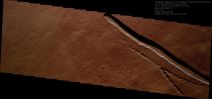
Collapse_Features-PavonisMons-20080306a.jpgChannel on Pavonis Mons (Natural Colors; credits for the additional process. and color.: Dr Paolo C. Fienga - Lunexit Team)81 visitenessun commentoMareKromium
|
|
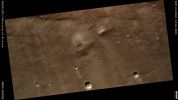
ESP_012692_1810_RED_abrowse.jpgThe "Dusty" Summit of Pavonis Mons (Natural Colors; credits: Lunar Explorer Italia)68 visitePavonis Mons is one of the 3 giant Tharsis Montes Shield Volcanoes. Its Summit rises so far above the Surface that the Atmosphere is extremely thin, even for Mars.
Dust that reaches these heights (for example, during major Dust Storms) is hard to remove, so the upper parts of these Volcanoes are covered by vast deposits of dust. The dust is moved a little by the thin winds, producing ripples and other textures near the limit of HiRISE’s resolution. The fluffy, ripply surface looks “smudged” or out of focus, but by looking at some of the small impact craters you can see that the HiRISE camera is, indeed, properly focused. It’s the surface of Mars that is blurry!
Nota Lunexit: NO. A nostro parere NON è la Superficie di Marte che è "sfuocata" (blurry) e non è neppure la fotocamera dell'Orbiter che è "out of focus". Si tratta, come abbiamo già visto in passato (nelle immagini dei fly-by ravvicinati di alcune Lune Saturniane - Encelado su tutte) di un caso classico di "Sfuocatura da Movimento" (in altre parole: è un mero problema di lunghezza dell'esposizione - ivi: eccessiva -, data la vicinanza del target ripreso in rapporto alla velocità dell'Orbiter rispetto al medesimo). Curioso che i Ragazzi di Pasadena non ci abbiano pensato...
The impact craters also show that the dust is not a thin veneer. Instead, it is a thick coat, at least several meters deep. This mantling of dust hides the details of the Lava Flows and Vents, frustrating volcanologists but delighting those who study dust.
Mars Local Time: 15:23 (early afternoon)
Coord. (centered): 0,9° North Lat. and 246,8° East Long.
Spacecraft altitude: 254,1 Km (such as about 158,8 miles)
Original image scale range: 50,8 cm/pixel (with 1 x 1 binning) so objects ~1,53 mt across are resolved
Map projected scale: 50 cm/pixel
Map projection: EQUIRECTANGULAR
Emission Angle: 2,5°
Phase Angle: 52,4°
Solar Incidence Angle: 55° (meaning that the Sun is about 35° above the Local Horizon)
Solar Longitude: 244,7° (Northern Autumn)
Credits: NASA/JPL/University of Arizona
Additional process. and coloring: Lunar Explorer ItaliaMareKromium
|
|
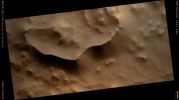
PSP_009356_1835_RED.jpgRidged Margin of Elevated Plateau North/West of Pavonis Mons (possible True Colors; credits: Lunar Explorer Italia)84 visiteSnaking across this observation is a ridged margin that appears as though it separates two parts of a canvas.
On closer examination (see the edm), it almost looks as though there is a relatively smooth landscape on the left, and pockmarked terrain on the right.
The ridge itself is revealed in incredible detail with what appear to be "gulley-esque" grooves running its length.
Pavonis Mons is part of what is called Tharsis Montes, being the middle of three volcanoes in this Region. The name "Pavonis Mons" itself is Latin for "Mount of the Peacock".
Mars Local Time: 15:25 (early afternoon)
Coord. (centered): 3,6° North Lat. and 243,8° East Long.
Spacecraft altitude: 265,3 Km (such as about 165,8 miles)
Original image scale range: 26,5 cm/pixel (with 1 x 1 binning) so objects ~80 cm across are resolved
Map projected scale: 25 cm/pixel
Map projection: EQUIRECTANGULAR
Emission Angle: 1,3°
Phase Angle: 54,5°
Solar Incidence Angle: 54° (meaning that the Sun is about 36° above the Local Horizon)
Solar Longitude: 103,5° (Northern Summer)
Credits: NASA/JPL/University of Arizona
Additional process. and coloring: Lunar Explorer ItaliaMareKromium
|
|
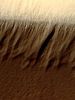
PSP_009356_1835_RED_abrowse-01.jpgRidged Margin of Elevated Plateau North-West of Pavonis Mons (edm - Natural Colors; credits: Lunar Explorer Italia)91 visitenessun commentoMareKromium
|
|

Volcanic_Features-Collapse_Pits-Pavonis_Mons_Area.jpgPit Chain on the Eastern Flank of Pavonis Mons (Original NASA/MGS/MSSS b/w Frame)89 visiteCaption NASA originale:"Pavonis Mons is the middle of the 3 large Tharsis Montes Volcanoes in the Martian Western Hemisphere.
Located on the Equator at about 113° West Longitude, Pavonis Mons stands as much as 7 Km above the surrounding Plain. The MGS-MOC recently spied the above Chain of Elliptical Pits on the lower East Flank of Pavonis Mons. The picture covers an area approx. 3 Km wide by 3,4 Km in length. The Pits are aligned down the center of a 485 meters-(approx. 530 yards)-wide, shallow Trough.
The straight Trough and the Pits were both formed by collapse associated with faulting. The Scarp on each side of the Trough is a "Fault Line" - Troughs of this type are known to geologists as "Graben". Such features are typically formed when the ground is being moved apart by tectonic forces, or when the ground is uplifted by molten rock injected into the near sub-surface from deeper underground. Both processes may be contributing to the features seen on Pavonis Mons. The Pits follow the trend of these Faults, and indicate the locus of collapse".
|
|

Volcanoes-Pavonis_Mons-PCF-LXTT.jpgPavonis Mons (Enhanced and Saturated Natural Colors; credits for the additional process. and color.: Dr Paolo C. Fienga - Lunexit Team)99 visiteCaption NASA originale:"This Mars Global Surveyor (MGS) Mars Orbiter Camera (MOC) wide angle color composite image, obtained in December 2003, shows the middle of the three Tharsis Montes, Pavonis Mons.
This is a broad shield volcano - similar to the volcanoes of Hawaii - located on the Martian Equator at approx. 113° West.
The Volcano Summit is near 14 Km (~8,7 mi) above the Martian Datum (such as 0 elevation); the central caldera (crater near center of image) is about 45 Km (~28 mi.) across and about 4,5 Km (~2.8 mi.) deep. Sunlight illuminates the scene from the lower left".MareKromium
|
|
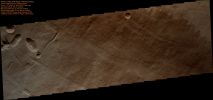
Volcanoes-Pavonis_Mons-PIA13671.jpgDetail of the N/W Flank of Pavonis Mons (Absolute Natural Colors; credits for the additional process. and color.: Dr Paolo C. Fienga - Lunexit Team) 100 visitenessun commentoMareKromium
|
|
|
| 7 immagini su 1 pagina(e) |
|








