| Risultati della ricerca nelle immagini - "Patches" |

Luna21-D.jpgLuna 21 and Lunokhod 2: a new "Moon-Walk"130 visiteThe Luna 21 spacecraft landed on the Moon and deployed the second Soviet Lunar Rover (Lunokhod 2). The primary objectives of the mission were to collect images of the Lunar Surface, examine ambient light levels to determine the feasibility of astronomical observations from the Moon, perform laser ranging experiments from Earth, observe solar X-rays, measure local magnetic fields, and study mechanical properties of the Lunar Surface material.
|
|
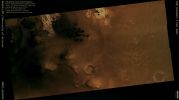
PSP_006820_1760_RED_abrowse~0.jpgPeri-Equatorial "Sand-Patches" on a Crater Floor (MULTISPECTRUM; credits: Lunexit)79 visiteThis image shows part of the floor of a large crater in Arabia Terra, near Mars’ Equator. A notable feature on this crater floor is a region of "Dark Patches" up to about 100 mt (330 feet) across. These Dark Patches sit in an area of connected small ridges and spurs and bury them, filling in the low areas and piling up. In several places light ridge crests protrude through the dark material.
The dark patches appear to be collections of wind-blown sand. Sand on Mars is often dark, likely because it is fragments of a volcanic rock called basalt. (Sand on Earth is most often light-toned quartz). Sand may tend to collect in patches that can ultimately evolve into large dunes if more sand gathers. The patches of sand here are not big enough to form such large structures, but small-scale regular texture due to blowing wind is visible on the surface.
The relatively dark tone which can be seen around the Sand Patches (compared with the surrounding material) is probably due to small amounts of additional sand. In some places this collects at the bottom of troughs.MareKromium
|
|
|
|
| 2 immagini su 1 pagina(e) |
|








