| Risultati della ricerca nelle immagini - "Patch" |

000-Clementine.gif000 - Clementine105 visiteDescription
Clementine was a joint project between the Ballistic Missile Defense Organization (BMDO, nee the Strategic Defense Initiative Organization, or SDIO) and NASA. The objective of the mission was to test sensors and spacecraft components under extended exposure to the space environment and to make scientific observations of the Moon and the near-Earth asteroid 1620 Geographos. The Geographos observations were not made due to a malfunction in the spacecraft. The lunar observations made included imaging at various wavelengths in the visible as well as in ultraviolet and infrared, laser ranging altimetry, gravimetry, and charged particle measurements. These observations were for the purposes of obtaining multi-spectral imaging the entire lunar surface, assessing the surface mineralogy of the Moon and obtaining altimetry from 60N to 60S latitude and gravity data for the near side. There were also plans to image and determine the size, shape, rotational characteristics, surface properties, and cratering statistics of Geographos. Clementine carried 7 distinct experiments on-board: a UV/Visible Camera, a Near Infrared Camera, a Long Wavelength Infrared Camera, a High Resolution Camera, two Star Tracker Cameras, a Laser Altimeter, and a Charged Particle Telescope. The S-band transmitter was used for communications, tracking, and the gravimetry experiment.
Spacecraft and Subsystems
The spacecraft was an octagonal prism 1.88 meters high and 1.14 m across with two solar panels protruding on opposite sides parallel to the axis of the prism. A high-gain fixed dish antenna was at one end of the prism, and the 489 N thruster at the other end. The sensor openings were all located together on one of the eight panels, 90 degrees from the solar panels, and protected in flight by a single sensor cover. The spacecraft propulsion system consisted of a nonpropellant hydrazine system for attitude control and a bipropellant nitrogen tetraoxide and monomethyl hydrazine system for the maneuvers in space. The bipropellant system had a total capability of about 1900 m/s with about 550 m/s required for lunar insertion and 540 m/s for lunar departure. Attitude control was achieved with 12 small attitude control jets, two star tracker cameras, and two inertial measurement units. The spacecraft was three-axis stabilized in lunar orbit via reaction wheels with a precision of 0.05 Deg. in control and 0.03 Deg. in knowledge. Power was provided by gimbaled, single axis, GaAs/Ge solar panels which charged a 15 amp-hour, 47-w hr/Kg Nihau (Ni-H) common pressure vessel battery. Spacecraft data processing was performed using a MIL-STD-1750A computer (1.7 million instructions per second) for savemode, attitude control, and housekeeping operations, a RISC 32-bit processor (18 million ips) for image processing and autonomous operations, and an image compression system provided by the French Space Agency CNES. A data handling unit sequenced the cameras, operated the image compression system, and directed the data flow. Data was stored in a 2 Gbit dynamic solid state data recorder.
Mission Profile
The mission had two phases. After two Earth flybys, lunar insertion was achieved approximately one month after launch. Lunar mapping took place over approximately two months, in two parts. The first part consisted of a five hour elliptical polar orbit with a periapsis of about 400 Km at 30 degrees south latitude and an apoapsis of 8300 Km. Each orbit consisted of an 80 minute lunar mapping phase near periapsis and 139 minutes of downlink at apoapsis. After one month of mapping the orbit was rotated to a periapsis at 30 degrees north latitude, where it remained for one more month. This allowed global imaging and altimetry coverage from 60 degrees south to 60 degrees north, over a total of 300 orbits. After a lunar/Earth transfer and two more Earth flybys, the spacecraft was to head for Geographos, arriving three months later for a flyby, with a nominal approach closer than 100 Km. Unfortunately, on May 7, 1994, after the first Earth transfer orbit, a malfunction aboard the craft caused one of the attitude control thrusters to fire for 11 minutes, using up its fuel supply and causing Clementine to spin at 80 rpm. Under these conditions, the asteroid flyby could not yield useful results, so the spacecraft was put into a geocentric orbit passing through the Van Allen radiation belts to test the various components on board. The mission ended in June 1994 when the power level onboard dropped to a point where the telemetry from the spacecraft was no longer intelligible.
|
|

Dunes-PIA14876.gifMoving Rippled Patch of Sand in Becquerel Crater (a GIF-Movie by NASA/JPL-Caltech/Univ. of Ariz./JHUAPL)217 visitenessun commentoMareKromium
|
|

ESP_022595_0955_RED_abrowse-PCF-LXTT.jpgSouth Polar Features: the "Patchy Ice" (Natural Colors; credits for the additional process. and color.: Dr Paolo C. Fienga - Lunexit Team)198 visitenessun commentoMareKromium
|
|

Luna21-D.jpgLuna 21 and Lunokhod 2: a new "Moon-Walk"127 visiteThe Luna 21 spacecraft landed on the Moon and deployed the second Soviet Lunar Rover (Lunokhod 2). The primary objectives of the mission were to collect images of the Lunar Surface, examine ambient light levels to determine the feasibility of astronomical observations from the Moon, perform laser ranging experiments from Earth, observe solar X-rays, measure local magnetic fields, and study mechanical properties of the Lunar Surface material.
|
|
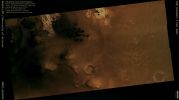
PSP_006820_1760_RED_abrowse~0.jpgPeri-Equatorial "Sand-Patches" on a Crater Floor (MULTISPECTRUM; credits: Lunexit)77 visiteThis image shows part of the floor of a large crater in Arabia Terra, near Mars’ Equator. A notable feature on this crater floor is a region of "Dark Patches" up to about 100 mt (330 feet) across. These Dark Patches sit in an area of connected small ridges and spurs and bury them, filling in the low areas and piling up. In several places light ridge crests protrude through the dark material.
The dark patches appear to be collections of wind-blown sand. Sand on Mars is often dark, likely because it is fragments of a volcanic rock called basalt. (Sand on Earth is most often light-toned quartz). Sand may tend to collect in patches that can ultimately evolve into large dunes if more sand gathers. The patches of sand here are not big enough to form such large structures, but small-scale regular texture due to blowing wind is visible on the surface.
The relatively dark tone which can be seen around the Sand Patches (compared with the surrounding material) is probably due to small amounts of additional sand. In some places this collects at the bottom of troughs.MareKromium
|
|
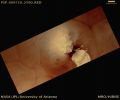
PSP_009710_2590_RED.jpgRelatively Fresh Ice-Patch near the North Polar Layered Deposits (possible True Colors; credits: Lunar Explorer Italia)67 visiteMars Local Time: 14:57 (early afternoon)
Coord. (centered): 78,7° North Lat. and 285,2° East Long.
Spacecraft altitude: 323,6 Km (such as about 202,2 miles)
Original image scale range: 32,4 cm/pixel (with 1 x 1 binning) so objects ~97 cm across are resolved
Map projected scale: 25 cm/pixel
Map projection: EQUIRECTANGULAR
Emission Angle: 11,8°
Phase Angle: 50,0°
Solar Incidence Angle: 60° (meaning that the Sun is about 30° above the Local Horizon)
Solar Longitude: 116,1° (Northern Summer)
Credits: NASA/JPL/University of Arizona
Additional process. and coloring: Lunar Explorer ItaliaMareKromium
|
|
|
|
| 6 immagini su 1 pagina(e) |
|








