| |
| Risultati della ricerca nelle immagini - "Ophir" |

Chasma-Echus_Chasma-Fractures-ESP_033591_1805-PCF-LXTT-IPF.jpgFeatures of Echus Chasma (CTX Frame - Absolute Natural Colors; credits for the additional process. and color.: Dr Paolo C. Fienga/Lunar Explorer Italia/Italian Planetary Foundation)96 visiteIn this image, we can see a so-called "Intersection Area" created by a number of Fractures (or, perhaps, Fissures and/or Water or Lava-carved narrow Channels) which are all located on the Floor of Echus Chasma (an Equatorial Chasma found in the Lunae Planum High Plateau Region of Mars, slightly to the North of the gigantic Valles Marineris Canyon System, and approx. 100 Km long and 10 Km wide).
Echus Chasma contains several Valleys which range - as far as their depth is concerned - from about 1 to 4 Km, and it is now considered, by Planetary Scientists, to be the Water Source Region that allowed the formation and then the (relevant) water-supply of the Kasei Valles Outflow Channel: a large Valley that extends for thousands of kilometers towards the North of the Red Planet.
Mars Local Time: 14:36 (Early Afternoon)
Coord. (centered): 0,377° North Lat. and 279,483° East Long.
Spacecraft altitude: 269,1 Km (such as about 161,111 miles)
Original image scale range: 53,8 cm/pixel (with 2 x 2 binning) so objects ~ 1 mt and 62 cm across are resolved
Map projected scale: 50 cm/pixel
Map projection: EQUIRECTANGULAR
Emission Angle: 7,7°
Phase Angle: 47,6°
Solar Incidence Angle: 40° (meaning that the Sun was about 50° above the Local Horizon at the time the picture was taken)
Solar Longitude: 27,0° (Northern Spring - Southern Fall)
Credits: NASA/JPL/University of Arizona
Additional process. and coloring: Lunar Explorer Italia
This picture (which is a NASA - Original Mars Reconnaissance Orbiter b/w and NON-Map Projected frame identified by the serial n. ESP_033591_1805) has been additionally processed, magnified, contrast enhanced, Gamma corrected, and then colorized in Absolute Natural Colors (such as the colors that a human eye would actually perceive if someone were onboard the NASA - Mars Reconnaissance Orbiter and then looked down, towards the Surface of Mars), by using an original technique created - and, in time, dramatically improved - by the Lunar Explorer Italia Team.MareKromium
|
|

Chasma-Ophir_Chasma-PIA17702-PCF-LXTT-IPF.jpgFeatures of Ophir Chasma (EDM - Absolute Natural Colors; credits for the additional process. and color.: Dr Paolo C. Fienga/Lunar Explorer Italia/Italian Planetary Foundation)99 visiteThe really huge Landslides existing along the Walls of Ophir Chasma (which is nothing else but a deep Canyon located in the Coprates Quadrangle of Mars, at about 4° South Latitude and 72,5° West Longitude. It is approx. 317 km long and it was so named after a "Classical Albedo Feature") host a variety of Geologic Surfaces and Mineralogies.
Some of them possess a variety of Hydrated Sulfate Minerals that formed, eons ago, in the presence of Partially Acidic Liquid Water. This NASA - Mars Reconnaissance Orbiter's Contextual (or "CTX", for short) Image, which is representing an ancient (possibly and approximately 3 Billion Years-old) Landslide, shows us the presence, within it, of 2 (two) very distinct Surface Albedoes, which, in fact, mark a Transition Zone from one Sulfate Mineralogy to another (a circumstance that proves beyod doubts the occurrence, in a far and distant past, of some remarkable variations in the evolution of the visible Surface).
The Upper Slopes (such as the ones located towards the North) are light-toned, and this fact is due to the concurrent abundance of Hydrated Sulfate Minerals and Bright Surface Dust. On the other hand, the Surfaces that make up the Southern Portion of the Landslide, are darker in tone, and this is due to the greater abundance of Dark Sediment that, in time, formed "Strings of Sand Drifts" (extremely well visible in this Extra Detail Magnification). In addition to the above, the underlying Units of Bedrock consist of Darker Minerals that received a lesser hydration then the Northern ones, and this further circumstance implies the occurrence of a strong (and, perhaps, sudden) change in the Ancient Aqueous Environments that formed them.
Mars Local Time: 14:52 (Early Afternoon)
Coord. (centered): 4,328° South Lat. and 288,657° East Long.
Spacecraft altitude: 271,0 Km (such as about 168,291 miles)
Original image scale range: 27,1 cm/pixel (with 1 x 1 binning) so objects ~ 81 cm across are resolved
Map projected scale: 25 cm/pixel
Map projection: EQUIRECTANGULAR
Emission Angle: 6,3°
Phase Angle: 52,7°
Solar Incidence Angle: 47° (meaning that the Sun was about 43° above the Local Horizon at the time the picture was taken)
Solar Longitude: 27,0° (Northern Spring - Southern Fall)
Credits: NASA/JPL/University of Arizona
Additional process. and coloring: Lunar Explorer Italia
This picture (which is an Original NASA - Original Mars Reconnaissance Orbiter - False Colors and NON-Map Projected sub-frame identified by the serial n. PSP_007535_1755-1) has been additionally processed, magnified, contrast enhanced, Gamma corrected, and then re-colorized in Absolute Natural Colors (such as the colors that a human eye would actually perceive if someone were onboard the NASA - Mars Reconnaissance Orbiter and then looked down, towards the Surface of Mars), by using an original technique created - and, in time, dramatically improved - by the Lunar Explorer Italia Team.MareKromium
|
|

Chasma-Ophir_Chasma-PSP_007535_1755-PCF-LXTT-IPF.jpgFeatures of Ophir Chasma (CTX Frame - Absolute Natural Colors; credits for the additional process. and color.: Dr Paolo C. Fienga/Lunar Explorer Italia/Italian Planetary Foundation)82 visiteThe really huge Landslides existing along the Walls of Ophir Chasma (which is nothing else but a deep Canyon located in the Coprates Quadrangle of Mars, at about 4° South Latitude and 72,5° West Longitude. It is approx. 317 km long and it was so named after a "Classical Albedo Feature") host a variety of Geologic Surfaces and Mineralogies.
Some of them possess a variety of Hydrated Sulfate Minerals that formed, eons ago, in the presence of Partially Acidic Liquid Water. This NASA - Mars Reconnaissance Orbiter's Contextual (or "CTX", for short) Image, which is representing an ancient (possibly and approximately 3 Billion Years-old) Landslide, shows us the presence, within it, of 2 (two) very distinct Surface Albedoes, which, in fact, mark a Transition Zone from one Sulfate Mineralogy to another (a circumstance that proves beyod doubts the occurrence, in a far and distant past, of some remarkable variations in the evolution of the visible Surface).
The Upper Slopes (such as the ones located towards the North) are light-toned, and this fact is due to the concurrent abundance of Hydrated Sulfate Minerals and Bright Surface Dust. On the other hand, the Surfaces that make up the Southern Portion of the Landslide, are darker in tone, and this is due to the greater abundance of Dark Sediment that, in time, formed "Strings of Sand Drifts". In addition to the above, the underlying Units of Bedrock consist of Darker Minerals that received a lesser hydration then the Northern ones, and this further circumstance implies the occurrence of a strong (and, perhaps, sudden) change in the Ancient Aqueous Environments that formed them.
Mars Local Time: 14:52 (Early Afternoon)
Coord. (centered): 4,328° South Lat. and 288,657° East Long.
Spacecraft altitude: 271,0 Km (such as about 168,291 miles)
Original image scale range: 27,1 cm/pixel (with 1 x 1 binning) so objects ~ 81 cm across are resolved
Map projected scale: 25 cm/pixel
Map projection: EQUIRECTANGULAR
Emission Angle: 6,3°
Phase Angle: 52,7°
Solar Incidence Angle: 47° (meaning that the Sun was about 43° above the Local Horizon at the time the picture was taken)
Solar Longitude: 27,0° (Northern Spring - Southern Fall)
Credits: NASA/JPL/University of Arizona
Additional process. and coloring: Lunar Explorer Italia
This picture (which is a NASA - Original Mars Reconnaissance Orbiter b/w and NON-Map Projected frame identified by the serial n. PSP_007535_1755) has been additionally processed, magnified, contrast enhanced, Gamma corrected, and then colorized in Absolute Natural Colors (such as the colors that a human eye would actually perceive if someone were onboard the NASA - Mars Reconnaissance Orbiter and then looked down, towards the Surface of Mars), by using an original technique created - and, in time, dramatically improved - by the Lunar Explorer Italia Team.MareKromium
|
|

Craters-Unnamed_Crater-PIA13977-PCF-LXTT.jpgUnnamed Crater on the Edge of Ophir Chasma (Absolute Natural Colors; credits: Dr Paolo C. Fienga - Lunexit Team)233 visitenessun commentoMareKromium
|
|
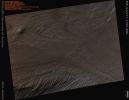
ESP_022277_1760_RED_abrowse.jpgFeatures of Ophir Chasma (Absolute Natural Colors; credits for the addtional process. and color.: Dr Paolo C. Fienga - Lunexit Team)193 visitenessun commentoMareKromium
|
|

Landslides-OC-20080108a.jpgPeri-Equatorial Landslides (Darkened Absolute Natural Colors; credits for the additional process. and color.: Dr Paolo C. Fienga - Lunexit Team)115 visitenessun commentoMareKromium
|
|
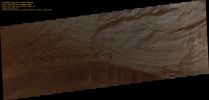
Landslides-Ophir_Chasma-PIA13184.jpgLandslide Deposit in Ophir Chasma (Natural Colors; credits: Dr Paolo C. Fienga - Lunexit Team)67 visitenessun commentoMareKromium
|
|

Ophir_Chasma-IR-20071219a.jpgLandslide in Ophir Chasma (IR) - coloring: Lunexit69 visiteCaption NASA: “The large landslide that can be seen on the right side (Dx) of this InfraRed (IR) image is located in Ophir Chasma. Although the resolution is less than the one that can be obtained from an image taken in Visible Light (VL), the large size of the feature is more completely covered by the wider frame size of the THEMIS infrared camera”.
Nota Lunexit: un esempio concreto di caption NASA "non sense".
Perchè vengono scattate le fotografie in IR? Beh – e questo lo sanno anche i bambini e gli “Scienziati da Salotto”… – non certo per avere una "qualità visiva migliore" (in senso stretto) del frame, né per "coprire meglio la superficie ripresa" (in termini di area inquadrabile).
A tal ultimo proposito Vi rammentiamo che il quantum di superficie inquadrabile dipende, in buona sostanza, non solo e non tanto dall'estensione del rilievo che interessa riprendere (attenzione: per questo tipo di frames si parla di rilievi aventi dimensioni comprese fra i 4 ed gli 8 Km di estensione in lunghezza ed i 2/3 Km di estensione in larghezza, e NON di rilievi grandi quanto possono esserlo dei continenti...), né dal tipo di "imaging strip" che la camera dell'Orbiter può ottenere.
Il quantum di cui sopra dipende, essenzialmente, DALL'ALTEZZA da cui la ripresa viene effettuata e dalla capacità di magnificazione della camera che riprende (ed ecco la semplicissima regola generale: per coprire una maggiore superficie con un singolo scatto, occorre aumentare l'altezza dell'Orbiter rispetto al suolo e ridurre la capacità di magnificazione della camera che riprende).
Tutto ciò premesso, e quindi tornando al quesito originale, Vi ricordiamo che le riprese orbitali in IR si fanno, di regola, di notte (o, comunque, in ore nelle quali la luminosità della superficie e bassissima e/o tendente a zero) e per verificare se un certo rilievo EMETTE o RITIENE (e, se SI, QUANTO) CALORE.
La spiegazione NASA, nei termini in cui viene esposta nella riportata caption, quindi – a nostro umile parere –, è totalmente priva di significato.
Anzi, peggio: è fuorviante.
Ed ora provate a rileggerla...
MareKromium
|
|
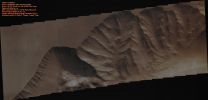
Ophir_Chasma-PIA14469-PCF-LXTT.jpgFeatures of Ophir Chasma (Absolute Natural Colors; credits for the additional process. and color: Dr Paolo C. Fienga - Lunexit Team)133 visitenessun commentoMareKromium
|
|
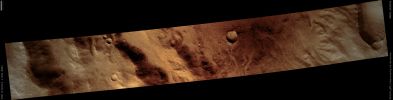
PSP_010435_1700_RED_abrowse.jpgPossible "Paleo-Lake" in Ophir Planum (Natural Colors; credits: Lunar Explorer Italia)100 visiteMars Local Time: 15:35 (middle afternoon)
Coord. (centered): 10,0° South Lat. and 306,2° East Long.
Spacecraft altitude: 274,2 Km (such as about 171,4 miles)
Original image scale range: 54,9 cm/pixel (with 1 x 1 binning) so objects ~ 1,65 mt across are resolved
Map projected scale: 50 cm/pixel
Map projection: EQUIRECTANGULAR
Emission Angle: 19,1°
Phase Angle: 75,7°
Solar Incidence Angle: 59° (meaning that the Sun is about 31° above the Local Horizon)
Solar Longitude: 143,2° (Northern Summer)
Credits: NASA/JPL/University of Arizona
Additional process. and coloring: Lunar Explorer ItaliaMareKromium
|
|
|
|
| 10 immagini su 1 pagina(e) |
|

|
|








