| Risultati della ricerca nelle immagini - "Olympus" |

ESP_011664_2015_RED_abrowse-00.jpgAt the base of Olympus Mons... (ctx frame - Natural Colors; credits: Lunar Explorer Italia)70 visiteThis image is located at the foot of the largest volcano of the Solar System: Olympus Mons.
The entire scene is covered with a multitude of Lava Flows. Most of the Flows consisted of relatively sticky lava that froze after flowing for only a short distance (often less than 1 Km, or about 1/2 a mile). However, a few of the Flows were more fluid and actually drained out of their Channels, leaving Troughs with distinct levees. These “Channelized” Flows extend out of the HiRISE image so they must be at least several kilometers (a few miles) long.
In all likelihood, both the short and long Lava Flows have very similar chemical compositions.
Based on experience with Lava Flows on Earth, the Channelized Flows were probably fed by more vigorous eruptions. That is, the Lava Flow was fed so quickly that the lava traveled a long distance before it solidified. With the shorter flows, a slow dribble of lava froze before going more than the equivalent of a few city blocks.MareKromium
|
|

ESP_011664_2015_RED_abrowse-01.jpgAt the base of Olympus Mons... (edm - Natural Colors; credits: Lunar Explorer Italia)71 visiteThe Ridge with 2 Knobs in the center of this edm is of special interest. The Lava Flows radiate away from these Knobs, indicating that the Flows were fed from these points. However, based on experience with the current eruption of Kilauea Volcano in Hawaii, it seems that these Vents were fed by a Lava Tube.
Thus the magma first reached the Surface some distance away, then was transported through a Tube to this location. A blockage in the Tube would force the lava to burst out and erupt onto the Surface.MareKromium
|
|
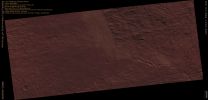
ESP_017888_1950_RED_abrowse.jpgOlympus' Lava Flows (Extremely Enhanced Natural Colors; credits for the additional process. and color.: Dr Paolo C. Fienga - Lunexit Team)86 visiteThe flanks of Olympus Mons are covered with Lava Flows (one on top of the other) Most of these Flows are relatively narrow, with a channel running down the middle. They appear similar to the Lava Flows found on Mt. Etna in Sicily (Italy).
However, in this image, we see these typical Flows partially covered by another, more recent one. This last one also shows a Central Channel, and it is about 10 times wider than the more typical Lava Flows. At the center of the HiRISE image the Channel disappears.
This is probably because the Channel was blocked here and Lava spilled out of it and covered a broad, fan-shaped, area. The eruption that produced this unusual flow was probably more vigorous and perhaps lasted longer than the more common ones.MareKromium
|
|
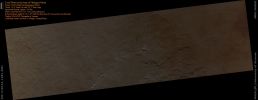
ESP_018534_1985_RED_abrowse-PCF-LXTT1.jpgLava Flows at the base of Olympus Mons (Absolute Natural Colors; credits for the additional process. and color.: Dr Paolo C. Fienga - Lunexit Team)117 visitenessun commentoMareKromium
|
|
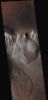
Landslides-Olympus_Mons-PIA07205-PCF-LXTT.jpgLandslide on the Northern Side of Olympus (Absolute Natural Colors; credits for the additional process. and color.: Dr Paolo C. Fienga - Lunexit Team)199 visiteCaption NASA:"The Landslide in this VIS image originated from the steep Escarpment which surrounds the Olympus Mons Volcano on Mars. This landslide is Located on the Northern Side of the Volcano".
Image information: VIS instrument;
Latitude: 23,2° North;
Longitude: 223,9° East (such as 136,1° West);
Resolution: 100 meter/pixel.
MareKromium
|
|

O-Mariner9-02.jpgMars from Mariner 9: Olympus, alias Nix Olimpica89 visitenessun commento
|
|

O-Mariner9-71-PIA02999_modest.jpgMars from Mariner 9: Ascraeus Lacus above the Martian Dust Storm151 visiteCaption NASA originale:"Oblique view of the crater complex near Ascraeus Lacus in the Tharsis region of Mars taken by Mariner 9. It is the northernmost of the prominent dark spots observed by Mariner during its approach to the Planet. The spot consists of several intersecting shallow crater-like depressions.
The main crater is approximately 21 Km (13 miles) across, the whole complex about 40 Km (25 miles) across.
The crater probably is in a relatively high area of the Martian surface, which accounts for its being visible above the dust storm.
The faint circular features outside the crater are probably atmospheric disturbances".
|
|

PSP_002184_2005_RED_browse-1.jpgOn the Edge of Olympus (Natural Colors; credits: Lunexit)78 visiteOlympus Mons, the largest volcano in the Solar System, has a mysterious halo (or "Aureole") of material on its Western and Northern Sides. There have been many ideas about how this feature may have formed over the years, but the hypothesis that this is a giant landslide deposit has gained favor.
Many large volcanoes on the Earth collapse under their own weight, so it seems reasonable that Olympus Mons would do the same. The edge of the Aureole is seen on the left (North) part of the image.
It is interesting that the main part of the Aureole seems sunk down compared to the edge. It is possible that the ridge along the outer margin of the Aureole formed as the flow turned around after pushing uphill for a ways. Imagine a giant wave of rock pushing up onto the "beach" and then receding. It might leave a deposit like this.
Alternatively, glaciers push up a ramp of rock at their fronts.
After they retreat, the ridge of rock is left at the furthest extent of the glacier. These are called "Terminal Moraines" by geologists.MareKromium
|
|
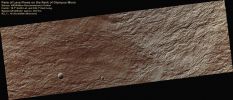
PSP_002909_2000_RED_abrowse-PCF-LXTT.jpgFeatures of Olympus Mons (Absolute Natural Colors; credits: Dr Paolo C. Fienga - Lunexit Team)231 visitenessun commentoMareKromium
|
|
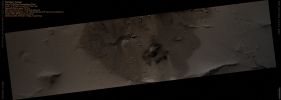
PSP_003450_1975_RED_abrowse-PCF-LXTT.jpgOlympus' Aureole (Absolute Natural Colors; credits for the additional process. and color.: Dr Paolo C. Fienga - Lunexit Team)103 visitenessun commentoMareKromium
|
|

PSP_003595_2115_RED_browse.jpgOlympus' Aureole (False Colors; credits for the additional process. and color.: Dr Paolo C. Fienga - Lunexit Team) 122 visiteThis image samples the rugged central portion of the mysterious "aureole" that extends to the West and North of Olympus Mons.
While many ideas for its formation have been advanced over the decades, these days it is generally thought to be a giant landslide deposit. The scene here fits that model with kilometer-scale (mile-sized) rocky hummocks and blocks strewn about. The blocks themselves are now covered with dust that is slumping off in small landslides or avalanches. These leave dark streaks on the sides of the blocks.MareKromium
|
|

PSP_003595_2115_RED_browse~0.jpgOlympus' Aureole (Absolute Natural Colors; credits for the additional process. and color.: Dr Paolo C. Fienga - Lunexit Team)86 visiteThis image samples the rugged central portion of the mysterious "aureole" that extends to the West and North of Olympus Mons.
While many ideas for its formation have been advanced over the decades, these days it is generally thought to be a giant landslide deposit. The scene here fits that model with kilometer-scale (mile-sized) rocky hummocks and blocks strewn about. The blocks themselves are now covered with dust that is slumping off in small landslides or avalanches. These leave dark streaks on the sides of the blocks. MareKromium
|
|
| 46 immagini su 4 pagina(e) |
1 |
 |
|








