| Risultati della ricerca nelle immagini - "Niger" |
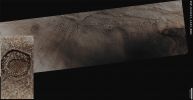
ESP_024315_1435_RED_abrowse-PCF-LXTT-001.jpgUnusually-looking Unnamed Crater near the Confluence of Dao Vallis with Niger Vallis (Absolute Natural Colors; credits for the additional process. and color.: Dr Paolo C. Fienga - Lunexit Team)201 visiteMars Local Time: 14:32 (Early Afternoon)
Coord. (centered): 36,1° South Lat. and 90,3° East Long.
Spacecraft altitude: 258,3 Km (such as about 161,4 miles)
Original image scale range: 51,7 cm/pixel (with 2 x 2 binning) so objects ~ 1 mt and 55 cm across are resolved
Map projected scale: 50 cm/pixel
Map projection: EQUIRECTANGULAR
Emission Angle: 5,6°
Sun-Mars-Spacecraft (or "Phase") Angle: 50,5°
Solar Incidence Angle: 54° (meaning that the Sun is about 36° above the Local Horizon)
Solar Longitude: 10,1° (Northern Spring)
Credits: NASA/JPL/University of Arizona
Additional process. and coloring: Dr Paolo C. Fienga - Lunar Explorer MareKromium
|
|

Niger_Vallis-TRA_000830_1440_IRB-1.jpgFeatures of Niger Vallis (Enhanced Natural Colors; credits for the additional process. and color.: Dr Paolo C. Fienga - Lunexit Team)427 visitenessun commentoMareKromium
|
|
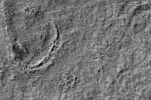
T-TRA_000830_1440_RED_NigerVallis_01.jpgNiger Vallis70 visiteThis image shows a portion of the floor of Niger Vallis, an ancient Martian outflow channel. Niger Vallis originates on the flanks of the volcano Hadriaca Patera, and empties into the Hellas impact basin. Outflow channels are observed in many regions of the planet, and may have been carved by brief eruptions of liquid water from beneath the surface. Since Niger Vallis formed, impacts have cratered the channel floor, and fine-grained wind-blown debris has been transported across the surface, eroding and burying all but the freshest craters. The curved ridge in the scene may be the remnant of a large crater rim. At the high resolution of this image, a pattern of parallel dunes and ripples can be seen, as well as individual boulders as large as two meters across.
|
|

TRA_000830_1440_IRB-1.jpgNiger Vallis (1)66 visiteThis image shows a portion of the floor of Niger Vallis, an ancient Martian outflow channel. Niger Vallis originates on the flanks of the volcano Hadriaca Patera, and empties into the Hellas impact basin. Outflow channels are observed in many regions of the planet, and may have been carved by brief eruptions of liquid water from beneath the surface. Since Niger Vallis formed, impacts have cratered the channel floor, and fine-grained wind-blown debris has been transported across the surface, eroding and burying all but the freshest craters. The curved ridge in the scene may be the remnant of a large crater rim. At the high resolution of this image, a pattern of parallel dunes and ripples can be seen, as well as individual boulders as large as two meters across.
Image TRA_000830_1440 was taken by the High Resolution Imaging Science Experiment (HiRISE) camera onboard the Mars Reconnaissance Orbiter spacecraft on September 30, 2006. The full image shown below is centered at -35.5 degrees latitude, 92.1 degrees East longitude. The range to the target site was 255 km (159 miles). At this distance the image scale is 51 cm/pixel (with 2 x 2 binning) so objects ~153 cm across are resolved. The image shown here has been map-projected to 50 cm/pixel and north is up. The image was taken at a local Mars time of 3:35 PM and the scene is illuminated from the west with a solar incidence angle of 77.5 degrees, thus the sun was about 12.5 degrees above the horizon. At a solar longitude of 113.8 degrees, the season on Mars is Northern Summer / Southern Winter.
|
|

TRA_000830_1440_IRB-2.jpgNiger Vallis (2)69 visitenessun commento
|
|
|
|
|
| 5 immagini su 1 pagina(e) |
|








