| Risultati della ricerca nelle immagini - "New" |

Craters-Newton_Crater-03.jpgNewton Crater's Gullies (Original NASA/MGS/MSSS b/w Frame)211 visiteDa "NASA - Picture of the Day" del 26.6.2000:"...Inside a small crater that lies inside large Newton Crater on Mars, numerous narrow channels run from the top down to the crater floor. The above picture covers a region spanning about 3000 meters across. These and other gullies have been found on Mars in recent HR pictures taken by the orbiting Mars Global Surveyor robot spacecraft. Similar channels on Earth are formed by flowing water, but on Mars the temperature is normally too cold and the atmosphere too thin to sustain liquid water. Nevertheless, many scientists now hypothesize that liquid water did burst out here from underground Mars, eroded the gullies and pooled at the bottom as it froze and evaporated. If so, life-sustaining ice and water might exist even today below the Martian surface (...)". L'idea che ci sia acqua allo stato liquido sotto la superficie di Marte non è nuova, anzi: la NASA stessa lo ipotizzava 4 anni fa. Oggi, dopo mesi di esplorazione "in loco", tutto tace. Forse un ripensamento?
|
|

Craters-Newton_Crater-PCF-LXTT-04.jpgNewton Crater's Gullies (Absolute Natural Colors; credits for the additional process. and color.: Dr Paolo C. Fienga - Lunexit Team)274 visitenessun commentoMareKromium
|
|

ESP_023045_1380-PCF-LXTT-00.jpgFlow Features inside Newton Crater (Absolute Natural Colors; credits for the additional process. and color: Dr Paolo C. Fienga - Lunexit Team)190 visitenessun commentoMareKromium
|
|

KemblesCascade.jpgKemble's Cascade72 visite"...Non abbiamo pi� un passato da venerare e un futuro da aspettare, e dunque una tradizione in cui selezionare ci� che passa e salvare ci� che resta.
La guerra civile tra Passato e Futuro si � conclusa con la sconfitta d�ambedue e la vittoria inappellabile del Presente.
Il Culto del Presente nega il capolavoro, che ha bisogno di sguardi lungimiranti oltre il Muro del Tempo; il Presente non consegna l�Opera alla storia n� tantomeno ai posteri, non elegge classici; consuma sul posto l�essere appena appare, fino a farlo sparire.
Senza la dimensione della Storia e la proiezione nel Futuro non � possibile partorire la grande opera.
...Il genio annega nel delirio narcisista dell�egocentrismo di massa, nell�invidia egualitaria, nel pari diritto al riconoscimento della genialit� e nella congiura della mediocrit� organizzata.
Nella mediocrazia universale, nell�uguaglianza metafisica delle anime o della loro assenza, il genio � un�anomalia arcaica, frutto iniquo della diseguaglianza e cicatrice deformante della disparit�.
Il genio � pregiudicato e rinnegato...
Marcello VenezianiMareKromium
|
|
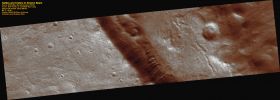
PSP_002620_1410_RED_browse-00.jpgGullies on the edge of Newton Basin (context image)67 visiteThis image shows a portion of two impact craters on the floor of Newton Basin where a smaller crater formed within a earlier larger one.
The larger crater's North rim can be seen diagonally (South-West/North-East) across the image and the smaller crater's north rim is near the right-side of the image.
Along the interior wall of the larger crater, several gullies have incised into the wall of the Crater. MareKromium
|
|
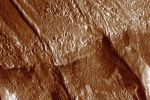
PSP_002620_1410_RED_browse-01.jpgGullies on the edge of Newton Basin (extra-detail mgnf)77 visiteThe gullies start near the top of the wall and can be traced across a break in slope partway down the wall (see here, 750 mt across). This break in slope occurs along the entire portion of the Crater wall in this image. The gullies appear shallower just above the break in slope, and deeper below the slope break.
This suggests that the fluid which eroded and carved out the wall materials forming the gullies, increased in velocity after the slope break, creating a deeper section of the gully.MareKromium
|
|

ZZ-ZZ-ZZ-ZZ-20100727_LORRILooksBack_lg.jpgOn the Way to Pluto: Jupiter, Europa and Ganymede122 visiteCaption NASA:"New Horizons had an exciting Fly-By encounter with Jupiter in early 2007, and the Spacecraft has been rapidly moving away from the Giant Planet ever since.
The New Horizons team looked back at Jupiter during Annual Checkout (ACO) to test the Long Range Reconnaissance Imager (LORRI)'s ability to image targets close, in angle, to the Sun.
This image was taken on June 24, 2010, when New Horizons was 16,3 Astronomical Units (about 1,5 Billion Miles) from Jupiter, at a Spacecraft-Sun-Planet angle of only 17°. Looking like Earth's moon at a quarter phase, Jupiter is clearly resolved, with an apparent diameter of nearly 12 LORRI pixels. LORRI also picks up the moons Ganymede and Europa, even though the exposure time was only 9 milliseconds and these Galilean satellites are extremely faint in comparison to Jupiter".MareKromium
|
|

ZZ-ZZ-ZZ-ZZ-20100727_LORRIM_lg.jpgOn the Way to Pluto: Messier 792 visiteCaption NASA:"The New Horizons team calibrates the Long Range Reconnaissance Imager (LORRI) by taking pictures of the Open Star Cluster Messier 7 (M 7). This is the first LORRI image of M 7 taken during Annual Checkout (ACO); the 100-millisecond manual exposure was taken on June 25, 2010. A preliminary comparison of this image to a 2008 LORRI picture of M7 indicated no degradation or change in LORRI's performance".MareKromium
|
|
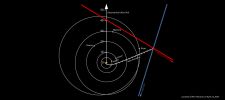
ZZ-ZZ-ZZ-ZZ-ZZ-Z-New_Horizons_Proxima-2025_28129_gifH_Interstellar_v2.jpgInterstellar Navigation131 visiteSince its launch in 2006, New Horizons has been on a trajectory that brought it past Pluto and then Kuiper Belt object Arrokoth and will eventually take it out of the solar system, into interstellar space over the next decade. In 2020, the New Horizons science team, in an effort led by Lauer, obtained images of the star fields around the nearby stars Proxima Centauri and Wolf 359 simultaneously from New Horizons and Earth. This program vividly demonstrated New Horizons’ change in perspective as it ventured from the inner to the outer solar system.
But more recent and sophisticated analyses of the exact positions of the two stars in those 2020 images allowed Lauer, working with retired Lawrence Livermore National Laboratory researcher David Munro, as well as members of the New Horizons team and external collaborators, to deduce New Horizons’ three-dimensional position relative to nearby stars – accomplishing the first use of stars imaged directly from a spacecraft to provide its navigational fix, and the first demonstration of interstellar navigation by any spacecraft on an interstellar trajectory.
A paper describing the results was accepted for publication in The Astronomical Journal. The preprint is available on the server arXiv.
“This pioneering interstellar navigation demonstration and its accompanying publication show that a deep-space mission can use its onboard imaging system to find its way among the stars,” said Alan Stern, principal investigator for New Horizons from the Southwest Research Institute in Boulder, Colorado. “While for New Horizons, this method isn’t as accurate as NASA’s sophisticated tracking from Earth, it could be highly useful for future deep space missions in the far reaches of the solar system and in interstellar space.”MareKromium
|
|
|
|
|
| 9 immagini su 1 pagina(e) |
|








