Triton-PIA00317-PCF-LXTT-IPF.jpgThe Southern Regions of Triton (Absolute Natural Colors; credits for the additional process. and color.: Dr Paolo C. Fienga/Lunar Explorer Italia/Italian Planetary Foundation)107 visiteThis wonderful and highly detailed global Absolute Natural Color image mosaic of Triton was obtained in the AD 1989 by the NASA - Voyager 2 Spacecraft during its Fly-By of the Neptunian System.
With a radius of approx. 1350 Km (such as a little more than 838 miles) and therefore some 22% smaller than Earth's Moon, Triton is by far the largest Natural Satellite of Neptune. Furthermore, Triton is one of the only 3 (three) objects in the Solar System known to have a Nitrogen-dominated Atmosphere (the others are our Home Planet Earth and the Saturnian giant moon, Titan). Triton has the coldest Surface known anywhere in the Solar System (38 K, or about - 391 degrees Fahrenheit, or - 235° Celsius): it is so cold that most of Triton's Nitrogen is condensed as Frost, making it the only Celestial Body in the whole Solar System that is known to have a Surface mainly composed of Nitrogen Ice.
The pinkish deposits constitute a vast South Polar Cap, that is believed to contain Methane Ice, which somehow reacted under Sunlight so to form pink or red Compounds. The Dark Streaks overlying these pink ices are believed to be an Icy and - perhaps - Carbonaceous Dust deposited from huge Geyser-like Plumes, some of which were found to be active during the Voyager 2 Fly-By. The light gray colored band visible in this image extends all the way around Triton, near the Equator and it may consist of relatively fresh Nitrogen Frost Deposits. The vaguely greenish areas of Triton (central and upper right side) include what is known as "The Cantaloupe Terrain", whose origin is still unknown, and a set of "Cryovolcanic" Landscapes apparently produced by Icy-cold Liquids (now totally frozen) that were erupted from Triton's interior.
This frame (which is the Original NASA - Voyager 2 color image mosaic published on the NASA - Planetary Photojournal with the ID n. PIA 00317) has been additionally processed and then re-colorized, according to an educated guess carried out by Dr Paolo C. Fienga (LXTT-IPF), in Absolute Natural Colors (such as the colors that a human eye would actually perceive if someone were onboard the NASA - Voyager 2 Spacecraft and then looked outside, towards the Neptunian moon Triton), by using an original technique created - and, in time, dramatically improved - by the Lunar Explorer Italia Team. Different colors, as well as different shades of the same color, mean, among others, the existence of different Elements present on the Surface of Triton, each having a different Albedo (---> Reflectivity) and Chemical Composition.MareKromium
|
|

Triton-PIA02234~0.jpgTriton (possible Natural Colors; credits for the additional process. and color.: Dr Paolo C. Fienga - Lunexit Team)75 visitenessun commentoMareKromium
|
|

Triton-PIA02246-PCF-LXTT-IPF.jpgStill in the Abyss (Absolute Natural Colors; credits for the additional process. and color.: Dr Paolo C. Fienga - Lunar Explorer Italia/Italian Planetary Foundation)98 visiteFeatures as small as approx. 100 Km (such as a little more than 62 miles) across can be seen in this Absolut Color Image of Neptune's moon Triton, photographed by the NASA - Voyager 2 Spacecraft on August 20, 1989, while it was still approx. 5,4 Million KiloMeters (such as about 3,35 Million Miles) from Neptune. Triton's overall light pinkish color may be due to the heavy irradiation (---> the action of the Cosmic Rays and other Charged Particles, including the ones forming the Solar Wind) of the Ice (and, maybe, other Elements which were already) existing on the Surface of this distant Celestial Body.
The dark areas near the top of the image seem to be part of a belt of dark markings observed near Triton's Equator at different Longitudes. However - and generally speaking -, the darker areas visible on Triton appear to be somewhat redder in color than the brighter ones. The central Longitude in the image is 123° East. The South Pole of Triton is at about 6 o'clock of the disk, approximately 1/6th (one sixth) of the way up from its lower limb.
This frame (which is the Original NASA - Voyager 2 color frame published on the NASA - Planetary Photojournal with the ID n. PIA 02246) has been additionally processed and then re-colorized, according to an educated guess carried out by Dr Paolo C. Fienga (LXTT-IPF), in Absolute Natural Colors (such as the colors that a human eye would actually perceive if someone were onboard the NASA - Voyager 2 Spacecraft and then looked outside, towards the Neptunian moon Triton), by using an original technique created - and, in time, dramatically improved - by the Lunar Explorer Italia Team. Different colors, as well as different shades of the same color, mean, among others, the existence of different Elements present on the Surface of Triton, each having a different Albedo (---> Reflectivity) and Chemical Composition.MareKromium
|
|
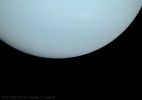
Z-Despina.jpgDespina transiting Neptune (Credits: NASA/JPL - Voyager 2 Mission; Credits for the additional process.: "zelario12" - https://creativecommons.org/licenses/by-sa/2.0/deed.en)135 visiteImmagine molto "datata", ma sempre molto bella ed ottimamente elaborata da tale "zelario12", al quale faccio i miei complimenti.MareKromium
|
|