| Risultati della ricerca nelle immagini - "Naked" |

Aeolian_Features-Windstreaks.jpgMagellan Probe: radio image of Windstreaks131 visiteUn'immagine decisamente chiara e relativa a quel fenomeno che viene chiamato 'wind streaking' e che ci indica, fra l'altro, la direzione usuale dei venti e la capacità di resistenza che i rilievi oppongono ad essi.
|
|

Craters-Adivar_Crater-0.jpgMagellan Probe: radio image of Adivar Crater137 visiteLa missione che ha ci dato, sino ad ora, i maggiori (e migliori) risultati in termini di mappatura della superficie del Pianeta - operando con l'ausilio di uno speciale strumento radar (il SAR e cioè il Synthetic Aperture Radar) - è stata la Missione Magellano.
Il lancio della Navicella avvenne il 4 Maggio 1989 e l'arrivo su Venere, con inserimento della stessa in un'orbita ellittica definita "presso/circa-polare" (near-polar elliptical orbit), occorse il 10 Agosto 1990.
La mappatura radar di Venere fu, come testimoniano ampiamente le immagini che Vi proponiamo, un grande successo.
|
|

Craters-Balch_Crater-0.jpgMagellan Probe: radio image of Balch Crater120 visiteI risultati di tutte queste analisi e studi ci dicono che Venere NON mostra segni di attività tettonica (che sia almeno in parte assimilabile a quella esistente sulla Terra) in corso.
Oltre l'85% della superficie del Pianeta è ricoperta da uno strato di lava (o, comunque, da prodotti derivanti da eventi vulcanici) mentre il 15% residuo è costituito da cinture montuose altamente irregolari ("highly deformed mountain belts", si legge nel rapporto finale).
|
|

Craters-Fossey_Crater-PCF-LXTT-00.jpgMagellan Probe: radio image of Fossey Crater128 visiteNonostante l'elevata temperatura media superficiale (circa 475°C) e la pressione, anch'essa molto alta (in media 92 bars), la totale mancanza di acqua rende i processi erosivi estremamente lenti.
Ne consegue che le caratteristiche superficiali del Pianeta restano sostanzialmente inalterate per milioni di anni salva l'esistenza, in alcune zone, di curiose striature del terreno determinate, probabilmente, da venti (wind streaks) o da getti di materiale (polveri e massi) a seguito del verificarsi di impatti meteorici (dust streaks).
|
|

Craters-Geopert_Crater-PIA00269.jpgMagellan Probe: radio image of Geopert-Meyer Impact Crater73 visiteCaption NASA originale:"During the third global cycle of Magellan's radar mapping mission, images were obtained at viewing angles that were slightly different than those used in the first two cycles. This strategy was designed to produce stereo image pairs, which take advantage of distortions induced by the different views to provide details of the surface topography. This is a stereo image pair of Crater Geopert-Meyer, named for the 20th Century Polish physicist and Nobel laureate (60° north latitude; 26,5° east longitude). The Crater, 35 Km (22 miles) in diameter, lies above an escarpment at the edge of a ridge belt in southern Ishtar Terra. West of the crater the scarp has more than 1 Km of relief. Perception of relief may be obtained with stereo glasses or a stereoscope".
|
|
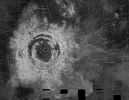
Craters-Mona_Lisa_Crater-PCF-LXTT-00.jpgMagellan Probe: radio image of Mona Lisa Crater112 visiteL'età media della superficie di Venere è di circa 500 milioni di anni ed una delle domande più interessanti attiene la causa dell'attuale aspetto della superficie del Pianeta (una "lastra di lava").
Forse una serie ravvicinata di eventi cataclismici occorsi, appunto, circa 500 milioni di anni fa i quali hanno causato l'esplosione simultanea di migliaia di vulcani (con conseguenze catastrofiche evidenti) oppure l'effetto di lenti, ma costanti e lunghissimi, processi di accumulo e deposito di materiali eiettati dagli innumerevoli vulcani che tutt'ora costellano - ed illuminano - la superficie del Pianeta?
|
|

Craters-Wanda_Crater-PIA00250.jpgMagellan Probe: radio image of "Wanda" Impact Crater in Akna Montes92 visiteCaption NASA originale:"This Magellan full-resolution image show the northern part of the Akna Montes. The Akna range is a North-South trending ridge belt that forms the western border of the elevated smooth plateau of Lakshmi Planum. The Lakshmi plateau plains are formed by extensive volcanic eruptions and are bounded by mountain chains on all sides. The plains appear to be deformed near the mountains. This suggests that some of the mountain building activity occurred after the plains formed. An impact crater (Official International Astronomical Union name 'Wanda,' mapped first by the Soviet Venera 15/16 mission in 1984 at LR) with a diameter of 22 Km was formed by the impact of an asteroid in the Akna mountains. The crater has a rugged central peak and a smooth radar-dark floor, probably volcanic material. The crater does not appear to be much deformed by later crustal movement that uplifted the mountains and crumpled the plains".
|
|

Lakhshmi_Planum-PIA00249.jpgMagellan Probe: radio image of Lakhsmi Planum and Danu Montes78 visiteCaption NASA originale:"Southwest Lakshmi Planum is bounded on the south by the Danu Montes. Lakshmi Planum is an elevated plateau that is bounded on all sides by mountain chains. Here, the Danu mountains have an angular fractured appearance. Chasms slice diagonally across the mountains in the lower left (southwest) corner of the image. Because of the steep slopes and the local relief of the mountains of several kilometers, these fault-bounded troughs appear to zig-zag through the mountains when, in fact, they are probably straight if viewed from above. The radar view provides a perspective that would place the viewer's eye to the right, 27° above the horizon. Thus, slopes facing to the right can be seen completely, though dark, and slopes facing away to the left appear shortened, often seen only as thin bright lines. In the center of the image is a low volcanic dome 20 Km in diameter. This type of volcanic feature frequently occurs on the low plains. This dome on the edge of Lakshmi is deformed and faulted where it has been affected by the forces that created the Danu mountains".
|
|

Landslides-Navka_Region-PIA00262.jpgMagellan Probe: radio image of Landslides in Navka Region80 visiteCaption NASA originale:"The Magellan spacecraft has observed remnant landslide deposits apparently resulting from the collapse of volcanic structures. This Magellan radar image is centered about 25,4° south latitude and 308° east longitude in the southwestern Navka Region of Venus. The image shows a 17,4 Km (approx. 10,8 mile) diameter volcanic dome on the plains. The dome is approximately 1,86 Km (approx. 1,2 mile) in height and it has a slope of about 23°. The northwest and northeast flanks of the dome have collapsed to form landslides that have deposited debris on the plains. The image shows an area 110 Km (approx. 68 miles) across and 100 Km (approx. 62 miles) in length".
|
|

Montes-Akna_Montes_-_Magellan.jpgMagellan Probe: radio image of Akna Montes120 visiteOltre il 98% della superficie del Pianeta venne ripresa con immagini ad altissima risoluzione (nell'ordine dei + o - 100 metri) e svariate aree vennero inquadrate più volte.
Furono scattate 4225 immagine SAR e, per gli amanti della tecnologia spaziale, possiamo dire che ogni orbita tipica (regolare) della Navicella copriva un'area (di Venere) lunga circa 17.000 Km e larga 20.
|
|

Volcanic_Features-_Volcanic_Domes_in_Tinantin_Planitia.jpgMagellan Probe: radio image of Volcanic Domes in Tinatin Planitia138 visiteTra le altre cause della perdita del contatto radio possiamo anche includere l'impatto della Navicella con un "corpo vagante" o magari il verificarsi di un repentino mutamento nell'orbita di Magellano causato da un fenomeno di influenza gravitazionale (p.e.: un altro corpo celeste che transita in prossimità della Navicella e la "spinge" fuori dalla propria orbita).
Forse la Sonda si è "rotta" o forse essa ha, semplicemente, esaurito la propria "energia vitale" e si è spenta per sempre: ognuno può pensare quello che vuole e, anche se la verità non la sapremo mai, i risultati del lavoro di Magellano, qualunque sia stata la causa della sua fine, renderanno questa Sonda, comunque, degna di una memoria immortale.
|
|

Volcanoes-Ammavaru.jpgMagellan Probe: radio image of Ammavaru Volcano & surroundings126 visiteGli scopi di Magellano consistevano, sommariamente, nella tracciatura di un modello relativo all'interno di Venere, nonchè nell'effettuazione di una serie di osservazioni di supporto allo studio della tettonica di Venere, nonchè delle sue vere e proprie forme esteriori, ivi inclusi i processi di superficie susseguenti ad impatti, erosioni, depositi ed altre reazioni chimiche.
|
|
| 16 immagini su 2 pagina(e) |
1 |
|





