| Risultati della ricerca nelle immagini - "NPLD" |

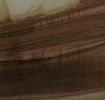
ESP_018482_2790_RED_abrowse-00.jpgNorth Polar Layered Deposits (CTX Frame - Natural Colors; credits for the additional process. and color.: Dr Paolo C. Fienga - Lunexit Team)70 visiteThe North Polar Layered Deposits (NPLD) are layers of dusty ice up to 3 Km (a little less than 2 miles) thick and approx. 1000 Km (about 620 miles) in diameter. We can see the Layers exposed on the Walls of Troughs and Scarps cut into the Deposits, such as the Trough Wall imaged here.
The bright region at the top is the flat surface above the Trough Wall; it is higher than the Terrain underneath. The wall exposing these Layers has a vertical relief of about 600 meters (1970 feet).
It is thought that the NPLD likely formed recently (however millions of years ago...) as rhythmic variations in Mars' orbit changed the distribution of Water Ice around the Planet. As ice moved to and from the Polar Region in response to a changing climate, Layers of Ice and Dust built up at the Poles. By studying the history of these Deposits, we hope to understand how the Martian climate has changed. This is similar to terrestrial scientists studying ice cores from Antarctica and Greenland to understand how Earth's climate has changed in the last tens of thousands of years.
Three things are immediately apparent about the Layers exposed on this Trough Face. First, individual Layers have different Surface Textures. Some scientists think that changing Surface Textures reflect changing physical properties (such as dust content or ice grain size) of the underlying Layer, and looking for patterns in the sequence of Layer Textures can tell us about patterns in the climate in which a Layer formed.
Second, there are several Unconformities, or places where one Layer is interrupted and overlain by another Layer. These Unconformities are due to periods where Layers were eroded or removed, followed by times when new Layers were deposited. Mapping the locations of Unconformities can tell us how the Deposit shrank and grew over time, and tell us where large changes in climate occurred, causing water ice to be removed from the Polar Regions.
Finally, the dark and bright Streaks are due to recent Winds blowing Surface Frost around, and can tell us about wind patterns in the current polar climate.MareKromium
|
|
ESP_018482_2790_RED_abrowse-01.jpgNorth Polar Layered Deposits (EDM - Natural Colors; credits for the additional process. and color.: Dr Paolo C. Fienga - Lunexit Team)86 visiteMareKromium
|
|

ESP_019193_2665_RED_abrowse.jpgExposed NPLD (Absolute Natural Colors; credits for the additional process. and color.: Dr Paolo C. Fienga - Lunexit Team)80 visitenessun commentoMareKromium
|
|

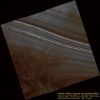
North_Polar_Features-Layers-PIA18238-PCF-LXTT-IPF.jpgNorth Polar Layers with "Unconformities" (Absolute Natural Colors; credits for the additional process. and color.: Dr Paolo C. Fienga/Lunar Explorer Italia/Italian Planetary Foundation)111 visiteIn this VIS image, taken by the NASA - Mars Odyssey Orbiter on March, 3rd, 2014, and during its 54.206th orbit around the Red Planet, we can see a small portion of the so-called North Polar Layered Deposits (or "NPLD", for short), which - according to the data collected so far and duly examined by Planetary Scientists - are (mostly) made of Water-Ice.
Latitude (centered): 79,8759° North
Longitude (centered): 339,4930° East
Instrument: VIS
This image (which is a crop taken from an Original Mars Odyssey Orbiter b/w and Map-Projected frame published on the NASA - Planetary Photojournal with the ID n. PIA 18240) has been additionally processed, magnified to aid the visibility of the details, contrast enhanced, Gamma corrected and then colorized in Absolute Natural Colors (such as the colors that a human eye would actually perceive if someone were onboard the NASA - Mars Odyssey Orbiter and then looked down, towards the Surface of Mars), by using an original technique created - and, in time, dramatically improved - by the Lunar Explorer Italia Team.MareKromium
|
|
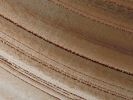
North_Polar_Layered_Deposits-PIA12997.jpgNorth Polar Layered Deposits (Natural Colors; credits for the additional process. and color.: Dr Paolo C. Fienga - Lunexit Team)77 visiteThe Martian North Polar Layered Deposits (NPLD) are an ice sheet much like the Greenland ice sheet on the Earth. Just as with the ice sheet in Greenland this Martian ice sheet contains many layers that record variations in the Martian Climate. Sometimes icy layers can be ablated away during warm climates. Later the ice sheet can be buried by new ice layers and grow in size again. It's likely that many of these cycles have occurred over the ice sheet's history.
The High Resolution Imaging Science Experiment (HiRISE) camera on NASA's Mars Reconnaissance Orbiter recorded this image of NPLD on March 11, 2010. The target for this observation was a suggestion submitted by Greg Clements through the camera team's HiWish public-suggestion program. For more information about how to submit target suggestions, see http://uahirise.org/hiwish/.
Fluctuations in the thickness of the ice sheet are most pronounced at the edges of the sheet, where this HiRISE image was taken. The ice sheet ends here in a gentle scarp that slopes about 8° downhill from bottom to top in this image. The layering within the ice is exposed on this Sloping Surface. The thickness of the ice here is about 1 Km (approx. 3300 feet). Scientists are analyzing these layers to see what information they might hold regarding previous Martian Climates.
This image covers a swath of ground about 1 Km (approx. two-thirds of a mile) wide.
It is a portion of HiRISE observation ESP_016973_2595, which is centered at 79,30° North Latitude and 351,46° East Longitude.
The season on Mars is Northern-Hemisphere Spring.MareKromium
|
|
North_Polar_Layers-PSP_001332_2620_RED.jpgUnconformity in the North Polar Layered Deposits (Absolute Natural Colors; credits for the additional process. and color.: Dr Paolo C. Fienga - Lunexit Team)78 visitenessun commentoMareKromium
|
|
North_Polar_Layers-Tra_000825_2665_red.jpgNorth Polar Layered Deposits (Absolute Natural Colors; credits for the additional process. and color.: Dr Paolo C. Fienga - Lunexit Team:)75 visitenessun commentoMareKromium
|
|
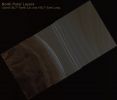
NorthernLayers-TRA_000878_2660_RED.jpgNorth Polar Layered Deposits (Absolute Natural Colors; credits for the additional process. and color.: Dr Paolo C. Fienga - Lunexit Team:)83 visitenessun commentoMareKromium
|
|
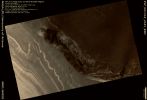
PSP_001334_2645_RED_abrowse-00.jpgNorth Polar Layered Deposits in Head Scarp of Chasma Boreale (CTX Frame - Natural Colors; credits: Lunexit)65 visitenessun commentoMareKromium
|
|
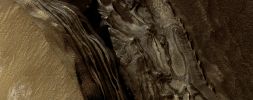
PSP_001334_2645_RED_abrowse-01.jpgNorth Polar Layered Deposits in Head Scarp of Chasma Boreale (EDM - Natural Colors; credits: Lunexit)66 visiteThis EDM shows the NPLD at top and darker materials at bottom exposed in a Scarp at the head of Chasma Boreale, a large canyon eroded into the Layered Deposits.
The Polar Layered Deposits appear of a brown/reddish color because of dust mixed within them, but they are ice-rich as indicated by previous observations. The water ice in the Layered Deposits is probably responsible for the pattern of fractures seen near the top of the scarp.
The darker material below the Layered Deposits may have been deposited as sand dunes, as indicated by the cross-bedding (truncation of curved lines) seen near the middle of the Scarp.
It appears that brighter, ice-rich layers were deposited between the dark dunes in places.
Exposures such as these are useful in understanding the recent climate variations that are likely recorded in the Polar Layered Deposits.MareKromium
|
|
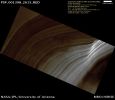
PSP_001398_2615_RED_abrowse.jpgExposure of NPLD with "Unconformities" (Natural - but enhanced - Colors; credits: Dr Paolo C. Fienga - Lunexit Team)100 visiteThis image shows a portion of the North Polar Layered Deposits (NPLD). The NPLD are layers that have been deposited over an extensive area at both Poles, possibly throughout Martian History. They likely contain ice-rich and dust-rich layers, with the darker layers being probably more dust-rich than the bright layers.
The NPLD holds clues to past climate regimes similar to ice cores on Earth. Several of the layers occur in fairly regular sequences, as seen in this image, suggesting that Mars underwent cyclic climate changes in the past.
Towards the top left side of the image, there is a series of layers that appears truncated at an angle, forming what geologists call "Angular Uncomformity". They typically form by first laying down a series of continuous beds. Then erosion cuts through the beds at an angle. Aferwards, a new set of beds are laid over this partially eroded sequence. A similar Unconformity exists at the bottom right of the image.MareKromium
|
|
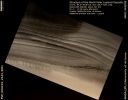
PSP_009293_2645_RED.jpgStructure of the North Polar Layered Deposits (natural colors; credits: Lunexit)64 visiteThe North Polar Layered Deposits on Mars are thought contain a record of global climate changes, similar to ice ages on Earth. This image shows that the geologic history of the NPLD has been complex enough to form angular unconformities.
An angular unconformity represents a gap in the geologic record, where erosion has removed material followed by deposition of more material on the eroded surface. In this image, the angular unconformities are recognized by the truncation, or cutting off of layers, for example right of center and at bottom center.
Also visible in this image are numerous streaks, perhaps caused by recent redistribution of frost by winds.MareKromium
|
|
| 35 immagini su 3 pagina(e) |
1 |
|








