| Risultati della ricerca nelle immagini - "Moons:" |

Europa-PIA01126.jpgEuropa's Lanscape (HR)71 visiteThis mosaic shows some of the highest resolution images obtained by the Solid State Imaging (SSI) System on NASA's Galileo spacecraft during its 11th orbit around Jupiter. North is to the top of the image. The Sun illuminates the scene from the left, showing hundreds of ridges that cut across each other, indicating multiple episodes of ridge formation either by volcanic or tectonic activity within the ice. Also visible in the image are numerous isolated mountains or "massifs". The highest of these, located in the upper right corner and lower center of the mosaic, are approx. 500 mt (about 1.640 feet) high. Irregularly shaped areas where the ice surface appears to be lower than the surrounding plains (e.g., in the left-center and lower left corner of the mosaic) may be related to the "chaos" areas of iceberg-like features seen in earlier SSI images of Europa.
The mosaic, centered at 35,4° North Lat. and 86,8° West Long., covers an area of 108 by 90 Km (about 66 x 55 miles).
The smallest distinguishable features in the image are about 68 meters (223 feet) across. These images were obtained on November 6, 1997, when the Galileo spacecraft was approximately 3,250 kilometers (1,983 miles) from Europa.
|
|

Europa-PIA01401.jpgThe frozen Ocean of Europa77 visiteThis complex area on the side of Europa which faces away from Jupiter shows several types of features that are formed by disruptions of Europa's icy crust. North is to the top of the image, taken by NASA's Galileo spacecraft, and the Sun illuminates the surface from the left. The prominent wide, dark bands are up to 20 Km (about 12 miles) wide and over 50 Km (appx. 30 miles) long. They are believed to have formed when Europa's icy crust fractured, separated and filled in with darker, "dirtier" ice or slush from below. A relatively rare type of feature on Europa is the 15-Km-diameter (about 9,3-mile) impact crater in the lower left corner. The small number of impact craters on Europa's surface is an indication of its relatively young age. A region of chaotic terrain south of this impact crater contains crustal plates which have broken apart and rafted into new positions. Some of these "ice rafts" are nearly 1 Km (about 1/2 a mile) across.
Other regions of chaotic terrain are visible and indicate heating and disruption of Europa's icy crust from below. The youngest features in this scene are the long, narrow cracks in the ice which cut across all other features. One of these cracks is about 30 kilometers (18 miles) to the right of the impact crater and extends for hundreds of miles from the top to the bottom of the image.
|
|

Europa-PIA01970.jpgApproaching Europa65 visiteCaption NASA originale:"View of Europa taken from a range of 2.869.252 Km (such as about 1,6 MMs). The color composite is made from three black and white images taken through the orange, green and violet filters. The 170° Longitude is at the center of the picture; this is the face away from Jupiter. Irregular dark and bright patches on the surface are different from the patterns on the other satellites of Jupiter and those on the Moon, Mars and Mercury. Dark intersecting lines may be faults that break the crust".
|
|
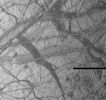
Europa-Ridges-PIA00518.jpgRidges on Europa65 visiteThis view of Jupiter's moon Europa shows a portion of the surface that has been highly disrupted by fractures and ridges. This picture covers an area about 238 Km (approx. 150 miles) wide by 225 Km (about 140 miles); in other words, the distance between Los Angeles and San Diego. Symmetric ridges in the dark bands suggest that the surface crust was separated and filled with darker material, somewhat analogous to spreading centers in the ocean basins of Earth. Although some impact craters are visible, their general absence indicates a youthful surface. The youngest ridges, such as the two features that cross the center of the picture, have central fractures, aligned knobs, and irregular dark patches. These and other features could indicate cryovolcanism, or processes related to eruption of ice and gases.
This picture, centered at 16° South Lat. and 196° West Long., was taken at a distance of 40.973 Km (about 25.290 mi) on November 6, 1996, by the Galileo spacecraft Solid State Imaging Television Camera.
|
|

Jupiter_s System-PIA01481.jpgJupiter's (Main) System86 visiteCaption NASA originale:"Jupiter and its four planet-size moons, called the Galilean Satellites, were photographed in early March by Voyager 1 and assembled into this collage. They are not to scale but are in their relative positions. (...) Nine other much smaller satellites circle Jupiter, one inside Io's orbit and the other millions of miles from the Planet.
Not visible is Jupiter's faint ring of particles, seen for the first time by Voyager 1".
|
|

The Galileans~0.jpgThe "Galileans"69 visiteIo, the large volcanic satellite of Jupiter, was first shown to the World in images transmitted from the Voyager 1 Spacecraft.
Unfortunately their cameras had no red filters and color pictures often had to be extrapolated substituting orange for red and violet for blue.
In the case of Io, this led to a garish 'pizza' appearance with many reproductions of the released images further wandering toward the red until Io looked like tomato soup!
Io is very bright, and largely a pale yellow with gray green to orange regions. Galileo has greatly refined the color information from Io. The albedo of Io (il primo a Sx) is a bright 0,6, while Europa (the brightest) is 0,64. Ganymede's albedo is just 0,42 and then - last - the dark Callisto is only 0,2.
|
|
|
|
| 6 immagini su 1 pagina(e) |
|








