| Risultati della ricerca nelle immagini - "Mons" |

APOLLO 15 AS 15-97-13252 HR-1.jpgAS 15-97-13252 - Mons Rümker (HR)122 visitenessun commento
|
|
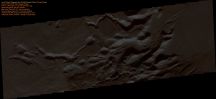
Arsia_Chasmata-PIA13499.jpgArsia Mons Chasmata (Absolute Natural Colors; additional process.: Dr Paolo C. Fienga - Lunexit Team)113 visitenessun commentoMareKromium
|
|

Clouds-Elysium_Mons-20080616a-PCF-LXTT-1.jpgLow altitude Clouds (or maybe "Fumes") from Elysium Mons (Absolute Natural Colors; credits for the additional process. and color.: Dr Paolo C. Fienga - Lunexit Team)74 visitenessun commentoMareKromium
|
|

Collapse_Features-PIA13734.jpgCollapse Features near Alba Mons (Absolute Natural Colors; credits for the additional process. and color.: Dr Paolo C. Fienga - Lunexit Team)112 visitenessun commentoMareKromium
|
|
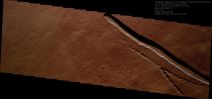
Collapse_Features-PavonisMons-20080306a.jpgChannel on Pavonis Mons (Natural Colors; credits for the additional process. and color.: Dr Paolo C. Fienga - Lunexit Team)80 visitenessun commentoMareKromium
|
|

ESP_011664_2015_RED_abrowse-00.jpgAt the base of Olympus Mons... (ctx frame - Natural Colors; credits: Lunar Explorer Italia)70 visiteThis image is located at the foot of the largest volcano of the Solar System: Olympus Mons.
The entire scene is covered with a multitude of Lava Flows. Most of the Flows consisted of relatively sticky lava that froze after flowing for only a short distance (often less than 1 Km, or about 1/2 a mile). However, a few of the Flows were more fluid and actually drained out of their Channels, leaving Troughs with distinct levees. These “Channelized” Flows extend out of the HiRISE image so they must be at least several kilometers (a few miles) long.
In all likelihood, both the short and long Lava Flows have very similar chemical compositions.
Based on experience with Lava Flows on Earth, the Channelized Flows were probably fed by more vigorous eruptions. That is, the Lava Flow was fed so quickly that the lava traveled a long distance before it solidified. With the shorter flows, a slow dribble of lava froze before going more than the equivalent of a few city blocks.MareKromium
|
|

ESP_011664_2015_RED_abrowse-01.jpgAt the base of Olympus Mons... (edm - Natural Colors; credits: Lunar Explorer Italia)71 visiteThe Ridge with 2 Knobs in the center of this edm is of special interest. The Lava Flows radiate away from these Knobs, indicating that the Flows were fed from these points. However, based on experience with the current eruption of Kilauea Volcano in Hawaii, it seems that these Vents were fed by a Lava Tube.
Thus the magma first reached the Surface some distance away, then was transported through a Tube to this location. A blockage in the Tube would force the lava to burst out and erupt onto the Surface.MareKromium
|
|
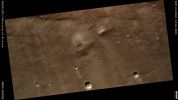
ESP_012692_1810_RED_abrowse.jpgThe "Dusty" Summit of Pavonis Mons (Natural Colors; credits: Lunar Explorer Italia)68 visitePavonis Mons is one of the 3 giant Tharsis Montes Shield Volcanoes. Its Summit rises so far above the Surface that the Atmosphere is extremely thin, even for Mars.
Dust that reaches these heights (for example, during major Dust Storms) is hard to remove, so the upper parts of these Volcanoes are covered by vast deposits of dust. The dust is moved a little by the thin winds, producing ripples and other textures near the limit of HiRISE’s resolution. The fluffy, ripply surface looks “smudged” or out of focus, but by looking at some of the small impact craters you can see that the HiRISE camera is, indeed, properly focused. It’s the surface of Mars that is blurry!
Nota Lunexit: NO. A nostro parere NON è la Superficie di Marte che è "sfuocata" (blurry) e non è neppure la fotocamera dell'Orbiter che è "out of focus". Si tratta, come abbiamo già visto in passato (nelle immagini dei fly-by ravvicinati di alcune Lune Saturniane - Encelado su tutte) di un caso classico di "Sfuocatura da Movimento" (in altre parole: è un mero problema di lunghezza dell'esposizione - ivi: eccessiva -, data la vicinanza del target ripreso in rapporto alla velocità dell'Orbiter rispetto al medesimo). Curioso che i Ragazzi di Pasadena non ci abbiano pensato...
The impact craters also show that the dust is not a thin veneer. Instead, it is a thick coat, at least several meters deep. This mantling of dust hides the details of the Lava Flows and Vents, frustrating volcanologists but delighting those who study dust.
Mars Local Time: 15:23 (early afternoon)
Coord. (centered): 0,9° North Lat. and 246,8° East Long.
Spacecraft altitude: 254,1 Km (such as about 158,8 miles)
Original image scale range: 50,8 cm/pixel (with 1 x 1 binning) so objects ~1,53 mt across are resolved
Map projected scale: 50 cm/pixel
Map projection: EQUIRECTANGULAR
Emission Angle: 2,5°
Phase Angle: 52,4°
Solar Incidence Angle: 55° (meaning that the Sun is about 35° above the Local Horizon)
Solar Longitude: 244,7° (Northern Autumn)
Credits: NASA/JPL/University of Arizona
Additional process. and coloring: Lunar Explorer ItaliaMareKromium
|
|
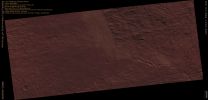
ESP_017888_1950_RED_abrowse.jpgOlympus' Lava Flows (Extremely Enhanced Natural Colors; credits for the additional process. and color.: Dr Paolo C. Fienga - Lunexit Team)86 visiteThe flanks of Olympus Mons are covered with Lava Flows (one on top of the other) Most of these Flows are relatively narrow, with a channel running down the middle. They appear similar to the Lava Flows found on Mt. Etna in Sicily (Italy).
However, in this image, we see these typical Flows partially covered by another, more recent one. This last one also shows a Central Channel, and it is about 10 times wider than the more typical Lava Flows. At the center of the HiRISE image the Channel disappears.
This is probably because the Channel was blocked here and Lava spilled out of it and covered a broad, fan-shaped, area. The eruption that produced this unusual flow was probably more vigorous and perhaps lasted longer than the more common ones.MareKromium
|
|
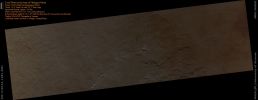
ESP_018534_1985_RED_abrowse-PCF-LXTT1.jpgLava Flows at the base of Olympus Mons (Absolute Natural Colors; credits for the additional process. and color.: Dr Paolo C. Fienga - Lunexit Team)117 visitenessun commentoMareKromium
|
|
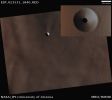
ESP_023531_1840-00.jpgSkylight on the Dusty Slopes of Arsia Mons (CTX Frame and EDM - Absolute Natural Colors; credits for the additional process. and color.: Dr Paolo C. Fienga - Lunexit Team)235 visiteMars Local Time: 14:08 (Early Afternoon)
Coord. (centered): 3,7° North Lat. and 248,5° East Long.
Spacecraft altitude: 263 Km (such as about 164,4 miles)
Original image scale range: 26,3 cm/pixel (with 1 x 1 binning) so objects ~ 79 cm across are resolved
Map projected scale: 25 cm/pixel
Map projection: EQUIRECTANGULAR
Emission Angle: 4,1°
Sun-Mars-Spacecraft (or "Phase") Angle: 30,4°
Solar Incidence Angle: 34° (meaning that the Sun is about 56° above the Local Horizon)
Solar Longitude: 339,1° (Northern Winter)
Credits: NASA/JPL/University of Arizona
Additional process. and coloring: Dr Paolo C. Fienga - Lunar Explorer ItaliaMareKromium
|
|
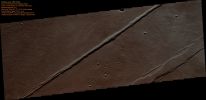
Graben-Alba_Mons-PIA13464-1.jpgGraben (CTX Frame - Absolute Natural Colors; additional process.: Dr Paolo C. Fienga - Lunexit Team)110 visitenessun commentoMareKromium
|
|
| 118 immagini su 10 pagina(e) |
1 |
 |
|
|
|
|
|
|
|








