| Risultati della ricerca nelle immagini - "Model" |

032-Mars_Interior.jpgWhat's inside Mars?173 visiteMars interior is simply modeled as a core and mantle with a thin crust, similar to Earth. Mars' size and total mass are known. Given four parameters, the core size and mass and mantle size and mass can be determined.
The combination of Pathfinder Doppler data with earlier data from the Viking Landers has determined a very important parameter, the "Moment of Inertia", through measurement of Mars' precession rate. A fourth measurement is needed to complete the interior model. This may be achieved through future Doppler tracking of Pathfinder, since the presence of a fluid core may be detectable through its effect on Mars' nutation. The determination of the moment of inertia is a significant constraint on possible models for Mars' interior. If the core is as dense as possible (i.e. completely iron) and the mantle is similar to Earth's (or similar to the SNC meteorites thought to originate on Mars) then the minimum core radius is about 1300 Km. If the core is made of less-dense material (i.e. a mixture of iron and sulfur) than the core radius is probably no more than 2000 Km.
|
|

033-Mars_Rotation.jpgMars' Rotation and Orbit Dynamics129 visiteMars rotation around its pole causes a signature in the data with a daily minimum, when the Lander is closest to the Earth. Changes in such a daily signature may reveal information about the interior of Mars, through its effect on Mars' precession and nutation.
The signature is also sensitive to variations in Mars' Rotation Rate, as the mass of the atmosphere increases and decreases along with the Polar Caps increase and decrease (obviously the Polar Caps increase during the Martian Fall and Winter and then, due to the higher heating of the Planet - and subsequent evaporation phoenomena - they decrease in Spring and Summer).
Long term signatures in the range to the Lander are caused by asteroids perturbing Mars' orbit; an analysis of these perturbations may allow us to also determinate the masses of these asteroids.
|
|

Controversial_Features-The_Villa-AB108405-SF-03.JPGUnusual Squared Structure on Mars (4)69 visiteMa lasciamo ora che sia il Dr Mc Cann a dirci la sua:"...This image (si riferisce al frame precedente) shows a sheer cliff with a very large ledge in its midst. On that ledge is a large two story structure, the first floor walls of which are facing camera and in shadow. The second floor is a well defined SQUARE and is turned at a precise 45° angle to the first floor. CENTERED in the midst of the roof of that squared second floor is an abrupt, sharp circle..a "landing pad" as for helicopters atop tall buildings and on decks of ships. UP and to the RIGHT of the building structure there is a culvert/conduit or PIPE with an open top which comes forth out of the upper cliff face. There is a fluid streaming from the end of the "U" shaped pipe and is blurred as it falls down to the ledge. The fluid hits the ledge and erodes a wavy channel to the edge of that ledge and then cascades down the lower cliff face to disperse in a deltaic pattern on a talus cone..." (continua)
|
|

Japetus-temp.1-PIA07006_modest.jpgJapetus Temperature Variation Map54 visiteCaption NASA originale:"This plot shows how daytime temp.s at low latitudes on the Dark Material on Japetus vary with time of day from about 130 Kelvin (-226 F) at noon to about 70 Kelvin (-334 F) at sunset. The observations are compared to a "forecast" model (green line) which predicts temperatures based on an assumed value of a parameter called the "thermal inertia. Rock or solid ice has a high thermal inertia (approx. 2.000.000 as measured in the obscure units used for thermal inertia), meaning that it is good at storing heat and cools down or heats up relatively slowly. On Japetus, in contrast, temperatures drop precipitously in the afternoon as the Sun sinks towards the horizon and a very small value of the thermal inertia (30.000 units) is needed in the model to match the data. This means that Japetus's surface is extremely bad at storing heat and is thus extremely fluffy, probably due to the pulverizing effect of billions of years of meteorite impacts (...)".
|
|
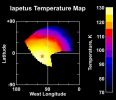
Japetus-temp.2-PIA07005_modest.jpgJapetus Temperature Map53 visiteCaption NASA originale:"Temperatures reach nearly 130 Kelvin (-226 F) at noon on the equator on the dark material that covers most of this side of Japetus, making high noon on Japetus's dark side probably the warmest place in the Saturn System. This is much warmer than temperatures on the moon Phoebe - as measured by the composite infrared spectrometer in June 2004 - which peaked near 112 Kelvin (-258 F). That's because, although Phoebe is almost as dark as Japetus's dark material and absorbs nearly as much sunlight, Phoebe rotates much more quickly (once every 9 hours, compared to 79 days for Japetus). That means the surface has less time to heat up during the day. Temperatures on Japetus' bright material are much colder, peaking near 100 Kelvin (-280 F), both because the bright material absorbs less sunlight and because it is further from the equator on this side of Japetus".
|
|
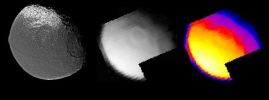
Japetus-temp.3-PIA07004_modest.jpgJapetus Thermal Radiation Image54 visiteCaption NASA originale:"This image of the infrared heat radiation from Saturn's moon Japetus was obtained by the Cassini composite infrared spectrometer instrument 16 hours before Cassini's closest approach to this mysterious moon, on December 31, 2004. The thermal radiation is shown as both a grayscale image, equivalent to what we would see if our eyes were sensitive to infrared wavelengths near 15 microns and as a color-coded temperature map. A previously-released mosaic obtained by Cassini's imaging camera shortly before the composite infrared spectrometer observation, with similar scale and orientation, is also shown for comparison. Temperatures in the large crater near the center of the disc are slightly different from those in surrounding areas, because sloping surfaces within the crater are warmer where they are tilted towards the Sun and cooler when tilted away from the Sun".
|
|
|
|
| 6 immagini su 1 pagina(e) |
|





