| Risultati della ricerca nelle immagini - "Mid-Latitudes" |

ESP_011527_1325_RED_abrowse.jpgSouthern Dunes and Volatiles (Natural Colors; credits: Lunar Explorer Italia)70 visitenessun commentoMareKromium
|
|

ESP_013557_1245_RED_abrowse-01.jpgThe "Argyre Lineae" and the "Lineae" seen on the Jovian moon "Europa": a comparison (CTX-Frame - image-mosaic by Lunexit)74 visitePer il momento, il nostro parallelo è solo un azzardo, giustificato - si fa per dire... - dalla notevole somiglianza esistente fra le linee che caratterizzano la Superficie della Luna Gioviana "Europa" (pensate, ad esempio, alla "Minos Linea" - in basso a Dx - che la NASA stessa ritiene essere la "Prova Geologica" dell'esistenza di un Oceano Sotterraneo - liquido! - situato ad un centinaio di Km di profondità) e queste "linee" che caratterizzano il Terreno Marziano intorno alla Latitudine 55° Sud. e 32° Est - Regione della Pianura di Argyre, a circa 2° di Lat. di distanza dal Distretto Montuoso di Charitum (il quale costituisce, nella sua interezza, il margine - Rim - Sud del Bacino di Argyre).
Certo, la NASA dice che queste "Linee Marziane" sono i soliti segni lasciati dal transito dei Dust Devils ma, se osservate con attenzione, potreste notare che esistono - invece - delle nette ed indubitabili differenze fra queste "Linee di Argyre" ed i DD-Tracks.
(nota: la definizione di questi segni della Superficie Marziana come "Argyre Lineae" è stata operata da Lunexit e non dalla NASA)MareKromium
|
|
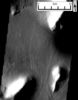
Islands.jpgThe Islands of Mars (Original NASA-2001 Mars Odyssey Orbiter b/w Frame)93 visiteNew HR images of mid-latitude Mars are revealing glacier-formed landscapes far from the Martian Poles, says a leading Mars Researcher.
Conspicuous trains of debris in valleys, arcs of debris on steep slopes and other features far from the polar ice caps bear striking similarities to glacial landscapes of Earth, says Brown University's James Head III. When combined with the latest climate models and orbital calculation for Mars, the geological features make a compelling case for Mars having ongoing climate shifts that allow ice to leave the poles and accumulate at lower latitudes.
"The exciting thing is a real convergence of these things, said Head, who will present the latest Mars climate discoveries on Sunday, 16 October, at the Annual Meeting of the Geological Society of America in Salt Lake City (Utah). "For decades people have been saying that deposits at mid and equatorial latitudes look like they are ice-created, said Head. But without better images, elevation data and some way of explaining it, ice outside of Mars' polar regions was a hard sell.
Now high-resolution images from the Mars Odyssey spacecraft's Thermal Emission Imaging System combined with images from the Mars Global Surveyor spacecraft's Mars Orbiter Camera and Mars Orbiter Laser Altimeter can be compared directly with glacier features in mountain and polar regions of Earth. The likenesses are hard to ignore.
For instance, consider what Head calls "lineated valley fill." These are lines of debris on valley floors that run downhill and parallel to the valley walls, as if they mark some sort of past flow. The same sorts of lines of debris are seen in aerial images of Earth glaciers. The difference is that on Mars the water ice sublimes away (goes directly from solid ice to gas, without any liquid phase between) and leaves the debris lines intact. On Earth the lines of debris are usually washed away as a glacier melts.
|
|
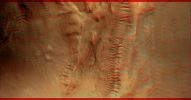
PSP_004085_1420_PSP_004019_1420_RED_browse.jpgMultiple Levels of Gullies (3D and possible True Colors; credits: NASA and Lunar Explorer Italia)80 visiteThis image shows groups of gullies at different elevations on the same crater wall. Although gullies are common in the mid-latitudes of Mars, they are rarely found to exist at such distinct elevations as visible here.
The mounds on the floor, one of which contains gullies, probably formed during a late stage of crater formation. Both levels of gullies appear to originate at layers. These layers might be ice-rich, or they might be capable of conducting water to the surface. The anaglyph image, providing a three-dimensional perspective, reveals the relative depth of the gullies in the crater walls and amount of alluvial material deposited at the bottom of the gullies.
The gullies visible here are good candidates for formation by subsurface water, as opposed to melting ice or snow originating on the surface. The rounded, theater-shaped alcove and tributary heads are typical of features formed by groundwater sapping on Earth. Surface runoff does not form this morphology.
This image contains possible evidence of subsurface piping, when soil pores connect to form a "pipe" that transports water. When piping occurs, water carries soil with it, leaving empty space beneath the surface. As this process continues, the overlying surface can no longer support itself, and it collapses to form a depression. Several depressions that could have formed this way are seen in this image. The depressions are also directly upslope of more developed alcoves. They also originate at upslope layers, and might be examples of developing alcoves.
Mars Local Time: 15:21 (early afternoon)
Coord. (centered): 37,9° South Lat. and 169,6° East Long.
Spacecraft altitude: 268,5 Km (such as about 167,8 miles)
Original image scale range: 26,9 cm/pixel (with 1 x 1 binning) so objects ~81 cm across are resolved
Map projected scale: 25 cm/pixel
Map projection: EQUIRECTANGULAR
Emission Angle: 20,6°
Phase Angle: 24,7°
Solar Incidence Angle: 45° (meaning that the Sun is about 45° above the Local Horizon)
Solar Longitude: 255,0° (Northern Autumn)
Credits: NASA/JPL/University of Arizona
Additional process. and coloring: Lunar Explorer ItaliaMareKromium
|
|

PSP_009334_2275_RED.jpgThermophysical Boundary (possible True Colors; credits: Lunar Explorer Italia)75 visiteMars Local Time: 15:14 (early afternoon)
Coord. (centered): 47,0° North Lat. and 118,4° East Long.
Spacecraft altitude: 304,8 Km (such as about 190,5 miles)
Original image scale range: 30,5 cm/pixel (with 1 x 1 binning) so objects ~61 cm across are resolved
Map projected scale: 25 cm/pixel
Map projection: EQUIRECTANGULAR
Emission Angle: 0,4°
Phase Angle: 44,5°
Solar Incidence Angle: 44° (meaning that the Sun is about 46° above the Local Horizon)
Solar Longitude: 102,7° (Northern Summer)
Credits: NASA/JPL/University of Arizona
Additional process. and coloring: Lunar Explorer ItaliaMareKromium
|
|

Psp_009492_3080_red.jpgNorthern Surface (possible True Colors; credits: Lunar Explorer Italia)81 visiteMars Local Time: 15:41 (middle afternoon)
Coord. (centered): 51,8° North Lat. and 304,8° East Long.
Spacecraft altitude: 304,5 Km (such as about 190,3 miles)
Original image scale range: 121,8 cm/pixel (with 1 x 1 binning) so objects ~3,66 mt across are resolved
Map projected scale: 1 mt/pixel
Map projection: EQUIRECTANGULAR
Emission Angle: 0,3°
Phase Angle: 90,0°
Solar Incidence Angle: 90° (meaning that the Sun is about 0° above the Local Horizon)
Solar Longitude: 108,3° (Northern Summer)
Credits: NASA/JPL/University of Arizona
Additional process. and coloring: Lunar Explorer ItaliaMareKromium
|
|
|
|
| 6 immagini su 1 pagina(e) |
|








