
ZZ-Mercury-Craters-Mena_Crater-PIA15202-PCF-LXTT-IPF-00.jpgMena Crater, in context (Possible Absolute Natural Colors; credits for the additional process. and color.: Dr Paolo C. Fienga/Lunar Explorer Italia/Italian Planetary Foundation)58 visiteThe (relatively) young Rays of Mena Crater (approx. 15 Km - such as about 9,315 miles - in diameter) contrast brightly against the surrounding Mercurian Surface, though these beautiful and colorful Rays will gradually fade, and disappear, with time (Eons, in fact).
Furthermore, the asymmetric pattern of the Rays themselves, with an obvious gap in their South-Western direction, may be due to the angle at which the Impact that formed the Crater occurred or, maybe, it can also be due to the circumstance that Mena Crater formed on a very uneven Surface, such as just right on top of the Outer Rim of a larger, pre-existing, Impact Crater, as it can well be seen in this contextual image-mosaic. We, as IPF, believe that the second scenario which was mentioned herebefore is quite more plausible than the first one (even though a combination of the two scenarios/factors cannot be excluded).
Date acquired: November, 12th, 2011
Images Mission Elapsed Time (MET): 229581348, 229581352, 229581356
Images ID: 1003074, 1003075, 1003076
Instrument: Wide Angle Camera (WAC) of the Mercury Dual Imaging System (MDIS)
Center Latitude: 0,97° South
Center Longitude: 234,00° East
Solar Incidence Angle: 29,7° (meaning that the Sun, at the time that the picture was taken, was about 60,3° above the imaged Local Mercurian Horizon)
Emission Angle: 16,3°
Sun-Mercury-Messenger (or "Phase") Angle: 46,0°
This frame (which is an Original NASA - MESSENGER Spacecraft's false colors and Map-Projected image-mosaic published on the NASA - Planetary Photojournal with the ID n. PIA 15202) has been additionally processed, contrast enhanced, magnified to aid the visibility of the details, Gamma corrected and then re-colorized in Absolute Natural Colors (such as the colors that a human eye would actually perceive if someone were onboard the NASA - MESSENGER Spacecraft and then looked down, towards the Western Edge of the Mercurian Impact Crater "Mena"), by using an original technique created - and, in time, dramatically improved - by the Lunar Explorer Italia Team. Different colors, as well as different shades of the same color, mean, among other things, the existence of different Elements (Minerals) present on the Surface of Mercury, each having a different Albedo (---> Reflectivity) and Chemical Composition.MareKromium
|
|

ZZ-Mercury-Craters-Mena_Crater-PIA17786-PCF-LXTT-IPF-01.jpgMena Crater, in detail (Possible Absolute Natural Colors; credits for the additional process. and color.: Dr Paolo C. Fienga/Lunar Explorer Italia/Italian Planetary Foundation)66 visiteIn this simple, and yet very interesting picture, taken by the NASA - MESSENGER Spacecraft on November, 13, 2013, we can get a relatively close look at the fresh, Bright-Rayed Impact Crater known as Mena (note: due to the distance between the Spacecraft and the Mercurian Surface, the Bright Rays of Mena Crater can just be barely seen in this image).
As you may want to notice, solidified Impact Melt formed some kind of a "Heart-shaped" and smooth Pond that is mostly concentrated on the South/Western Side of the Crater Floor; the quite obvious (---> very clear, easy to see) asymmetry existing between the aforementioned South/Western Side of the Floor and some (actually, a large) portion of its North/Eastern one, is due to the fact that Mena Crater did not form on a Flat Surface, but on the Sloping Rim of a much older Impact Crater (as it will be better seen tomorrow's contextual APOD).
Date acquired: November, 13th, 2013
Image Mission Elapsed Time (MET): 26657614
Image ID: 5189176
Instrument: Narrow Angle Camera (NAC) of the Mercury Dual Imaging System (MDIS)
Center Latitude: 0,24° South
Center Longitude: 235,30° East
Solar Incidence Angle: 54,7° (meaning that the Sun, at the time that the picture was taken, was about 35,3° above the imaged Local Mercurian Horizon)
Emission Angle: 23,4°
Sun-Mercury-Messenger (or "Phase") Angle: 71,0°
This frame (which is an Original NASA - MESSENGER Spacecraft's b/w and NON Map-Projected image published on the NASA - Planetary Photojournal with the ID n. PIA 17786) has been additionally processed, contrast enhanced, magnified to aid the visibility of the details, Gamma corrected and then colorized in Absolute Natural Colors (such as the colors that a human eye would actually perceive if someone were onboard the NASA - MESSENGER Spacecraft and then looked down, towards the Western Edge of the Mercurian Impact Crater "Mena"), by using an original technique created - and, in time, dramatically improved - by the Lunar Explorer Italia Team. Different colors, as well as different shades of the same color, mean, among other things, the existence of different Elements (Minerals) present on the Surface of Mercury, each having a different Albedo (---> Reflectivity) and Chemical Composition.MareKromium
|
|
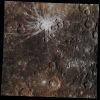
ZZ-Mercury-Craters-Mena_and_Cezanne_Crater-PIA16341-PCF-LXTT-IPF.jpgMena and Cezanne Crater (Absolute Natural Colors; credits for the additional process. and color.: Dr Paolo C. Fienga/Lunar Explorer Italia/Italian Planetary Foundation)68 visiteIn this Image-Mosaic, the Bright Rays of Mena Crater and the distinctive color difference of Cezanne Crater (with the surrounding area) are well highlighted. These two distinctive Impact Features provide beautiful contrast to this Absolute Natural Color image, giving the viewer more insight into reflectance variations (---> Albedoes) on Mercury's Surface. Also note the extremely old, degraded and larger, infilled Unnamed Crater visible on the center right of the frame, which is crossed by at least three major Crater Chains.
Date acquired: June 04, 2012
Image Mission Elapsed Time (MET): 247336883, 247336875, 247336879
Image ID: 1955368, 1955366, 1955367
Instrument: Wide Angle Camera (WAC) of the Mercury Dual Imaging System (MDIS)
WAC filters: 9, 7, 6 (996, 748, 433 nanometers) in red, green, and blue
Center Latitude: 3,78° South
Center Longitude: 235,8° East
Resolution: 552 meters/pixel
Scale: Cezanne Crater, such as the Crater in the bottom center, is about 67 km (approx. 41 miles) in diameter.
Solar Incidence Angle: 55,6° (meaning that the Sun was about 34,4° above the imaged Local Horizon at the time the pictures were taken)
Emission Angle: 0,0° (meaning that the MESSENGER Spacecraft, at the time that the pictures were taken, was absolutely perpendicular to the Mercurian Surface visible in the center of the frame)
Sun-Mercury-MESSENGER (or "Phase") Angle: 55,6°MareKromium
|
|
|





