| Risultati della ricerca nelle immagini - "Meanders" |

ESP_014100_1600_RED_abrowse.jpgPossible Inverted Meanders (Natural - but enhanced - Colors; credits: Lunexit)73 visitenessun commentoMareKromium
|
|

PSP_002840_1855_RED_abrowse-00.jpgMeanders in Nanedi Valles (Natural Colors; credits for the additional process. and color.: Dr Paolo C. Fienga - Lunexit Team)70 visiteThis observation shows a portion of Nanedi Valles, an equatorial Martian valley network.
Valley networks are thought to have formed by groundwater sapping either in conjunction with an ice layer to cover the running water or during a past warmer, wetter climate regime on Mars. Glacial activity has also been proposed to form the valley networks.
Groundwater sapping is the leading theory because of the morphology of the valleys. They commonly have approximately constant width along their reaches, as seen here, as well as theater shaped heads, as seen in the tributary valley in the bottom right of the scene. The meandering nature of valleys suggests persistent or repeated flow as required to form meanders in streams on Earth.
The subimage shows a potential remnant channel seen on the floor of Nanedi Valles just below the center of the image. If this is a remnant channel, it suggests that there was either repeated or waning flows in this valley. Winding dunes and abundant impact craters are found throughout the valley, as well as within this putative channel.
Dunes are thought to be transient features on Mars, although no movement has been detected to date. It is interesting to note that some of the dunes are superposed by craters indicating that the dunes were stable long enough for craters to form and not be erased.
It is possible that the craters on top of the dunes are secondary craters that formed as a product of a larger impact. Secondary craters from a single impact are clustered in space and form almost simultaneously, implying that the dunes were stable for a time period—long enough for a single crater, rather than multiple craters, to form.
MareKromium
|
|
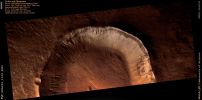
PSP_006261_1410_RED_abrowse.jpgGullies with Meanders (MULTISPECTRUM; credits: Lunexit)73 visiteThis observation features a relatively pristine crater in the Southern Mid-Latitudes. The crater still has a sharp rim on its South end, but it has experienced modification since forming.
The North half of the crater is populated by a large number of gullies that appear to emanate from resistant layers. The layers likely continue around the crater, but the gullies do not. Distinct layers are visible on the South wall of the crater.
It is unknown why gullies form on certain slopes and not others. Interestingly, the gullies themselves are not so pristine. They are covered by dunes and cut by polygonal fractures, indicating that they have been modified by aeolian and periglacial processes, respectively.
There are a large number of boulder tracks visible on the crater walls. Boulder tracks typically are approximately constant in width, and can often be seen at the track ends.
The crater floor has a texture indicative of sublimation processes.
If a soil is ice-rich under Martian conditions, the ice can sublimate causing the ground to collapse and “crinkle” where the ice used to be.
MareKromium
|
|
|
| 3 immagini su 1 pagina(e) |
|








