| Risultati della ricerca nelle immagini - "Mc" |
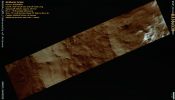
ESP_014324_0955_RED_abrowse.jpgSnow-Streaks on McMurdo Crater (Natural Colors; credits: Lunexit)76 visiteThe SPLD are a stack of ice and dust about 3 Km (a little less than 2 miles) thick. The many layers that make up this feature are of great interest to planetary scientists because, just as with ice sheets on Earth, they are thought to contain a record of the Planet’s climate in previous times.
As with the rest of Mars, impact craters form continuously on these Polar Deposits.
Rarely, a very large impact will occur and the crater will excavate all the way through this ice-sheet to the rocky terrain underneath. This is what happened in the case of McMurdo, a crater roughly 20 Km (about 12,5 miles) across which punched through the ice-sheet in the past.
This HiRISE image shows the wall of this Crater, only half of which has been preserved until current times.
You can see the many layers that comprise the SPLD exposed here.
Scientists study exposures like this to try to understand the length of the climatic record that is recorded in the icy material at the Poles of Mars.MareKromium
|
|
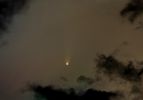
McNaught-00.jpgComet McNaught (1)65 visiteCaption NASA:"Early morning risers with a clear and unobstructed eastern horizon can enjoy the sight of Comet McNaught (C/2006 P1) in dawn skies over the next few days. Discovered in August by R. H. McNaught (Siding Spring Survey) the comet has grown bright enough to see with the unaided eye but will soon be lost in the glare of the Sun. Still, by January 11 sun-staring spacecraft SOHO should be able to offer web-based views as the comet heads toward a perihelion passage inside the orbit of Mercury. This image captures the new naked-eye comet at about 2nd magnitude in twilight skies near sunset on January 3rd. After rounding the Sun and emerging from the solar glare later this month, Comet McNaught could be even brighter".
|
|

McNaught-01.jpgComet McNaught (2)67 visiteCaption NASA:"The brightest comet in decades is unexpectedly now visible. The most optimistic predictions have Comet McNaught (C/2006 P1) shortly becoming one of the brightest comets of the past century. For the next few days, its short tail and bright coma can be spotted with the unaided eye close to the Sun and near the horizon in both evening and morning skies. This dramatic picture of the comet shining through cloudy skies was taken near sunset on January 7, 2007, from Bad Mergentheim, Germany".
|
|

McNaught-02.jpgComet McNaught (3)66 visiteCaption NASA:" Bright Comet McNaught (C/2006 P1) graced the twilight this week, seen by many and often described with superlatives. Watching the skies over Krakow, Poland, Andrzej Sawow recorded this view on Wednesday - with an ordinary handheld digital camera. He notes that "... astronomy is really for everyone who loves to look at the night sky. And fortunately (sometimes) the sky generously rewards its observer". Now very close to the Sun, Comet McNaught (along with Mercury) is visible in realtime images from the SOHO spacecraft. Otherwise, skywatchers will find the comet hard to see this weekend. But southern hemisphere observers could be rewarded next week as Comet McNaught begins to climb higher in southern skies".
|
|

McNaught-03.jpgComet McNaught (4)66 visiteCaption NASA:"This past weekend Comet McNaught peaked at a brightness that surpassed even Venus. Fascinated sky enthusiasts in the Earth's Northern Hemisphere were treated to an instantly visible comet head and a faint elongated tail near sunrise and sunset. Recent brightness estimates had Comet McNaught brighter than magnitude - 5 (minus five) over this past weekend, making it the brightest comet since Comet Ikeya-Seki in 1965, which was recorded at - 7 (minus seven). The Great Comet of 2007 reached its brightest as it rounded the Sun well inside the orbit of Mercury. Over the next week Comet McNaught will begin to fade as it moves south and away from the Sun. The unexpectedly bright comet should remain visible to observers in the Southern Hemisphere with unaided eyes for the rest of January.
The above image, vertically compressed, was taken at sunset last Friday from mountains above Catalonia, Spain".
|
|

McNaught-04.jpgComet McNaught (5)66 visiteCaption NASA:"The brightest comet of recent decades was a surprising first sight for a new camera in space.
The Sun Earth Connection Coronal and Heliospheric Investigation (SECCHI) instrument onboard the Solar TErrestrial RElations Observatory (STEREO) satellite had just opened up on January 11, 2007, when it snapped the above image of Comet McNaught. Visible was a spectacular view of the ion tail of Comet McNaught being swept away from the Sun by the solar wind in filamentary rays. The comet tail is seen to extend at least seven degrees across the above image, while the central coma is so bright it saturates. Comet McNaught is now reportedly so bright that it is visible even in broad daylight by blocking out the Sun with your hand.
Comet McNaught has rounded the Sun and will slowly fade away for observers in Earth's Southern Hemisphere as it recedes from the Sun".
|
|

McNaught-05.jpgComet McNaught (6)78 visiteCaption NASA:"After a remarkable performance in the Northern Hemisphere, the brightest comet in decades is now showing off in the South. Recorded during evening twilight on January 17, 2007, this view features the bright coma and gorgeous, sweeping tail of Comet McNaught (c/2006 P1) over Lake Horowhenua in Levin, a small town on New Zealand's North Island.
Astronomer Noel Munford reports that the five second long digital camera exposure comes close to capturing the visual appearance of the comet in a sky coloured by smoke from distant brush fires in Australia. Discovered last summer by R. H. McNaught (Siding Spring Survey), the comet grew impressively bright in early January and has even been sighted in full daylight.
In the coming days Comet McNaught will continue to move south, for now a spectacle in Southern Skies as it heads for the outer Solar System".
|
|
McNaught-06.jpgComet McNaught (7)79 visitenessun commento
|
|

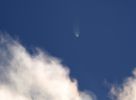
McNaught-07.jpgComet McNaught (8)67 visiteCaption NASA:"Comets grow bright when they're close to the Sun, basking in the intense solar radiation. Of course, they're also usually impossible to see against the overwhelming scattered Sunlight. But surprising Comet McNaught - whose January 12, 2007, closest approach to the Sun (perihelion passage) was well inside the orbit of Mercury - gave an enjoyable performance in bright blue daytime skies. In fact, comet expert David Levy captured this remarkable inset (upper left) telescopic view of McNaught within an hour of perihelion, with the comet in broad daylight only about 7° away from the Sun's position.
Stefan Seip's wider daytime view of the comet and fluffy clouds was recorded approximately a day later. Seip used a polarizing filter and a telescope/camera set up near Stuttgart, Germany.
No longer visible in broad daylight, Comet McNaught is now touring twilight Southern Skies".
|
|

McNaught-08.jpgComet McNaught (9)68 visiteCaption NASA originale:"Comet McNaught, the Great Comet of 2007, has grown a long and filamentary tail. The spectacular tail spreads across the sky and is visible to Southern Hemisphere observers just after sunset. The head of the comet remains quite bright and easily visible to even city observers without any optical aide. The amazing tail is visible on long exposures and even to the unaided eye from a dark location. Reports even have the tail visible just above the horizon after sunset for many Northern observers as well. Comet McNaught, estimated at magnitude - 2 (minus two), was caught by the comet's discoverer in the above image just after sunset last Friday from Siding Spring Observatory in Australia.
Comet McNaught, the brightest comet in decades, is now fading as it moves further into Southern Skies and away from the Sun and Earth".MareKromium
|
|

McNaught-09.jpgThe "Tail" of McNaught, at Sunset...84 visiteCaption NASA originale:"What's happening over the horizon? Many a sky enthusiast who thought they had seen it all had never seen anything like this. To the surprise of many Northern Hemisphere observers, the tail of Comet McNaught remained visible even after the comet's head set ahead of the Sun. What's more, visible were bright but extremely rare filamentary striae from the comet's expansive dust tail. The cause of dust tail striae are not known for sure, but are possibly related to fragmentation of comet's nucleus. The last comet to show prominent striae was Comet Hale-Bopp in 1997.
Pictured above, the tail of Comet McNaught was caught just after Sunset last Friday above the Carnic Alps of Northern Italy".
|
|

McNaught-9.jpgComet McNaught (10)69 visiteCaption NASA:"By January 19/20, 2007, Comet McNaught's magnificent dust tail stretched for about 150 MKM (~1 AU), requiring images from both Southern and Northern Hemispheres of planet Earth to take it all in. Two such views - from Cerro Paranal in Chile (left) and the Carnic Alps in Italy - are combined in this unique graphic that also outlines a perspective view of the Comet's orbit (dotted line) and relative position of the Sun. Driven by solar radiation pressure the dust tail initially points away from the Sun, but also trails outside the comet's orbit. Astronomers try to account for the complex structure along the tail, including the pronounced striations, by considering forces acting on the dust (e.g. gravity, solar wind and radiation) as well as the release time and size of the dust grains. In the diagram, the modeled location of dust grains released at approximately the same time relative to perihelion passage, synchrones, are shown as dashed lines. The location of grains of similar size, syndynes, are shown as solid lines".
|
|
| 20 immagini su 2 pagina(e) |
1 |
|








