| Risultati della ricerca nelle immagini - "Mamers" |
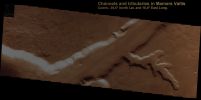
Channels-Mamers_Vallis-PCF-LXTT.jpgChannel and Tributaries - Mamers Vallis (Absolute Natural Colors; credits for the additional process. and color.: Dr Paolo C. Fienga - Lunexit Team)83 visitenessun commentoMareKromium
|
|
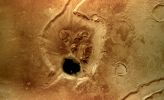
Craters-Unnamed_Crater_at_the_end_of_Mamers_Valles-392-250408-3304-6-co-01.jpgBird's-Eye view of Mamers Valles (MULTISPECTRUM; credits: Lunexit)124 visiteThe High-Resolution Stereo Camera (HRSC) onboard the ESA Spacecraft Mars Express obtained images focusing on a depression that displays a crater at the end of the long, winding Valley System known as Mamers Valles.
The data was obtained on 5 August 2006, with a ground resolution of approx. 14 mt/pixel. The image is centred at approx. 39° North and 17° East on the Planet.
The Mamers Valles System is approx. 1000 Km long, running along the boundary between the Northern Lowlands and Southern Highlands in the Region of Deuteronilus Mensae.
Scientists term a Region such as Mamers Valles ‘fretted terrain’ because it shows numerous deep and wide labyrinth-like valleys and circular depressions which often show structures formed by flowing liquid on their even floors. The structures formed by the flows are thought to be ice-rich debris flows. They show some resemblance to block glaciers seen on Earth.
The patches of rock at the centre of the depression are thought to be remnants of rock detached from the flanks of the depression and transported into its centre MareKromium
|
|

ESP_023790_2160_RED_abrowse.jpgPossible Phyllosilicate-Rich Terrain in Mamers Vallis (Absolute Natural Colors; credits for the additional process. and color.: Dr Gianluigi Barca - Lunexit Team) 214 visiteMars Local Time: 14:07 (Early Afternoon)
Coord. (centered): 35,6° North Lat. and 13,7° East Long.
Spacecraft altitude: 298,2 Km (such as about 186,4 miles)
Original image scale range: 59,7 cm/pixel (with 2 x 2 binning) so objects ~ 1 mt and 79 cm across are resolved
Map projected scale: 50 cm/pixel
Map projection: EQUIRECTANGULAR
Emission Angle: 8,6°
Sun-Mars-Spacecraft (or "Phase") Angle: 43,9°
Solar Incidence Angle: 50° (meaning that the Sun is about 40° above the Local Horizon)
Solar Longitude: 349,7° (Northern Winter)
Credits: NASA/JPL/University of Arizona
Additional process. and coloring: Dr Paolo C. Fienga - Lunar Explorer ItaliaMareKromium
|
|
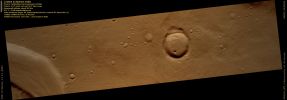
PSP_010630_2115_RED_abrowse-00.jpgCraters and possible "Pingo" in Mamers Vallis (ctx frame - Natural Colors; credits: Lunar Explorer Italia)80 visiteThis image was suggested by Mr. Dennis Mitchell's 8th grade NASA team, Evergreen Middle School, Cottonwood, CA, as part of the HiRISE Quest Student Image Challenge.
They write: "Located near Mamers Valles, this image shows numerous fluvial features that indicate this area was once rich with water. The lineated valley fill suggests an ice-rich soil. [Of particular interest] is a small cone-like feature [located on the floor of a 2 Km-diameter] impact crater in the center of the ctx frame.MareKromium
|
|
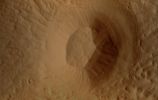
PSP_010630_2115_RED_abrowse-01.jpgCraters and possible "Pingo" in Mamers Vallis (edm - Natural Colors; credits: Lunar Explorer Italia)101 visite"At first this resembles a cinder cone volcano on Earth. However, when magnified, it reveals a feature [found in Arctic regions] on Earth called "Pingo". These are caused by ice protruding through the soil creating a positive-relief geologic feature. If you examine the smaller craters in the surrounding terrain you'll see a checkerboard pattern in each one. These closely resemble melted Pingos on Earth, again suggesting an area of Mars that was once rich with water."
While the student's suggestion that the mound-like structure is a Pingo is reasonable, there is yet no scientific consensus for the origin of these interesting structures.
Nota Lunexit: con tutto il rispetto per le brillanti intuizioni dei ragazzini "sponsorizzati" dalla NASA, l'idea del "Pingo" non stà - davvero - nè in cielo, nè in Terra. Eppure, come leggete, anche a queste boutades (perchè provengono da fanciulli - probabilmente - "quotati" a tutti i livelli), viene dato spazio. Poi però, se chiedi ai Signori di Pasadena o della University of Arizona, ad esempio, cosa potrebbe essere la Silver Sphere (o altri rilievi anomali simili, a parer nostro - e NON SOLO nostro - MOLTO più intriganti dello "pseudo Pingo")...Ecco che cala il silenzio più totale.
Che tristezza...MareKromium
|
|
|
|
|
| 5 immagini su 1 pagina(e) |
|








