| Risultati della ricerca nelle immagini - "Major" |

Controversial_Features-The_Bridges_of_Meroe_Patera-MGS-1.jpgThe "White Bridges" of Meroe Patera (Original NASA/MGS/MSSS CTX b/w Frame)66 visiteCaption NASA originale:"This MGS-MOC image shows terrain South-West of Meroe Patera in Syrtis Major Planum, Mars. Wind streaks formed in the "lee" (the downwind side) of impact craters are common throughout the scene, including the small impact crater near the center of the image with light-toned ejecta radiating outward from its rim.
Near the South (Dx) of the image, 3 light-toned slope streaks, created by dry mass movements of dust, extend down the sloping side walls of two overlapping impact craters".
Location near: 5,3° North; 295,4° West
Image width: ~3 Km (~1,9 mi)
Illumination from: lower left
Season: Northern Winter
|
|

Controversial_Features-The_Bridges_of_Meroe_Patera-MGS-2.jpgThe "White Bridges" of Meroe Patera (Original NASA/MGS/MSSS b/w Frame - EDM)64 visiteLi abbiamo chiamati "ponti", ma ovviamente si tratta di qualcosa di molto diverso da una serie di "ponti ad arco". Per il Dr Feltri si potrebbe trattare di enormi bio-strutture; per il Dr Skipper si tratta di ciclopici manufatti in parte sepolti.
La nostra posizione al riguardo di questi "Bianchi Ponti" i quali si vedono anche in altre Regioni Marziane è interlocutoria: sappiamo che si tratta di caratterizzazioni superficiali talmente peculiari da potersi definire, in tutta tranquillità, cime Anomalìe di Superficie (Anomalìe che la NASA e l'ESA, ovviamente, non vedono e non commentano...); sappiamo che non sono dune e che la loro morfologia NON sposa la morfologia dell'ambiente a cui esse accedono (e dunque sono rilievi - tecnicamente - "alieni") e che, con ogni probabilità, si tratta di rilievi (effettivamente) di dimensioni enormi i quali non hanno riscontri similari nè sulla Terra, nè su nessun altro Corpo del Sistema Solare.
Questi, a nostro parere, sono i fatti.
|
|

Craters-Unnamed_Craters-Syrtis_Major.jpgUnnamed Craters in Syrtis Major Planum (Original NASA/MGS/MSSS b/w Frame)63 visiteCaption NASA originale:"This MGS-MOC image shows a portion of Syrtis Major Planum, dominated in this area by two Impact Craters of differing age. The large one is about 1,3 Km (approx. 0,8 miles) in diameter, the smaller is about 250 mt (~820 feet) across.
The smaller Unnamed Crater has a well-defined Ejecta Blanket and Rays emanate outward from its center. The larger Unnamed Crater does not exhibit these features. The larger one is older, and its Ejecta Blanket and Rays have been removed and degraded over time".
Location near: 5,4° North; 294,2° West
Image width: ~3 Km (~1,9 mi)
Illumination from: upper left
Season: Northern Spring
|
|
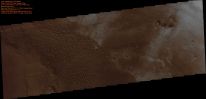
Dunes-Nili_Patera_Region-PIA13992-PCF-LXTT.jpgLarge Dunefield in Nili Patera (Absolute Natural Colors; credits for the additional process. and color.: Dr Paolo C. Fienga - Lunexit Team)217 visitenessun commentoMareKromium
|
|

Dunes-Syrtis_Major_Region-PIA08597-2.jpgFeatures of Syrtis Major Planum, proximities of Meroe Patera (Absolute Natural Colors; credits for the additional process. and color.: Dr Paolo C. Fienga - Lunexit Team)125 visiteImage information: VIS instrument;
Latitude: 6,3° North;
Longitude 68,3° East;
Resolution: 18 meter/pixel.
MareKromium
|
|

ESP_013951_1955_RED_abrowse-00.jpgDark Syrtis Major (CTX Frame - Natural Colors; credits: Dr Paolo C. Fienga - Lunexit Team)66 visiteOn 13 October 1659, Dutch Astronomer Christiaan Huygens turned one of his telescopes towards a bright orange spot in the sky and produced what Percival Lowell would later call “the first drawing of Mars worthy of the name ever made by man”.
Huygens included a "dark spot" in his drawing that is thought to represent Syrtis Major, a small sliver of which is visible in this HiRISE image.
Syrtis Major is a Shield Volcano and its dark color comes from the dark Basaltic Rock present in the area, visible because it lacks the Dust that paints the rest of the Planet its distinct, rusty orangish color. By tracking this "dark spot" in repeated observations, Huygens concluded that Mars rotated every 24 hours: a time not too far off from its true rotation period of approx. 24 hours and 39,58 minutes.MareKromium
|
|

ESP_013951_1955_RED_abrowse-01.jpgDark Syrtis Major (EDM - Natural Colors; credits: Dr Paolo C. Fienga - Lunexit Team)76 visiteIn this EDM of Syrtis Major, ancient Noachian Bedrock is exposed. This is rock made in the early Soles of Martian History.
An Impact Crater (about 50 Km in diameter) into this rock exposes Layers along its Wall. These Layers may be made from several different geologic materials, such as Lava Flows, Debris from nearby impact craters, or deposits of Dust or Sand.
They may also represent different periods of deposition and erosion. The Layers are of varying thickness: some of the lighter, resistant units are less than 10 meters thick, while some of the darker layers might be over 100 meters thick.MareKromium
|
|

ESP_019186_1955_RED_abrowse-PCF-LXTT.jpgTrough in Syris Major (Natural Colors; credits for the additional process. and color.: Dr Paolo C. Fienga - Lunexit Team)103 visitenessun commentoMareKromium
|
|
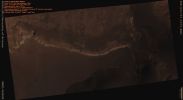
ESP_021757_1975_RED_abrowse-PCF-LXTT.jpgScarp in Syrtis Major (Absolute Natural Colors; credits for the additional process. and color.: Dr Paolo C. Fienga - Lunexit Team)332 visitenessun commentoMareKromium
|
|
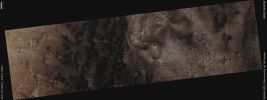
ESP_024025_2005_RED_abrowse-PCF-LXTT-00.jpgDark Dunes in Syrtis Major Planum (Absolute Natural Colors; credits for the additional process. and color.: Dr Paolo C. Fienga - Lunexit Team)192 visiteMars Local Time: 14:11 (Early Afternoon)
Coord. (centered): 20,3° North Lat. and 79,2° East Long.
Spacecraft altitude: 281,4 Km (such as about 175,9 miles)
Original image scale range: 28,2 cm/pixel (with 1 x 1 binning) so objects ~ 84 cm across are resolved
Map projected scale: 25 cm/pixel
Map projection: EQUIRECTANGULAR
Emission Angle: 1,1°
Sun-Mars-Spacecraft (or "Phase") Angle: 39,3°
Solar Incidence Angle: 38° (meaning that the Sun is about 52° above the Local Horizon)
Solar Longitude: 359,0° (Northern Winter)
Credits: NASA/JPL/University of Arizona
Additional process. and coloring: Dr Paolo C. Fienga - Lunar Explorer ItaliaMareKromium
|
|
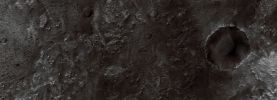
ESP_024513_1980-PCF-LXTT-01.jpgFeatures of the Dark Syrtis Major Region (Absolute Natural Colors; credits for the additional process. and color.: Dr Paolo C. Fienga - Lunexit Team)225 visiteMars Local Time: 14:23 (early afternoon)
Coord. (centered): 18,0° North Lat. and 76,9° East Long.
Spacecraft altitude: 280,9 Km (such as about 175,6 miles)
Original image scale range: 28,1 cm/pixel (with 1 x 1 binning) so objects ~ 84 cm across are resolved
Map projected scale: 25 cm/pixel
Map projection: EQUIRECTANGULAR
Emission Angle: 5,0°
Phase Angle: 41,4°
Solar Incidence Angle: 36° (meaning that the Sun is about 54° above the Local Horizon)
Solar Longitude: 17,5° (Northern Spring)
Credits: NASA/JPL/University of Arizona
Additional process. and coloring: Lunar Explorer ItaliaMareKromium
|
|

Windstreaks-SyrtisMajor-20091125a.jpgWindstreaks (Natural Colors; credits: Lunexit)66 visitenessun commentoMareKromium
|
|
| 13 immagini su 2 pagina(e) |
1 |
|








