| Risultati della ricerca nelle immagini - "Lutetia" |

Lutetia-01.jpgAsteroid "Lutetia"94 visiteAsteroid Lutetia will no longer remain a mystery as the European Space Agency's (ESA) Rosetta has captured the first close-up images of this Celestial Body, which will help them gain insights into the composition of the space rock that has long puzzled the scientists.
In what can be termed as the closest encounter with one of the largest asteroid, ever visited ESA led robotic spacecraft mission, Rosetta, raced past Lutetia as close as 3200 Km, with the closest encounter at 18:10 CEST (Central Europe Standard Time), when the spacecraft was just 3162 Km away from the giant asteroid.
Rosetta, which had a first look of Lutetia in January 2007, has this time “triumphed at asteroid” and captured images like never before.MareKromium
|
|

Lutetia-02.jpgAsteroid "Lutetia"79 visiteThough the first look of the giant asteroid, through nearly 400 images, has revealed a lot about the primitive survivor's cratered surface, a lot more needs to be unlocked.
The data collected by Rosetta Spacecraft, with the help of multi-wavelength cameras, spectrometers etc., will unravel the mysteries surrounding the composition of Lutetia. Some asteroids are a broken part of iron-rich cores of proto-planets or they may just be composed of Carbon.MareKromium
|
|

Lutetia-03.jpgAsteroid "Lutetia"85 visiteA closer look at the asteroid that orbits between Mars and Jupiter reveals that Lutetia's Surface is battered with many craters, indicating that during the 4,5 BY (Billion Years) of existence, the primitive survivor has suffered many impacts.
The information gathered also confirm that Lutetia, discovered by French painter turned astronomer Hermann Goldschmidt in 1852, is approx. 100 Km in diameter, has a elongated body, and its longest side measures about 130 Km.
In a statement, David Southwood, ESA Director of Science and Robotic Exploration, said:“It has been a great day for exploration, a great day for European science. The clockwork precision is a great tribute to the scientists and engineers in our Member States in our industry and, not least, in ESA itself”.MareKromium
|
|
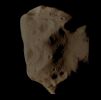
Lutetia-04-PCF-LXTT.jpgAsteroid "Lutetia" (possible Natural Colors; credits for the additional process. and color.: Dr Paolo C. Fienga - Lunexit Team)120 visiteMareKromium
|
|

Lutetia-05-CTX-EDM-PCF-LXTT-IPF.jpgAsteroid 21-Lutetia (CTX Frame and EDM - Absolute Natural Colors; credits for the additional process. and color.: Dr Paolo C. Fienga - Lunexit Team)167 visite21 Lutetia is a relatively large Main-Belt Asteroid, measuring about 100 Km in diameter (approx. 120 km along its Major Axis). It was discovered in the AD 1852 by the French-German Astronomer Hermann Goldschmidt, and is named after Lutetia, such as the Latin name of the city that stood where Paris was later built. The Asteroid 21 Lutetia has an irregular shape and is heavily cratered, with the largest Impact Crater reaching about 45 Km in diameter.
The Surface of this Asteroid is geologically heterogeneous and it is intersected by a system of Grooves and Scarps, which are thought to be the external manifestation of deep, internal, Fractures; it also possess an high Average Density, which could have meant that is (likely) made of Iron and Nickel rich Rock (even though, as we shall better see later on, this - however logical - claim, is still unproven). The ESA - Rosetta Probe passed as close as about 3162 Km (approx. 1965 miles) from 21 Lutetia in July 2010 and, at the time of Rosetta's Fly-By, it was the largest Asteroid ever visited by a Spacecraft (that, until the NASA - Dawn Spaceraft arrived at 4 Vesta, in July 2011).
The composition of 21 Lutetia has puzzled astronomers for some time, and that is because, while classified among the M-type Asteroids, most of which are Metallic (better yet: rich of Metallic Minerals/Elements), 21 Lutetia must be one of the so-called Anomalous Members of this classification, since it does not display much evidence of Metallic Minerals on its Surface. As a matter of fact, after most part of the data received from the Rosetta Probe were analyzed, several indications of a NON-Metallic Surface of this Asteroid were found, like, for instance, a flat, Low Frequency Spectrum (similar to that of Carbonaceous Chondrites and C-type Asteroids - which is, of course, deeply different from the one of the so-called Metallic Meteorites, such as those Meteorites which are logically believed to derive from a Metallic - such as, we repeat, Iron and Nickel-rich - Celestial Body), a low Radar Albedo (unlike the high Albedoes of Strongly Metallic Asteroids, like 16 Psyche), evidence of Hydrated Materials on its Surface, abundant Silicates, and a thicker layer of Regolith than most of the other known (as far as their composition is concerned) Asteroids.MareKromium
|
|
|
|
|
| 5 immagini su 1 pagina(e) |
|








