| |
| Risultati della ricerca nelle immagini - "Light" |

G-APOLLO-11_AS_11-37-5455_%28Mosaic%29.jpgThe evolution of a Lunar Mis(t)ery: The "Flare-like Light"2170 visiteQuesto collage (o "mosaico", come piace dire alla NASA) l'ho realizzato io, in circa 10 minuti di lavoro. Sono Paolo C. Fienga, Presidente e Socio Fondatore di Lunexit.
Ci ho pensato a lungo e poi ho deciso: un posto (d'Onore!) fra le "Balle Spaziali" deve averlo anche la bizzarra "evoluzione grafica" (e digitale) di uno dei frames a mio parere più importanti della Storia delle Missioni Apollo: il frame AS 11-37-5455 il quale, come forse molti di Voi già sanno, potrebbe essere rappresentativo di quella strana e misteriosissima "flare-like light" di cui parlò il Com.te Neil Armstrong, mentre si rivolgeva a Houston ed al Mondo intero, in diretta dalla Luna, nel Luglio 1969.
Nessuno, a parte noi di Lunexit, qualche Anomaly Hunter e forse 2 o 3 Ricercatori di Frontiera, si è mai soffermato troppo a lungo su questa meravigliosa e del tutto indecifrabile immagine.
Flare-like light, ossìa: luce simile ad una fiaccola. La NASA, da noi interpellata nel 2002, ci disse questo:"...it is nothing more than a highly reflective surface in the distance..." (estratto da messaggio e-mail ricevuto dall'Information Service Center di Houston, TX in data 18-12-2002).
Una rilievo piuttosto luccicante, insomma, colpito dai raggi del Sole da poco sorto sulla Tranquillity Base. Ok, va bene. Ora guardate Voi stessi come la "highly reflective surface" è mutata nel tempo. Tutte le immagini usate per comporre questo piccolo mosaico sono ORIGINALI NASA.
"Highly Reflective Surface"? A me sta bene, ma da quando in qua un "sasso bene illuminato" è capace di proiettare un fascio di luce verso l'alto e quindi SCOMPARIRE a distanza di pochi secondi - si veda il frame AS 11-37-5456 per credere a quanto dico e scrivo)?
Guardate, analizzate e riflettete: l'essenza del mio lavoro è tutta qui. E, se mi consentite un istante di sincerità, permettetemi di dire che di "Balle Spaziali", in svariati anni di studio, ricerca ed analisi, ne ho sentite e viste davvero tante, alcune di fonte "povera", altre, come questa, di fonte "autorevole".
Anzi: autorevolissima! La "Fonte" della nostra Scienza e Conoscenza per definizione: la NASA, Cari Amici!
Buona meditazione!... MareKromium
|
|
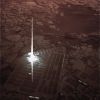
OPP-SOL1329-1N246175987EFF8788P0775L0M1.jpgThe "Light-Drop" effect - Sol 1329 (red-orange filter ON - possible natural colors; elab. Lunexit)67 visitenessun commentoMareKromium
|
|

PHOE-SOL010-lg_82.jpgLights ON!80 visiteRicordate quando abbiamo detto che il colore del terriccio recuperato da Phoenix per le analisi era "falsissimo" oppure illuminato da una sorgente molto intensa e prossima? Ok. Ecco, nell'immagine, la "sorgente" in questione: un gruppo-luce costituito da leds blu, rossi e verdi. Sicuramente utili in alcuni casi ed altrettanto sicuramente fuorvianti in altre situazioni.
Comunque sia: "Lights ON" (!) e fine del mini-mistero relativo al colorito assurdo del suolo Marziano raccolto e fotografato da Phoenix.MareKromium
|
|

SOL410-2P162770050EFFA800P2268L6M1-3.jpgRectangular Hole? - Sol 410 (by Dr Gianluigi Barca)215 visiteUn buco "rettangolare" su Marte? No, è una semplice illusione ottica determinata dal particolare angolo di ripresa, ove rapportato alla configurazione del suolo ed alla posizione del Sole nel Cielo di Marte.
In realtà come si vede piuttosto bene nell'inset magnificato, si tratta di una modesta depressione a forma circolare, sulla quale insiste un'ombra netta e squadrata, determinata - nel suo lato inferiore e laterale Dx - appunto - dalla configurazione della superficie che la proietta e resa curiosamente affilata non solo dalla posizione del Sole nel Cielo Marziano (ancora molto alto, riteniamo), ma anche dalla scarsa definizione e qualità del frame.
Un ringraziamento al nostro Dr Barca per l'occhio, la curiosità e, ovviamente, lo "spunto" (perchè risolvere i piccoli misteri è, a nostro modo di vedere, estremamente formativo e di grande aiuto per poi affrontare e tentare di risolvere quelli Grandi...).MareKromium
|
|

SOL536-2N173953008EFFACB9P0683L0M1-5.jpgOverexposed Flying Object near Spirit - Sol 536 (credits: Dr G. Barca)188 visiteIl dettaglio evidenziato e magnificato dal Dr Barca è un image-artifact? Secondo noi, no. L'unico artifact che caratterizza l'immagine è dato soltanto dal segmento scuro che taglia il disco (o la sfera, se volete) che ben si distingue nell'inset magnificato.
Altri esempi di image-artifacts caratterizzati da un "segmento" che taglia la sorgente luminosa puntiforme - la quale, tecnicamente, è la causa del vizio (da sovraesposizione) -? Nei tre insets, Saturno e due comete riprese dal Satellite SOHO (sono solo tre esempi ma, di immagini similari - e cioè che evidenziano quasto tipo di artifact, tipicamente derivante dalla sovraesposizione di un oggetto, si puntiforme, ma dotato di grandissima luminosità - ce ne sono migliaia negli Archivi SOHO.
Si noti che alcune di esse vennero astutamente sfruttate da pseudo-Ricercatori - in realtà dei furbetti prezzolati - per gabbare tantissimi appassionati. Come?
Semplice: dicendo che il segmento di luce - e cioè l'artifact da sovraesposizione - era la porzione periferica di mega-astronavi caratterizzate da vascelli lunghi e tubolari, con living quarters allocati in una struttura sferica centrale. Disgustoso, davvero...).
Un'ultima annotazione sul frame individuato dal Dr Barca: ai lati del dettaglio controverso (diremmo tutto intorno ad esso) tracce di una evidente pixellizzazione a trama reticolare la quale ci lascia supporre (si sottolinea che abbiamo scritto SUPPORRE: qui di certezze non ce ne sono - nè possono essercene...) che l'oggetto luminosissimo - e quindi causa dell'artifact - emana anche calore o, comunque, un qualche tipo di energia che interagisce con l'ambiente ad esso circostante, deformando l'esatta percezione delle sue caratteristiche fisiche.MareKromium
|
|

Saturn-Lightning-PIA14921.jpgSaturnian Lightning86 visiteThese false-color mosaics from NASA's Cassini spacecraft captured a Lightning striking within the huge storm that encircled Saturn's Northern Hemisphere for much of the AD 2011. The larger mosaic on the left of the panel shows the Lightning Flash, which appears as a blueish dot. The smaller mosaic on the right is composed of images taken 30 minutes later, and the Lightning is (let's say OBVIOUSLY...) not flashing at that time.
The white arrow points to the location where the Lightning occurred in the Clouds. The Optical Energy of this and other Flashes on Saturn is comparable to the strongest of the flashes on Earth. The flash is approx. 120 miles (about 200 Km) long when it exits the Clouds Tops. From this, scientists deduced that the Lightning Bolts originated in the Clouds deeper down in Saturn's Atmosphere where Water Droplets freeze. This is the analogous Region of the Atmosphere where Lightnings are created on Earth.
This Lightning Flash appeared only in the filter sensitive to Blue Visible Light, and the images were enhanced to increase the visibility of the Lightning. Images taken using red, green and blue spectral filters are usually combined to create a Natural Color View. Since Visible Red-Light images were not available, images taken using a spectral filter sensitive to wavelengths of Near-InfraRed Light centered at 752 nanometers were used in place of red. Also, the blue filter image was enhanced to increase the visibility of the lightning. The result is a type (as a matter of fact, just one of the VERY many...) of False Color Image.
The images were obtained with the Cassini Spacecraft narrow-angle camera on March 6, 2011, at a distance of approximately 2 MMs (such as about 3,3 MKM) from Saturn and at a Sun-Saturn-Spacecraft, or Phase, Angle of 83°. These mosaics are simple Cylindrical Map Projections, defined such that a square pixel subtends equal intervals of Latitude and Longitude. At higher Latitudes, the pixel size in the North-South direction remains the same, but the pixel size (in terms of physical extent on the Planet) in the East-West direction becomes smaller. The pixel size is set at the Equator, where the distances along the sides are equal. This map has a pixel size of approx. 12 miles (such as about 20 Km) at the Equator.MareKromium
|
|

Saturn-PIA08858.jpgInfrared Saturn (elab. NASA)76 visiteCaption NASA:"This psychedelic view of Saturn and its Rings is a composite made from images taken with the Cassini spacecraft wide-angle camera using spectral filters sensitive to wavelengths of infrared light centered at 728, 752 and 890 nanometers.
Cassini acquired the view on Dec. 13, 2006 at a distance of approx. 822.000 Km(such as about 511.000 miles) from Saturn. Image scale is roughly 46 Km (approx. 28 miles) per pixel". MareKromium
|
|

Saturn-PIA21899.gifPolar Lights (Auroral Emissions from the North Pole of Saturn)127 visiteCaption NASA Originale:"On Sept. 14, 2017, one day before making its final plunge into Saturn's Atmosphere, NASA's Cassini Spacecraft used its Ultraviolet Imaging Spectrograph, or UVIS, instrument to capture this final view of Ultraviolet Auroral Emissions over the Planet's North Polar Regions.
The view is centered on the North Pole of Saturn, with lines of Latitude visible for 80, 70 and 60°. Lines of Longitude are spaced 40° apart. The Planet's Day-Side is at the bottom of the picture, while the Night-Side is at the top. A sequence of images from this observation has also been assembled into a movie sequence. The last image in the movie was taken about an hour before the still image, which was the actual final UVIS auroral image.
Auroral Emissions are generated by charged particles traveling along the invisible lines of Saturn's Magnetic Field. These particles (then) precipitate into the Atmosphere, releasing light when they strike (the) Gas Molecules (that are present) there.
Several individual auroral structures are visible here, despite that this UVIS view was acquired at a fairly large distance from the Planet (such as about 424.000 miles or approx. 682.361,856 Km). Each of these features is connected to a particular phenomenon (occurring) in the Saturnian Magnetosphere. For instance, it is possible to identify Auroral "signatures" here that are related to the injection of "Hot Plasma" from the Day-Side Magnetosphere, as well as Auroral Features associated with a change in the Magnetic Field's shape (existing) on the Magnetosphere's Night-Side.
Several possible scenarios have been postulated over the years to explain Saturn's changing Auroral Emissions, but researchers are still far from a complete understanding of this complicated puzzle. Researchers will continue to analyze the hundreds of image sequences UVIS obtained of Saturn's auroras during Cassini's 13-year mission, with many new discoveries likely to be made.
This image and movie sequence were produced by the Laboratory for Planetary and Atmospheric Physics (LPAP) of the STAR Institute of the University of Liege in Belgium, in collaboration with the UVIS Team".MareKromium
|
|
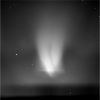
W00041312.jpgReflections in the Space of Saturn68 visitenessun commentoMareKromium
|
|

ZZ-ZZ-ZZ-ZZ-ZZ-ZZ-ZZ-ZZ-ZZ-ZZ-ZZ-ZZ-APOLLO 12 AS 12-46-6769 HR.jpgAS 12-46-6769 (HR) - Blue Flare or reflections?147 visiteUna nuova (piccola-piccola) "Blue Flare" illumina il cielo al di sopra del Surveyor Crater? No.
In questo frame, la Blue Flare è solo un'illusione. Anzi, ad essere precisi, essa è la porzione terminale di un photoartifact ricorrente nelle immagini Up-Sun (controluce) che viene comunemente identificato come "effetto prismatico". Un effetto prismatico che diventa ancora più accattivante - ma ingannevole! - a causa della sfuocatura della fotografia.
Caption originale:"116:27:03 MT - Rightward of 6768. Frame from Pete's 8 o'clock pan showing the deep shadow on the eastern wall of Surveyor Crater and, as indicated in a detail, the sunlit solar panels of Surveyor III. Compare with the corresponding frames from Pete's 12 o'clock pan, AS 12-46-6741, and his 4 o'clock pan, AS12-46-6746. Note that Pete mistakenly took these pans at 15-foot focus rather than 74-foot focus".
|
|
|
|
| 10 immagini su 1 pagina(e) |
|

|
|








