| Risultati della ricerca nelle immagini - "Le" |

APOLLO 15 AS 15-9299.jpgAS 15-9299 - Le Monnier Crater56 visiteOn January 16, 1973, the Soviet unmanned roving vehicle Lunokhod 2 was landed by Luna 21 in or near this area in the South-Eastern part of the crater Le Monnier. This crater is a large (61 Km) pre-Imbrian crater cut into terra at the Eastern edge of Mare Serenitatis before Serenitatis was flooded by mare laves. Part of Le Monnier's Southern wall fills the lower part of the picture. A conspicuous chain of elongate depressions has formed in the lava-filled floor of the crater. The chain trends 22 Km northward and its pattern is quite surely controlled by an underlying fracture system. Regionally, the inferred fracture system is concentric to the grossly circular Serenitatis Basin and in this area trends Northward. No comparably young structural features having the same trend cut the terrae surrounding Le Monnier. However, older structures having this trend occur in the southern and northern walls and rims of Le Monnier. The aligned depressions on the mare are mostly 300 to 400 mt wide and 30 to 60 mt deep. The three deepest stretches are 1 to 2 km long and about 50 to 65 m deep. These depressions probably were the locus of fissure eruptions of mare basalt. Withdrawal of the last lava back into the fissure may have created subsurface voids into which collapse took place, causing the depressions and accounting for the absence of raised rims on the depressions.
|
|

Comets-Shoemaker-Levy_9_before_collision.jpgThe Shoemaker-Levy 9 Comet just before colliding with Jupiter150 visiteCaption NASA originale:"The comet's original single nucleus was torn to pieces by Jupiter's strong gravity during a close encounter with the Solar System's largest planet in 1992. The pieces are seen in this composite of HST images to be "pearls" strung out along the comet's orbital path.
In July of 1994 these pieces collided with Jupiter in a rare and spectacular series of events".
|
|
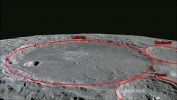
Kaguya-020-hdtv_004_1c.jpgSome Lunar Geography from Kaguya: around Leibnitz Crater (FarSide)60 visiteLeibnitz Crater - Coord.: 38,3° South Lat. and 179,2° East Long; Diam.: about 245 Km
Davisson Crater - Coord.: 37,5° South Lat. and 174,6° West Long.; Diam.: about 87 Km
Finsen Crater - Coord.: 42,0° South Lat. and 177,9° West Long.; Diam.: about 72 KmMareKromium
|
|

Luna21-Horz01.jpgThe first picture of the Moon, from Luna-21: LeMonnier Crater117 visiteScientific instruments included a soil mechanics tester, solar X-ray experiment, an astrophotometer to measure visible and UV light levels, a magnetometer deployed in front of the Rover on the end of a 2,5 mt boom, a radiometer, a photodetector (Rubin-1) for laser detection experiments, and a French-supplied laser corner-reflector. The Lander and Rover together weighed 1814 Kg.
Mission Profile
The SL-12/D-1-e launcher put the spacecraft into Earth parking orbit followed by Translunar Injection. On 12 January 1973, Luna 21 was braked into a 90x100 Km orbit around the Moon. On 13 and 14 January, the perilune was lowered to 16 Km altitude. On 15 January, after 40 orbits, the braking rocket was fired at 16 Km altitude, and the craft went into free fall.
At an altitude of 750 mt, the main thrusters began firing, slowing the fall until a height of 22 mt was reached.
|
|

Luna21-Horz05-1.jpgRover tracks and the far distant walls of LeMonnier Crater134 visiteAfter landing, the Lunokhod-2 took TV images of the surrounding area, then rolled down a ramp to the surface at 01:14 UT on 16 January and took pictures of the Luna 21 Lander and Landing Site. It stopped and charged batteries until 18 January, took more images of the Lander and Landing Site, and then set out over the Moon. The Rover would run during the Lunar Day, stopping occasionally to recharge its batteries via the solar panels. At night the Rover would hibernate until the next sunrise, heated by the radioactive source. Lunokhod-2 operated for about 4 months, covered 37 Km of terrain, including hilly upland areas and rilles, and sent back 86 panoramic images and over 80.000 TV pictures.
Many mechanical tests of the surface, laser ranging measurements and other experiments were completed during this time.
|
|

Luna21-Horz10.jpgThe walls of LeMonnier Crater108 visiteOn June 4, 1973, the Soviet Authorities announced that the Program was completed, leading to speculation that the vehicle probably failed in mid-May or could not be revived after the lunar night of May-June.
The Lunokhod-2 was not left in a position such that the laser retro-reflector could be used, thus indicating that the failure may have happened suddenly.
|
|

Luna21-Horz12-1.jpgRover tracks and the far distant walls of LeMonnier Crater108 visitenessun commento
|
|

Luna21-Video02.jpgThe floor of LeMonnier Crater (video frames) - (2)116 visitenessun commento
|
|

Luna21-Video03.jpgThe floor of LeMonnier Crater (video frames) - (3)86 visitenessun commento
|
|

Luna21-Video04-1.jpgRover tracks - video frame (1)103 visitenessun commento
|
|

Luna21-Video04-2.jpgRover tracks - video frame (2)100 visitenessun commento
|
|

OPP-SOL1623-1-MF.JPGExtremely bizarre Surface Feature - Sol 1623 (ctx frame - Hi-Def3-D; b/w - credits and Copyright: Dr M. Faccin and Lunar Explorer Italia)67 visiteI nostri Amici di Pasadena - al pari dei "Positivisti a Tutti i Costi" -, quando incontrano rilievi come quello che viene qui evidenziato (ed individuato, ancora una volta, dall'ottimo Marco Faccin), di solito...passano oltre, ignorando completamente quello che si vede (e che, a nostro umile modo di vedere, costituisce un'Anomalìa di Superficie al 100%).
Si, certo: una spiegazione razionale esisterà senz'altro...Ma noi non l'abbiamo ancora trovata e quindi, se volete contribuire, aspettiamo le Vostre interpretazioni, idee e commenti!
...E Buon Lavoro!MareKromium
|
|
| 26 immagini su 3 pagina(e) |
1 |
|





