| Risultati della ricerca nelle immagini - "Kasei" |

Channels-Kasei_Valles-20080528a-PCF-LXTT.jpgKasei Valles (Absolute Natural Colors; additional process.: Dr Paolo C. Fienga - Lunexit Team)79 visitenessun commentoMareKromium
|
|

Channels-Kasei_Valles-PIA15213-PCF-LXTT.jpgFeatures of Kasei Valles (Enhanced and Darkened Absolute Natural Colors; credits for the additional process. and color.: Dr Paolo C. Fienga - Lunexit Team)140 visiteOrbit Number: 44118
Latitude: 25,546° North
Longitude: 300,382° East
Instrument: VIS
Captured: December, 24th, 2011MareKromium
|
|

Dunes-Kasei_Valles-PIA13311.jpgDunes in Kasei Valles (Natural Colors; credits for the additional process. and color.: Dr Paolo C. Fienga - Lunexit Team)65 visiteThis small group of dunes in located within Kasei Valles.
Orbit Number: 37716
Latitude: 25,887° North
Longitude: 297,492° East
Instrument: VIS
Captured: 2010, June, 15thMareKromium
|
|
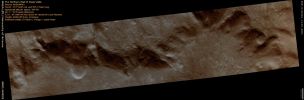
ESP_018492_2120_RED_abrowse-PCF-LXTT3.jpgThe Northern Wall of Kasei Valles (Natural Colors; credits for the additional process. and color.: Dr Paolo C. Fienga - Lunexit Team)64 visitenessun commentoMareKromium
|
|

ESP_024202_2010-PCF-LXTT.jpgFeatures of Kasei Valles (Natural Colors; credits for the additional process. and color.: Dr Paolo C. Fienga - Lunexit Team) 270 visiteMars Local Time: 14:16 (Early Afternoon)
Coord. (centered): 20,8° North Lat. and 287,4° East Long.
Spacecraft altitude: 283,0 Km (such as about 176,9 miles)
Original image scale range: 28,3 cm/pixel (with 1 x 1 binning) so objects ~ 85 cm across are resolved
Map projected scale: 25 cm/pixel
Map projection: EQUIRECTANGULAR
Emission Angle: 3,3°
Sun-Mars-Spacecraft (or "Phase") Angle: 35,0°
Solar Incidence Angle: 38° (meaning that the Sun is about 52° above the Local Horizon)
Solar Longitude: 5,8° (Northern Spring)
Credits: NASA/JPL/University of Arizona
Additional process. and coloring: Dr Paolo C. Fienga - Lunar Explorer ItaliaMareKromium
|
|
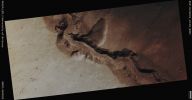
ESP_024202_2010_RED_abrowse.jpgFeatures of Kasei Valles (Enhanced Absolute Natural Colors; credits for the additional process. and color.: Dr Paolo C. Fienga - Lunexit Team) 189 visiteMars Local Time: 14:16 (Early Afternoon)
Coord. (centered): 20,8° North Lat. and 287,4° East Long.
Spacecraft altitude: 283,0 Km (such as about 176,9 miles)
Original image scale range: 28,3 cm/pixel (with 1 x 1 binning) so objects ~ 85 cm across are resolved
Map projected scale: 25 cm/pixel
Map projection: EQUIRECTANGULAR
Emission Angle: 3,3°
Sun-Mars-Spacecraft (or "Phase") Angle: 35,0°
Solar Incidence Angle: 38° (meaning that the Sun is about 52° above the Local Horizon)
Solar Longitude: 5,8° (Northern Spring)
Credits: NASA/JPL/University of Arizona
Additional process. and coloring: Dr Paolo C. Fienga - Lunar Explorer ItaliaMareKromium
|
|
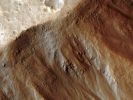
Kasei_Valles-PIA13265.jpgFeatures of Kasei Valles (EDM - Saturated Natural Colors; credits for the additional process. and color.: Dr Paolo C. Fienga - Lunexit Team)65 visiteThis observation from NASA's Mars Reconnaissance Orbiter (MRO) shows the very steep side of a Plateau, part of the Northern Limit of the Kasei Valles System, which is one of the largest Outflow Channel Systems on Mars. The difference in elevation here between the mostly flat Channel's Floor (bottom right) and the top of the Plateau (top left) is over 1300 meters (about 0,8 miles), comparable in height to the Grand Canyon Walls. The Kasei Valles System is much wider than the Grand Canyon, though, getting to be in places approx. 500 Km (such as about 300 miles) wide. (The Grand Canyon's maximum width is approx. 30 Km, or about 18 miles).
This EDM shows numerous paths with the appearance of dotted lines, criss-crossing the steep side of the Plateau. The carving agents can be found at the end of some of these paths: rocky blocks such as the ones in this subset, up to 2 meters (2,2 yards) across (4 meters or 4,4 yards across elsewhere in the image). Some of these blocks traveled downhill several hundred meters (yards) as they rolled and bounced leaving behind a trail of indentations or poke marks in the surface's fine-grained, light-toned soils. The raised borders in some of these poke marks indicate they are relatively recent features, unaffected by wind erosion, or that this soil has cohesive properties, such as if it was cemented.
The sound of these blocks falling did not travel very far, though. According to computer simulations sound in Mars travels only 1,5% (per-cent) the distance it would travel on Earth. (No Martian sound has ever been officially recorded) Hence, the same sound which would travel one Km (0,6 miles) on Earth, would travel only 15 meters (16 yards) on Mars. This is due to the lower Martian Atmospheric Pressure, which is approximately 1% of that of the Earth.MareKromium
|
|

Kasei_Valles-PIA13742-PCF-LXTT.jpgEnd of Kasei Valles (Absolute Natural Colors; credits: Dr Paolo C. Fienga - Lunexit Team)274 visitenessun commentoMareKromium
|
|

Landslides-Kasei_Vallis-PCF-LXTT.jpgLandslide in Kasei Valles (Absolute Natural Colors; credits: Dr Paolo C. Fienga - Lunexit Team)123 visitenessun commentoMareKromium
|
|
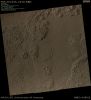
PSP_001456_2010_RED_abrowse.jpgFlood-carved Canyon in Kasei Valles (Natural Colors; credits: Lunexit)79 visiteThis HiRISE image shows a wonderfully complex surface on the floor of this ancient Flood-carved Canyon.
The floor of this Canyon, now, does not show any kind of landform that scientists expect to see from the occurrence of flood erosion phenomena.
Instead, it appears that the floor of the valley has been covered, after the inundation that first designed it, by another flow made by some very dense material that also contained huge ridged plates.
Some of the plates are more than 1 Km (0,6 miles) across. The ridges appear to have formed when the solid crust on the flow crumpled; the plates are pieces of the crust that were rafted apart.
Actually, very large Lava Flows can produce a surface like this, but also water-ice and frozen mud can create similar features.MareKromium
|
|
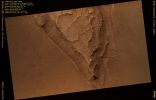
PSP_006005_2050_RED-00-PCF-LXTT.jpgStreamlined Island in Kasei Valles (Saturated Natural Colors; credits for the additional process. and color.: Dr Paolo C. Fienga - Lunexit Team)63 visiteIn this picture there is a Streamlined Island: one of many observed in the large outflow channels on Mars. This outflow channel is called Kasei Valles, and is one of the largest catastrophic outflow channels on Mars.
The Streamlined Island forms as water flows through the channel, but is blocked by some sort of obstacle, such as a crater or other topographic landform. In this HiRISE image, we only see the very tail end of the Streamlined Island, which is over 118 Km in length.
The platy surface within the channels has been attributed to either later lava or mud flows along the surface. The island itself is quite dusty and covered in small craters, so the island may be quite old. Along the edge of the island, however, you can see individual layers of rock.
These layers represent individual rock units that may be volcanic or sedimentary in origin.MareKromium
|
|
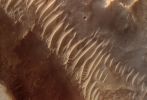
PSP_008523_2060_RED_abrowse-01.jpgSubchannels in Kasei Valles (EDM - MULTISPECTRUM; credits for the additional process. and color.: Dr Paolo C. Fienga - Lunexit Team)82 visiteCaption NASA:"This Region is very dusty, and therefore Dust Streaks can be seen covering the flat Mesas. Within the Channels, large Dunes of Dust have formed from Winds blowing through the Channels themselves. On the steep Slopes of the Dunes, smaller set of Ripples can be seen".MareKromium
|
|
| 12 immagini su 1 pagina(e) |
|








