| Risultati della ricerca nelle immagini - "Ius" |

Dunes-Ius_Chasma-PIA13166.jpgDunes in Ius Chasma (Natural Colors; credits for the additional process. and color.: Dr Paolo C. Fienga - Lunexit Team)120 visitenessun commentoMareKromium
|
|

ESP_012625_1720_RED_abrowse.jpgSulfate Strata in Ius Chasma (Natural Colors; credits: Lunexit)83 visite...Ed ora, dato che al peggio ed al ridicolo non c'è mai fine, ci aspettiamo che qualcuno trovi una "Scritta", da qualche parte, che indichi questi depositi di Solfati...MareKromium
|
|

PSP_007219_1720_RED_abrowse-00~0.jpgFinely-Layered Rocks in Ius Chasma (context-frame - MULTISPECTRUM; credits: Lunexit)66 visiteThe high resolution of HiRISE allows us to see the many Fine Layers, or Strata, of Rock Outcrops all over Mars. This image shows a portion of Ius Chasma in the western portion of the large Valles Marineris Canyon System.
The Outcrop of Rock in the center of the image is about 5,5 Km across. Similar light-toned Strata are observed elsewhere in the canyon system and the CRISM instrument has shown that they often contain sulfate salts. The presence of Sulfate Salts indicate that water once interacted with this area, possibly as fluids that migrated through pre-existing rocks or as shallow evaporating pools of water.MareKromium
|
|
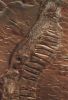
PSP_007219_1720_RED_abrowse-01.jpgFinely-Layered Rocks in Ius Chasma (extra-detail mgnf - MULTISPECTRUM; credits: Lunexit)90 visiteMuch of this Region has been covered by dust and sand, which appears brownish-red. This material is eroded by wind over time and allows us to see the light-toned rock underneath the surface.
There are also dunes that obscure portions of the outcrop.
Many outcrops within Ius Chasma and elsewhere on Mars are covered by such dunes and dust, but the high spatial resolution of instruments such as HiRISE and CRISM allow us to see the Geology and Mineralogy of regions between these dunes to help unravel the Geologic History of Mars.MareKromium
|
|

Psp_002538_1720_red.jpgJust like Thaumasia: more "bright" dunes in Ius Chasma64 visiteIus Chasma is one of several canyons that make up Valles Marineris, the largest canyon system in the Solar System.
The canyons likely formed by extension in association with the development of the Tharsis plateau and volcanoes to the West. Wind and possibly water have modified the canyons after they formed.
This HiRISE image shows the floor of Ius Chasma. The floor is bounded to the North and South by higher standing wallrock, with a few exposures of wallrock seen in the North (Sx) of the picture. Much of the floor is covered by ripples that are oriented approximately North-South, indicating an East to West wind flow, parallel to the orientation of Ius Chasma.
Layered deposits and bright patches of material are also seen along portions of the Ius Chasma floor. The layered deposits appear distinct in morphology from the nearby wallrock. These layered deposits could be lava flows, sediments deposited in a former lake, or fines that settled out from the atmosphere over time, such as dust or volcanic ashes.
The bright outcrops visible further south in the image have been seen elsewhere in Valles Marineris as well as other locations on Mars and tend to have mineral signatures consistent with sulfates. Data from the CRISM instrument (also on Mars Reconnaissance Orbiter) of the composition of these bright patches in Ius Chasma could shed insight into their origin. MareKromium
|
|
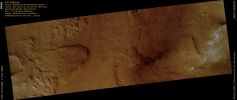
Psp_009368_1720_red.jpgIus Chasma (natural colors; credits: Lunexit)75 visiteThis image spans the floor of Ius Chasma’s Southern Trench. Ius Chasma is located in the Western Region of Valles Marineris, the Solar System’s largest canyon. This canyon is well known for its fine stratigraphic layers modified by wind and water.
The outcrops contain interchanging layers of dark and bright rocks. The layered deposits consist of dark basalt lava flows and bright sedimentary layers. The sediments are likely to be from atmospheric dust, sand, or alluvium from an ancient water source. The layers are visible on the gentle slopes above the canyon floor, in pitted areas, and in small mesa buttes. The floor of the canyon is littered with megaripples that are aligned in a North-South direction.
Ius Chasma is believed to have been shaped by a process called "sapping" that occurred when water seeped from the layers of the cliffs and evaporated before it reached the canyon floor. This process is thought to have dominated during the Amazonian Period.
Ius Chasma also has several structural features such as East trending normal Faults and Grabens that deformed the canyons. Recent geomorphological events include Mass Wasting (Avalanches) and minor Sapping from Gullies that continued to erode the canyon walls.MareKromium
|
|
|
|
| 6 immagini su 1 pagina(e) |
|








