| Risultati della ricerca nelle immagini - "Isidis" |
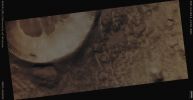
ESP_023814_1970_RED_abrowse-PCF-LXTT-00.jpgPossible Olivine-Rich Terrain in Isidis Planitia Region (Absolute Natural Colors; credits for the additional process. and color.: Dr Paolo C. Fienga - Lunexit Team)205 visiteMars Local Time: 14:08 (Early Afternoon)
Coord. (centered): 16,7° North Lat. and 80,1° East Long.
Spacecraft altitude: 279,9 Km (such as about 174,9 miles)
Original image scale range: 56,0 cm/pixel (with 2 x 2 binning) so objects ~ 1 mt and 68 cm across are resolved
Map projected scale: 50 cm/pixel
Map projection: EQUIRECTANGULAR
Emission Angle: 0,2°
Sun-Mars-Spacecraft (or "Phase") Angle: 38,0°
Solar Incidence Angle: 38° (meaning that the Sun is about 52° above the Local Horizon)
Solar Longitude: 350,6° (Northern Winter)
Credits: NASA/JPL/University of Arizona
Additional process. and coloring: Dr Paolo C. Fienga - Lunar Explorer ItaliaMareKromium
|
|
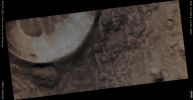
ESP_023814_1970_RED_abrowse.jpgPossible Olivine-Rich Terrain in Isidis Planitia Region (Natural Colors; credits for the additional process. and color.: Dr Paolo C. Fienga - Lunexit Team) 198 visiteMars Local Time: 14:08 (Early Afternoon)
Coord. (centered): 16,7° North Lat. and 80,1° East Long.
Spacecraft altitude: 279,9 Km (such as about 174,9 miles)
Original image scale range: 56,0 cm/pixel (with 2 x 2 binning) so objects ~ 1 mt and 68 cm across are resolved
Map projected scale: 50 cm/pixel
Map projection: EQUIRECTANGULAR
Emission Angle: 0,2°
Sun-Mars-Spacecraft (or "Phase") Angle: 38,0°
Solar Incidence Angle: 38° (meaning that the Sun is about 52° above the Local Horizon)
Solar Longitude: 350,6° (Northern Winter)
Credits: NASA/JPL/University of Arizona
Additional process. and coloring: Dr Paolo C. Fienga - Lunar Explorer ItaliaMareKromium
|
|

Landslides-Isidis_Planitia-PIA08034-1.jpgLandslide in Isidis Planitia (Absolute Natural Colors; credits for the additional process. and color.: Dr Paolo C. Fienga - Lunexit Team)135 visiteImage information: VIS instrument;
Latitude: 0,8° North;
Longitude: 98,3° East;
Resolution: 18 meter/pixelMareKromium
|
|

PSP_002136_1920_cut_b.jpgPhotoartifacts?76 visiteThe image shows two portions of the Isidis Planitia image (PSP_002136_1920) with bright noise at top, and 6 examples of bright noise seen in the cruise images; all are from the original, unprocessed images.MareKromium
|
|
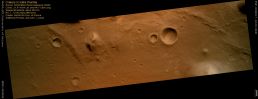
PSP_008017_2020_RED_abrowse.jpgCraters in Isidis Planitia (MULTISPECTRUM; credits: Lunexit)78 visiteThis image shows a young impact crater in the Northern part of Isidis Planitia. The crater is fresh enough to preserve some fine textures that are eroded around other craters.
The ejecta blanket of material thrown out of the crater is distinctly dark and rough, with many small boulders and rugged texture. To the South of the crater there is a wedge-shaped area with little ejected material. This may indicate that the impactor which formed this crater came from the south, since at moderate impact angles ejecta is preferentially thrown in the direction of motion of the impactor.
Eventually, a combination of erosion and mantling by dust will smooth and obscure the ejecta and cover over the crater, turning it into a shallow depression like the others in this image. Reworking of the crater is already beginning, as shown by the network of fine ridges (wind-blown ripples) on the crater floor.MareKromium
|
|
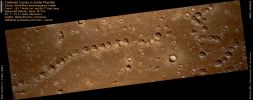
PSP_009177_1985_RED.jpgCratered Cones in Isidis Planitia (natural colors; credits: Lunexit)75 visiteThis image shows part of a broad field of cratered cones in the Isidis Planitia region of Mars. The cones occur over a wide area and are commonly aligned in chains, like those here.
The cratered-cone morphology suggests formation by eruption of some material. The cones resemble small volcanoes on Earth called cinder cones, and are approximately the same size. Another possibility is that these are mud volcanoes, formed by eruption of wet, pressurized mud. This has been suggested as an important process in some parts of Mars. The aligned chains probably indicate sites of weakness, perhaps faults, where lava or mud could preferentially rise.
The scene is relatively bland in color, but this could be due to a thin coating of dust veiling color differences. The cones are clearly not very young or pristine; they have a battered, pitted appearance. However, they have not been heavily eroded, as features like the cone rims are still sharp in most cases. This state is typical of the cones in Isidis region.
MareKromium
|
|
|
|
| 6 immagini su 1 pagina(e) |
|








