| Risultati della ricerca nelle immagini - "Io" |
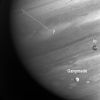
14-vg1_1610104.jpgJupiter, Io, Ganymede and...74 visiteL'oggetto indicato dalla freccia e contraddistinto da un "?" non è un photoartifact (nella maniera più categorica) e non è neppure una delle altre Lune Maggiori (o Galileiane) di Giove - e quindi non si tratta nè di Europa, nè di Callisto.
Abbiamo pensato potesse trattarsi di Amalthea, ma l'oggetto è troppo piccolo e non riusciamo a risolverlo per osservarne i dettagli superficiali e, soprattutto, le fattezze esteriori.
Se qualcuno di Voi avesse delle idee, ci scriva!
|
|

30-vg1_1636836.jpgIo and His volcanoes... (1)65 visitenessun commento
|
|

31-vg1_1637750.jpgIo and His volcanoes... (2)75 visitenessun commento
|
|
32-vg1_p21162.jpgFlying over the storms of Jupiter...70 visitenessun commento
|
|

40-vg1_p21227c.jpgClosing-up on a "Restless World" (1 - Natural Colors; credits: NASA/JPL-Caltech)67 visitenessun commento
|
|

41-vg1_p21286.jpgClosing-up on the restless World (Extremely Enhanced Natural Colors; credits: NASA/JPL-Caltech)72 visitenessun commento
|
|
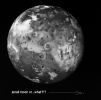
42-vg1_1636836.jpgIo: the "restless moon" and a "strange companion" (b/w)66 visiteIl vantaggio fondamentale (per i Cacciatori di Anomalìe) dei frames NASA originali ed in HR è che il livello di image-artifacts (o photo-artifacts) è tendente a zero. Abbiamo, con i mezzi a nostra disposizione, analizzato a lungo il dettagli che vedete in basso a Dx e l'unica conclusione affidabile che abbiamo raggiunto è che NON si tratta di un image-artifact.
Il resto...Decidetelo Voi.
|
|

43-vg1_1637750.jpgIo: the "restless moon" and a "strange companion" (b/w)81 visiteIndubitabile: qualsiasi cosa esso sia, l'oggetto (il "Transient", come abbiamo deciso di identificare questi corpi erranti e dalla natura imprecisata) si è mosso, e per giunta MOLTO rapidamente...
|
|

Amalthea and Io-PIA01626.jpgAmalthea and Io (approx. true colors)149 visiteComposite view of Amalthea and Io at the same scale. The visible part of Amalthea is about 150 Km across. The colors are just approximate. Amalthea is actually much darker than Io, but is displayed at a similar brightness for ease of viewing. The shape of Amalthea is controlled largely by impact cratering and fragmentation. In contrast, Io, like Earth, has gravity sufficient to form it into a slightly ellipsoidal sphere. Amalthea is covered by craters because there are no processes which erode or cover them efficiently. On extremely volcanically active Io, impact craters are covered quickly by lavas and other volcanic materials. Some of the volcanic materials escape from Io and probably contribute to the reddish colors of Amalthea and the other small inner satellites. The Amalthea and Io composites, obtained by the Solid State Imaging (SSI) camera on NASA's Galileo spacecraft on different orbits, were placed side by side for comparison purposes. The Amalthea composite combines data taken with the clear filter of the SSI system during orbit six, with lower resolution color images taken with the green, violet, and 1 micrometer filters during orbit 4. The Io data was obtained on July 2nd, 1998 (orbit 14) using the green, violet, and 1 micrometer filters.
|
|

IO - TRUE COLOR FROM GALILEO.jpgIo in true colors100 visiteNASA's Galileo spacecraft acquired its highest resolution images of Jupiter's moon Io on 3 July 1999 during its closest pass to Io since orbit insertion in late 1995. This color mosaic uses the near-infrared, green and violet filters (slightly more than the visible range) of the spacecraft's camera and approximates what the human eye would see. Most of Io's surface has pastel colors, punctuated by black, brown, green, orange, and red units near the active volcanic centers. A false color version of the mosaic has been created to enhance the contrast of the color variations.
The improved resolution reveals small-scale color units which had not been recognized previously and which suggest that the lavas and sulfurous deposits are composed of complex mixtures (Cutout A of false color image). Some of the bright (whitish), high-latitude (near the top and bottom) deposits have an ethereal quality like a transparent covering of frost (Cutout B of false color image). Bright red areas were seen previously only as diffuse deposits. However, they are now seen to exist as both diffuse deposits and sharp linear features like fissures (Cutout C of false color image). Some volcanic centers have bright and colorful flows, perhaps due to flows of sulfur rather than silicate lava (Cutout D of false color image). In this region bright, white material can also be seen to emanate from linear rifts and cliffs.
Comparison of this image to previous Galileo images reveals many changes due to the ongoing volcanic activity.
Galileo will make two close passes of Io beginning in October of this year. Most of the high-resolution targets for these flybys are seen on the hemisphere shown here.
North is to the top of the picture and the sun illuminates the surface from almost directly behind the spacecraft. This illumination geometry is good for imaging color variations, but poor for imaging topographic shading. However, some topographic shading can be seen here due to the combination of relatively high resolution (1.3 kilometers or 0.8 miles per picture element) and the rugged topography over parts of Io. The image is centered at 0.3 degrees north latitude and 137.5 degrees west longitude. The resolution is 1.3 kilometers (0.8 miles) per picture element. The images were taken on 3 July 1999 at a range of about 130,000 kilometers (81,000 miles) by the Solid State Imaging (SSI) system on NASA's Galileo spacecraft during its twenty-first orbit.
|
|
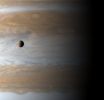
IO 2.jpgIo & Jupiter (from Cassini)77 visiteL'immenso Giove ed il piccolo (ma affascinante e VIVO, geologicamente parlando) Io, in un transito immortalato dalla Sonda Cassini, in transito accanto al Signore degli Dei ed in viaggio verso il Sistema di Saturno.
|
|

IO 4.jpgIo (Flying over a volcanic eruption and a sea of sulphur - Tvashtar Catena)114 visiteAn active volcanic eruption on Jupiter's moon Io was captured in this image taken on February 22, 2000 by NASA's Galileo spacecraft. Tvashtar Catena, a chain of giant volcanic calderas centered at 60 degrees north, 120 degrees west, was the location of an energetic eruption caught in action in November 1999. A dark, "L"-shaped lava flow to the left of the center in this more recent image marks the location of the November eruption. White and orange areas on the left side of the picture show newly erupted hot lava, seen in this false color image because of infrared emission. The two small bright spots are sites where molten rock is exposed to the surface at the toes of lava flows. The larger orange and yellow ribbon is a cooling lava flow that is more than more than 60 kilometers (37 miles) long. Dark, diffuse deposits surrounding the active lava flows were not there during the November 1999 flyby of Io.
This color mosaic was created by combining images taken in the near-infrared, clear, and violet filters from Galileo's camera. The range of wavelengths is slightly more than that of the human eye. The mosaic has been processed to enhance subtle color variations. The bright orange, yellow, and white areas at the left of the mosaic use images in two more infrared filters to show temperature variations, orange being the coolest and white the hottest material. This picture is about 250 kilometers (about 155 miles) across. North is toward the top and illumination from the Sun is from the west (left).
|
|
| 111 immagini su 10 pagina(e) |
1 |
 |
|
|
|
|
|
|
|








