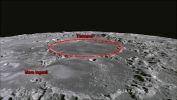
Kaguya-022-hdtv_004_3c.jpgSome Lunar Geography from Kaguya: Thomson Crater and Mare Ingenii (FarSide)64 visiteMare Ingenii - Coord.: 33,7° South Lat. and 163,5° East Long; Total length: about 318 Km
Thomson Crater - Coord.: 32,7° South Lat. and 166,2° East Long.; Diam.: about 112 Km
MareKromium
|
|

LRO-Mare_Ingenii-M191830503LR-PCF-LXTT-IPF.jpgFeatures of Mare Ingenii (Absolute Natural Colors; credits for the additional process. and color.: Dr Paolo C. Fienga - Lunexit Team)147 visiteDear Friends, shall we go back to the Moon! The answer, of course, is "Yes", but...How? Well, since (apparently) there are no human missions planned in the very near Future (and for the time being), in order to do so (and possibly a little earlier than the AD 2025...), we decided to offer you, in Today's APOD, a really suggestive and impressive photographic panorama of the Lunar Mare Ingenii (such as the "Sea of Ingenuity") that was obtained by the NASA - Lunar Reconnaissance Orbiter.
Mare Ingenii is one of the few Lunar "Mare-like" Surface Features that is located in the so-called Far (or either "Dark") Side of the Moon. As a matter of fact, this Mare sits in the Ingenii Basin, whose material (according to some Planetary Scientists) can be related to the Pre-Nectarian Epoch or Period (note that the so-called Pre-Nectarian Period of the Lunar Geologic Timescale, runs from approx. 4,5 Billion Years ago - such as the time of the alleged formation of the Moon - to about 3,9 Billion Years ago, when the Nectaris Impact Basin formed after the occurrence of a large Meteor Strike); however, the Surface Material located in the Mare Ingenii itself, as well as in the Impact Craters which are immediately surrounding it, seems to relate, instead, to the Late Imbrian Epoch (remember that the Late Imbrian Epoch occurred, on the other hand, between approx. 3,8 to about 3,2 Billion Years ago and it is believed to be the Lunar Epoch during which the Mantle existing below the Major Lunar Impact Basins partially melted, and so filled them up with - mostly - Basalt).
The Dark Circular Surface Feature which dominates the Mare Ingenii is the Impact Crater named Thomson (a Crater that is approx. 112 Km in diameter). The Mare Ingenii also appears to be unevenly and thinly covered by a Layer of Lava (a fact, this one, which leads us to believe, once again, that the very distant past of the Moon was characterized by an almost continuous and, somehow, extraordinary violent Volcanic Activity, which was likely caused - if not entirely, at least for a very large part - by the occurrence of some powerful Tidal Stress which we believ that can be related to the action of the Earth itself). Furthermore, the Mare Ingenii contains one of the very few "Lunar (Collapse) Pits" which have so far been located on the Moon (but, anyway and for sake of clarity, just one of the VERY MANY Collapse Features located outside our Home Planet Earth).
The frame has been colorized in Absolute Natural Colors (such as the colors that a normal - meaning "in average" - human eye would actually perceive if someone were onboard the NASA - Lunar Reconnaissance Orbiter and then looked outside, towards the Surface of the Moon), by using an original technique created - and, in time, dramatically emproved - by the Lunar Explorer Italia Team.
MareKromium
|
|
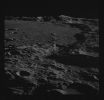
as17-153-23538.JPGAS 17-153-23538 - Mare Ingenii (Sea of Ingenuity)83 visiteImage Collection: 70mm Hasselblad
Mission: 17
Magazine: 153
Magazine Letter: MM
Revolution: 36
Latitude: 27,5° South
Longitude: 163,4° East
Lens Focal Length: 250 mm
Camera Altitude: 119 Km
Sun Elevation (on Local Horizon): 9°
Mission Activity: REV 36
Film Type: SO-368
Film Width: 70 mm
Film Color: color
Feature(s): MARE INGENIIMareKromium
|
|
|








