| Risultati della ricerca nelle immagini - "Imbrium" |

APOLLO 17 AS 17-2444.jpgAS 17-2444 - Mare Imbrium & Copernicus Crater72 visiteThis oblique view across southern Mare Imbrium looks toward Copernicus, the large crater near the horizon. The distance from the lower edge of the picture to the center of Copernicus is 400 km. The mountains at the edge of Mare Imbrium are the Montes Carpatus, and the large crater near the center of the picture is Pytheas, almost 19 km in diameter. Copernicus is one of the youngest of the Moon's large craters. It is visible from Earth, even without the aid of a telescope because of its bright ejecta blanket and its extensive bright rays. The many chains and clusters of small irregular craters and the many bright streaks or rays extending across Mare Imbrium are caused by the secondary impact of debris ejected from Copernicus. The viewing angle accentuates the radial pattern of the secondary impact features. The Sun angle is sufficiently low to show their relief, but high enough to show the contrast between the bright streaks and the normal dark mare surface. As in figure 124, herringbone ridges point toward the primary crater, and the flaring sides of the secondary craters point away from it. The arrow midway between Copernicus and the left edge of the photograph points to a less common pattern of secondary craters; these are concentric to Copernicus.
|
|

LRO-2502-Mare_Imbrium.jpgMare Imbrium74 visitenessun commentoMareKromium
|
|
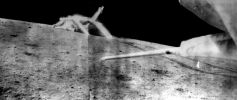
Luna17-Horz01.jpgMare Imbrium: the Rover is leaving the "nest"...274 visiteLuna-17 landed on the Moon on November 15, 1970. The robotic rover, Lunokhod-1 rolled off the landing platform to explore the surface of the Moon for about a month. Two cycloramic cameras on either side of the rover were oriented for 180° horizontal panoramas (500×3000 pixels). These panoramas are sometimes geometrically warped to correct for the 15° tilt of the camera. Two other cameras were oriented for 360° vertical panoramas of 500×6000 pixels, including images of the sky, for star locations. A level indicator was placed below these cameras, with a bull's eye pattern and a small metal ball bearing.
Over 200 panoramas were returned. Two cameras transmitted simultaneously, on 130 and 190 KHz subcarriers. Analysis of these images was carried out by the Sternberg Astronomical Institute (SAI), the Vernadskii Geophysical Institute (GEOKhI), and the Space Research Institute (IKI). The cameras were built by Arnold Selivanov's Team.
|
|

Luna17-Horz02.jpgTracks on the Moon308 visiteAs with many Soviet space images, generation loss prevents us from seeing the original quality. Most Lunokhod images are derived from scanning printed images or second-generation film copies.
Each stage of photography, printing and scanning introduces noise, nonlinear brighness mapping, and (worst of all) clamping to white or black.
As a matter of fact, all these images only hint at the appearance of the original video signal.
Nota: oltre le tecnicalità sulla fotografia, guardate attentamente il "nido" e le "tracce" lasciate dal Rover Lunokhod-1. Eravamo nel 1970, in piena Era Apollo, lontanissimi dai giorni di Spirit ed Opportunity eppure...eppure la tecnologia di Spirit ed Opportunity c'era già: davanti a noi, in queste immagini, e sulla Luna.
Le considerazioni - inevitabili - che seguono, già le conoscete...
|
|

Luna17-Horz03-a.jpgThe "Nest" of Lunokhod-1247 visitenessun commento
|
|

Luna17-Horz03-b.jpgThe "Tracks" - again - of Lunokhod-1203 visiteLuna 17 was launched from an Earth parking orbit towards the Moon and entered lunar orbit on November 15, 1970. The spacecraft soft landed on the Moon in the Sea of Rains. The spacecraft had dual ramps by which the payload, Lunokhod-1, descended to the Lunar Surface. Lunokhod-1 was a lunar vehicle formed of a tub-like compartment with a large convex lid on eight independently powered wheels. Lunokhod-1 was equipped with a cone-shaped antenna, a highly directional helical antenna, 4 tv cameras and special extendable device to impact the lunar soil for soil density and mechanical property tests. An X-Ray spectrometer, an X-Ray telescope, cosmic-ray detectors and a laser device were also included. The vehicle was powered by a solar cell array mounted on the underside of the lid. Lunokhod-1 was intended to operate through 3 Lunar Days but actually operated for 11! The operations of Lunokhod-1 officially ceased on October, 4, 1971, the anniversary of Sputnik 1. Lunokhod1- traveled 10,54 Km and transmitted more than 20,000 TV pictures and more than 200 TV panoramas. It had also conducted more than 500 lunar soil tests.
|
|

Luna17-Horz09-a.jpgThe "Nest" of Lunokhod-1 (close detail)222 visitenessun commento
|
|

Luna17-Horz09-b.jpgLarge depression and Rover tracks173 visiteUn'immagine molto importante poichè ci mostra, in maniera più che discreta, sullo sfondo verso la Vostra Dx, le tracce lasciate dal Rover Lunokhod-1.
Esse, oltre a dimostrare che il Rover si mosse in lungo ed in largo sulla superficie di questa zona del Mare Imbrium, ci dicono pure che questo antenato di Spirit ed Opportunity riuscì, diremmo senza difficoltà, ad attraversare una sensibile depressione del terreno: una prova ulteriore dell'elevata qualità del Rover, dei suoi sistemi di guida remota e delle sue notevolissime capacità di movimento.
Se Vi chiedeste come facciamo a dire che Lunokhod-1 non ebbe problemi ad attraversare la depressione lunare che si vede in questo frame, Vi diciamo che lo abbiamo dedotto dalla linearità delle tracce da esso lasciate sul terreno. Tracce che ci suggeriscono una guida spedita e per nulla indecisa. Le zone più "smosse" della Superficie Lunare, invece, ci indicano, i punti di stazionamento, di (eventuale) slittamento e di sosta per l'esecuzione di esperimenti del Rover.
|
|

Mare Imbrium.jpgA "Castle of Shadows" in Mare Imbrium122 visitenessun commento
|
|
|
|
|
| 9 immagini su 1 pagina(e) |
|








