| Risultati della ricerca nelle immagini - "Hyakutake" |
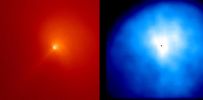
Comets-Comet_Hyakutake-PIA01288_modest.jpgThe "Hyakutake" Comet76 visiteOriginal caption:"These are 2 images of the inner coma of Comet Hyakutake made on April 3 and 4, 1996, using the NASA HST-WFPC2. The 1st one, shown in red, was taken through a narrow-band red filter that shows only sunlight scattered by dust particles in the inner coma of the comet. The 2nd one, shown in blue, was taken with an ultraviolet "Woods" filter image that shows the distribution of scattered ultraviolet radiation from H atoms in the inner coma (the "coma" is the head - or dusty-gas atmosphere - of a comet). The square field of view is 14.000 Km on a side and the Sun is toward the upper right corner of the image. H atoms represent the most abundant gas in the whole coma of the comet. They are produced when solar ultraviolet light breaks up molecules of water, the major constituent of the nucleus of the comet. The inner yellow region near the center of the red dust image is dominated by the contribution from the dust which shows sunward directed spiral jets to the upper right".
|
|
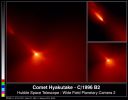
Comets-Comet_Hyakutake-PIA01290_modest.jpgThe "Hyakutake" Comet80 visiteFULL-FIELD VIEW (Left)--->This image is 3340 Km acroos and shows that most of the dust is being produced on the sunward-facing hemisphere of the comet. Also at upper left are 3 small pieces which have broken off the comet and are forming there own tails. Icy regions on the nucleus are activated as they rotate into sunlight, ejecting large amounts of dust in the jets that are faintly visible in this image. Sunlight striking this dust eventually turns it around and "blows" it into the tailward hemisphere. What might be another jet is emanating from the nightside of the nucleus, but this direction might be misleading due to the angle of the jet relative to our line-of-site.
CLOSE-UP OF NUCLEUS (Bottom Right) This expanded view of the near-nucleus region is only 760 Km across. The nucleus is near the center of the frame, but the brightest area is probably the tip of the strongest dust jet rather than the nucleus itself. Presumably, the nucleus surface lies just below this bright jet.
CLOSE-UP OF COMET FRAGMENTS (Top Right) This image shows pieces of the nucleus that apparently broke off and were first detected during ground-based observations on March 24. The Hubble image shows at least three separate objects that are probably made up of coarse-grained dust. Large fragments of the nucleus would not be accelerated into the tail, which appears to be the case in this image.
|
|
|
|
| 2 immagini su 1 pagina(e) |
|








