| Risultati della ricerca nelle immagini - "Huygens" |
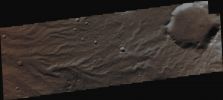
Channels-Unnamed_Channels_near_Huygens_Crater-PIA16322-PCF-LXTT-IPF.jpgUnnamed Channel near Huygens Crater (Absolute Natural Colors; credits for the additional process. and color.: Dr Paolo C. Fienga/Lunar Explorer Italia/Italian Planetary Foundation)85 visiteOrbit Number: 47248
Latitude: 16,8887° South
Longitude: 61,3382° East
Instrument: VIS
Captured: August, 8, 2012MareKromium
|
|

Craters-Huygens_Crater-PIA13800-PCF-LXTT.jpgFractures and Layers in Carbonate-bearing Rocks at Mars' Huygens Basin (Absolute Natural Colors; credits: Dr Paolo C. Fienga - Lunexit Team)294 visiteCaption NASA:This image from orbit covers an area about 460 meters (approx. 1500 feet) across, in which Carbonate Minerals have been identified from spectrometer observations. Fractures and possible Layers are visible in the light-toned Rock exposure containing the Carbonates.
The location is inside an Unnamed Crater about 35 Km (approx. 21,73 miles) in diameter that lays on the Uplifted Rim of the extremely wide Huygens Crater, which is about 467 Km (approx. 290 miles) in diameter. The excavations by the impacts that dug first Huygens and then the smaller crater have exposed material in this image that had been buried an estimated 5 Km (3,1 miles) deep.
The Carbonates may be from part of an extensive Buried Layer that could hold much of the Carbon that was once in a thick Martian Atmosphere of Carbon Dioxide, some researchers propose.
Mars now has a thin Atmosphere that is mostly Carbon Dioxide, but evidence that liquid water was once widespread on the Surface suggests the Atmosphere was much thicker billions of years ago. The High Resolution Imaging Science Experiment (HiRISE) camera on NASA's Mars Reconnaissance Orbiter provided this image.
Identification of Iron or Calcium Carbonates at this site, and also of Clay Minerals indicating a formerly wet environment, comes from an observation by the Compact Reconnaissance Imaging Spectrometer for Mars (CRISM) on the same Orbiter.
The point is that in the presence of water and other (favourable) conditions, the CO2 (Carbon Dioxide) that is present in the Martian Atmosphere can be captured into Carbonate Minerals.
The image is from HiRISE observation ESP_012897_168, made on April 27, 2009, and centered at 11,6° South Lat. and 51,9° East Long.".MareKromium
|
|
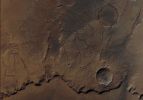
Craters-Huygens_Crater-Rim-ESA-PCF-LXTT.jpgDrainage Channels on the Rim of Huygens Crater (Absolute Natural Colors; credits for the additional process. and color.: Dr Paolo C. Fienga - Lunexit Team)201 visitenessun commentoMareKromium
|
|

ESP_019569_1640_RED_abrowse-PCF-LXTT.jpgPortion of Huygens Crater (Absolute Natural Colors; credits for the additional process. and color.: Dr Paolo C. Fienga - Lunexit Team)100 visitenessun commentoMareKromium
|
|

Huygens-IMG001253-br500.jpgThe "Huygens Probe", "camera artifacts" and 4 "known" stars92 visiteShown in white boxes are known stars; the probe is the brightest item on the lower right. The other dots are artifacts of the camera. Although only a few pixels across, this image is helping navigators reconstruct the probe's trajectory and pinpoint its position relative to Cassini. This information so far shows that the probe and Cassini are right on the mark and well within the predicted trajectory accuracy. This information is important to help establish the required geometry between the probe and the orbiter for radio communications during the probe descent on January 14. The Huygens probe, built and managed by ESA, will remain dormant until the onboard timer wakes it up just before the probe reaches Titan's upper atmosphere. Then it will begin a dramatic plunge through Titan's murky atmosphere, tasting its chemical makeup and composition as it descends to touch down on its surface. The data gathered during this 2,5 hours descent will be transmitted from the probe to the Cassini orbiter. Afterward, Cassini will point its antenna to Earth and relay the data through NASA's Deep Space Network to JPL and on to the European Space Agency's Space Operations Center in Darmstadt, Germany, which serves as the operations center for the Huygens probe mission.
|
|

Huygens-IMG001254-br500.jpgThe "Huygens Probe" - detail mgnf157 visiteCaption NASA originale: "The European Space Agency's Huygens Probe appears shining as it coasts away from Cassini in this close-up of an image taken on Dec. 26, 2004, just two days after it successfully detached from the Cassini spacecraft.
Shown here side-by-side is a close-up of the Huygens probe. The image on the left shows the relative size of the probe. The bright spots in both images are probably due to light reflecting off the blanketing material that covers the probe".
|
|
|
|
| 6 immagini su 1 pagina(e) |
|








