| Risultati della ricerca nelle immagini - "Hubble," |

M-081-4.jpgM 81: Feeding a Black Hole68 visite"...L'unico "trend" che gli Istituti dediti ai Sondaggi ed alle Statistiche si sono dimenticati di misurare è quello che io chiamo "Trend Umanistico". Ed è l'unico trend che misura e dimostra, in maniera inquivocabile, che l'Umanità, nel suo complesso - e fatte salve le ovvie ed inevitabili (e Benedette!) eccezioni -, di giorno in giorno diventa sempre più instabile, violenta, egoista ed ignorante..."
P.C. Floegers - "Conversations"
MareKromium
|
|
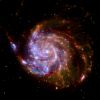
M-101-PIA11797.jpgM 10168 visiteIn 1609, Galileo improved the newly invented telescope, turned it toward the heavens, and revolutionized our view of the universe. In celebration of the 400th anniversary of this milestone, 2009 has been designated as the International Year of Astronomy.
Today, NASA's Great Observatories are continuing Galileo's legacy with stunning images and breakthrough science from the Hubble Space Telescope, the Spitzer Space Telescope, and the Chandra X-ray Observatory.
While Galileo observed the sky using visible light seen by the human eye, technology now allows us to observe in many wavelengths, including Spitzer's infrared view and Chandra's view in X-rays. Each wavelength region shows different aspects of celestial objects and often reveals new objects that could not otherwise be studied.
This image of the spiral galaxy Messier 101 is a composite of views from Spitzer, Hubble, and Chandra.
The red color shows Spitzer's view in infrared light. It highlights the heat emitted by dust lanes in the galaxy where stars can form.
The yellow color is Hubble's view in visible light. Most of this light comes from stars, and they trace the same spiral structure as the dust lanes.
The blue color shows Chandra's view in X-ray light. Sources of X-rays include million-degree gas, exploded stars, and material colliding around black holes.
Such composite images allow astronomers to see how features seen in one wavelength match up with those seen in another wavelength. It's like seeing with a camera, night vision goggles, and X-ray vision all at once.
In the four centuries since Galileo, astronomy has changed dramatically. Yet our curiosity and quest for knowledge remain the same. So, too, does our wonder at the splendor of the universe.
The International Year of Astronomy Great Observatories Image Unveiling is supported by the NASA Science Mission Directorate Astrophysics Division. The project is a collaboration between the Space Telescope Science Institute, the Spitzer Science Center, and the Chandra X-ray Center.
MareKromium
|
|
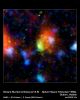
PIA10932.jpgBaby Boom!73 visiteThe green and red splotch in this image is the most active star-making galaxy in the very distant universe. Nicknamed "Baby Boom", the galaxy is churning out an average of up to 4000 stars per year, more than 100 times the number produced in our own Milky Way galaxy. It was spotted 12,3 Billion Light-Years away by a suite of telescopes, including NASA's Spitzer Space Telescope.
Baby Boom is a type of galaxy called a "Starburst".
Like some other Starbursts, it is thought to be a collection of colliding galaxies. As the galaxies smash together, gas becomes compressed, triggering the birth of stars. In this multi-wavelength portrait, the color red shows where loads of new stars are forming in Baby Boom, and where warm dust heated by the stars is giving off infrared light.
Green (visible-light wavelengths) denotes gas in the Baby Boom galaxy, while blue (also visible light) shows galaxies in the foreground that are not producing nearly as many stars. Yellow/orange (near-infrared light) indicates starlight from the outer portion of Baby Boom. The red blob to the left is another foreground galaxy that is not producing a lot of stars.
This composite contains data from NASA's Hubble Space Telescope, Spitzer and Japan's Subaru Telescope in Hawaii.MareKromium
|
|
|
| 3 immagini su 1 pagina(e) |
|








