| Risultati della ricerca nelle immagini - "Hill" |
APOLLO 15 AS 15 82-11082.jpgAS 15-82-11082 - Hadley Delta Panorama212 visitenessun commento
|
|

APOLLO 15 AS 15 82-11122 HR.jpgAS 15-82-11122 - Elbow and S. George Crater (HR)227 visiteOriginal caption:"165:21:14 MT. This frame from Jim's Station 9 pan is an excellent picture toward the South showing the bend of the rille near Elbow Crater".
|
|

APOLLO 15 AS 15 82-11122 LBL.jpgAS 15-82-11122 - Elbow and S. George Crater (lab)290 visitenessun commento
|
|

APOLLO 15 AS 15 82-11123 HR-1.jpgAS 15-82-11123 - S. George Crater (HR)193 visitenessun commento
|
|

APOLLO 15 AS 15 82-11178.jpgAS 15-82-11178 - Hadley Delta Panorama with "Anomaly" (St. 10)317 visitePanorama completo di una porzione del meraviglioso Hadley.
Nella Cerchiatura Rossa il corpo anomalo, squadrato e sagomato, che sembra librarsi a qualche centinaio di metri dagli Astronauti e di cui abbiamo visto il detail mgnf nel frame che precede.
|
|

APOLLO 17 AS 17 144.22027 - HR-1.jpgAS 17-144-22027 - White hills, distant outcrops, dark sky101 visiteUn'altra immagine della Collezione di Kipp Teague: un frame bellissimo, senza dubbio ma, se provate a confrontarlo con altri frames della serie AS 17 (Reserved Area) potrete notare come il (pur) ottimo lavoro di "pulitura&restauro" operato da Kipp finisce con lo snaturare il VERO Paesaggio Lunare. In che senso? Nel senso che il bianco intenso delle colline - esaltato dalla pulizia - cancella la profondità di campo ed il nero del cielo (palesemente "piallato" per eliminare i difetti - o presunti tali...) è assolutamente troppo denso e compatto per essere naturale. D'altra parte, come lo stesso Dr Schmitt ce lo ha recentemente ricordato, il panorama lunare è fatto di contrasti: affilati, netti, unici.
Il Sole è infinitamente più brillante di come lo possiamo vedere qui sulla Terra (anche in alta quota), e le stelle "riempiono ogni spazio della notte lunare". Certo, nelle immagini standard, la luce delle colline può "lavar via" tanti dettagli, ma nelle elaborazioni di Kipp viene "lavato via" quasi tutto...
|
|

APOLLO_15_AS_15-85-11377.jpgAS 15-85-11377 - Hadley Delta (possible True Colors; credits: Dr Paolo C. Fienga)76 visitenessun commentoMareKromium
|
|
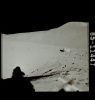
APOLLO_15_AS_15-85-11447_HR.JPGAS 15-85-11447 - Hill 305 and Station 2 Boulder (1)79 visiteCaption NASA:"123:17:15 MT - Rightward of 11446. The Station 2 boulder is on the right with Hill 305 in the distance. The rake head is still sitting on top of the boulder".
MareKromium
|
|

APOLLO_15_AS_15-86-11599-1.jpgAS 15-86-11599 (1) - Image Artifact or Bright Sphere in the distance?91 visiteCaption NASA:"125:45:12 MT - Jim is working at the back of the Rover, having taken a Sample Collection Bag (SCB) out from under his seat.
St.George Crater in in the distance behind him".
Nota Lunexit: la possibile scoperta è del Dr Barca. Indicato dalla freccia, situato ad una distanza - di fatto - indefinibile, ma non particolarmente elevata dal LR (saremo nell'ordine dei 150/200 metri e forse meno), una piccola sfera di luce bianca, dai bordi azzurri.
Vizio dell'immagine? Superi-imposed Image Artifact? "Presenza" di luce?
Congratulazioni all'attenzione ed alla passione del Dr Barca. Per il resto, lo sapete, regna il silenzio.MareKromium
|
|

Bright_Features-Ganges_Chasma-MO-PCF-LXTT.jpgBright Hills (?) in Ganges Chasma (Absolute Natural Colors; credits for the additional process. and color.: Dr Paolo C. Fienga - Lunexit Team)88 visiteCaption NASA:"This image shows a small portion of the Floor of Ganges Chasma. Visible in this image are Sand Dunes, a Sand Sheet with dune forms and eroded Bright Deposits".
Coord.: 8,4° South Lat. and 314,0° East Long.MareKromium
|
|

ESP_021569_1650-PCF-LXTT.jpgOver the Columbia Hills (Absolute Natural Colors; credits: Dr Paolo C. Fienga - Lunexit Team)317 visiteAcquisition date: 04 March 2011
Mars Local Time (M.L.T.): 15:11 (Early Afternoon)
Latitude (centered): 14,6° South
Longitude (East): 175,6°
Spacecraft Altitude: approx. 264 Km (163,944 miles)
Original Image Scale Range: 26,4 cm/pixel (with 1 x 1 binning) so objects ~79 cm across are resolved
Map Projected Scale: 25 cm/pixel and North is up
Map Projection: EQUIRECTANGULAR
Emission Angle: 2,9°
Sun-Surface-Spacecraft Angle (i.e.: Phase Angle): 48,7°
Solar Incidence Angle (S.I.A.): 46°, with the Sun about 44° above the Local Horizon
Solar Longitude: 247,7° - Northern AutumnMareKromium
|
|

ESP_021569_1650_RED_abrowse-PCF-LXTT-1.jpgOver the Columbia Hills (Natural Colors; credits: Dr Paolo C. Fienga - Lunexit Team)253 visiteAcquisition date: 04 March 2011
Mars Local Time (M.L.T.): 15:11 (Early Afternoon)
Latitude (centered): 14,6° South
Longitude (East): 175,6°
Spacecraft Altitude: approx. 264 Km (163,944 miles)
Original Image Scale Range: 26,4 cm/pixel (with 1 x 1 binning) so objects ~79 cm across are resolved
Map Projected Scale: 25 cm/pixel and North is up
Map Projection: EQUIRECTANGULAR
Emission Angle: 2,9°
Sun-Surface-Spacecraft Angle (i.e.: Phase Angle): 48,7°
Solar Incidence Angle (S.I.A.): 46°, with the Sun about 44° above the Local Horizon
Solar Longitude: 247,7° - Northern AutumnMareKromium
|
|
| 236 immagini su 20 pagina(e) |
1 |
 |
|
|
|
|
|
|
|
|
|








