| Risultati della ricerca nelle immagini - "Hesperia" |

ESP_025237_1600_RED-PCF-LXTT-00.jpgFeatures of Hesperia Planum: recent Impact Crater superposing a "Wrinkle Ridge" (CTX Frame - Absolute Natural Colors; credits for the additional process. and color.: Dr Paolo C. Fienga - Lunexit Team)141 visiteMars Local Time: 14:50 (early afternoon)
Coord. (centered): 19,7° South Lat. and 114,9° East Long.
Spacecraft altitude: 256,8 Km (such as about 160,5 miles)
Original image scale range: 25,7 cm/pixel (with 1 x 1 binning) so objects ~ 77 cm across are resolved
Map projected scale: 25 cm/pixel
Map projection: EQUIRECTANGULAR
Emission Angle: 4,0°
Sun - Mars - MRO (or "Phase") Angle: 58,7°
Solar Incidence Angle: 56° (meaning that the Sun is about 34° above the Local Horizon)
Solar Longitude: 43,4° (Northern Spring)
Credits: NASA/JPL/University of Arizona
Additional process. and coloring: Lunar Explorer ItaliaMareKromium
|
|

ESP_025237_1600_RED-PCF-LXTT-01.jpgFeatures of Hesperia Planum: recent Impact Crater superposing a "Wrinkle Ridge" (EDM - Absolute Natural Colors; credits for the additional process. and color.: Dr Paolo C. Fienga - Lunexit Team)160 visiteMars Local Time: 14:50 (early afternoon)
Coord. (centered): 19,7° South Lat. and 114,9° East Long.
Spacecraft altitude: 256,8 Km (such as about 160,5 miles)
Original image scale range: 25,7 cm/pixel (with 1 x 1 binning) so objects ~ 77 cm across are resolved
Map projected scale: 25 cm/pixel
Map projection: EQUIRECTANGULAR
Emission Angle: 4,0°
Sun - Mars - MRO (or "Phase") Angle: 58,7°
Solar Incidence Angle: 56° (meaning that the Sun is about 34° above the Local Horizon)
Solar Longitude: 43,4° (Northern Spring)
Credits: NASA/JPL/University of Arizona
Additional process. and coloring: Lunar Explorer ItaliaMareKromium
|
|

Hesperia_Planum-224co01_H-PCF-LXTT.jpgHuge Massif in Hesperia Planum249 visiteCaption ESA:"The HRSC on ESA's Mars Express obtained this image on June, 13th, 2004, during orbit 506 with a ground resolution of approx. 37,6 mt per pixel.
This view shows a portion of the Hesperia Planum Region, containing the Massif, and located at approx. 30,3° South Lat. and 97,8° East Long.".MareKromium
|
|
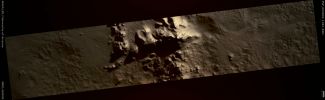
PSP_009849_1485_RED.jpgCentral Uplift and Impact Melt in Unnammed Crater in Hesperia Region (possible True Colors; credits: Lunar Explorer Italia)84 visiteMars Local Time: 15:38 (middle afternoon)
Coord. (centered): 31,3° South Lat. and 108,7° East Long.
Spacecraft altitude: 253,2 Km (such as about 158,3 miles)
Original image scale range: 50,7 cm/pixel (with 1 x 1 binning) so objects ~1,52 mt across are resolved
Map projected scale: 50 cm/pixel
Map projection: EQUIRECTANGULAR
Emission Angle: 0,4°
Phase Angle: 74,6°
Solar Incidence Angle: 74° (meaning that the Sun is about 16° above the Local Horizon)
Solar Longitude: 121,1° (Northern Summer)
Credits: NASA/JPL/University of Arizona
Additional process. and coloring: Lunar Explorer ItaliaMareKromium
|
|
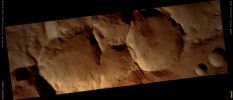
Psp_009572_1620_red.jpgSecondary Craters in Hesperia Planum (Enhanced and Saturated Natural Colors; credits for the additional process. and color.: Dr Paolo C. Fienga - Lunar Explorer Italia)72 visiteMars Local Time: 15:33 (middle afternoon)
Coord. (centered): 17,7° South Lat. and 109,6° East Long.
Spacecraft altitude: 257,5 Km (such as about 160,9 miles)
Original image scale range: 25,8 cm/pixel (with 1 x 1 binning) so objects ~77 cm across are resolved
Map projected scale: 25 cm/pixel
Map projection: EQUIRECTANGULAR
Emission Angle: 3,8°
Phase Angle: 63,7°
Solar Incidence Angle: 66° (meaning that the Sun is about 24° above the Local Horizon)
Solar Longitude: 111,1° (Northern Summer)
Credits: NASA/JPL/University of Arizona
Additional process. and coloring: Lunar Explorer Italia
Nota Lunexit: la caption NASA originale titola la foto "Fresh or Well-Preserved Chain of Impact Craters". A nostro avviso, le features di questo frame NON sono rappresentative di Crateri da Impatto Primari bensì - ed al limite - da Crateri da Impatto Secondari (è la loro forma, infatti, alquanto irregolare e squadrata, che ci suggerisce di escludere l'ipotesi per cui si tratti di Primary Impact Craters).MareKromium
|
|
|
|
|
| 5 immagini su 1 pagina(e) |
|








