| Risultati della ricerca nelle immagini - "Hemisphere" |

Dunes-Migrating_Dunes-PCF-LXTT.JPGUnnamed Southern Crater with Migrating Dunefield (Extremely Saturated and Enhanced Natural Colors; credits for the additional process. and color.: Dr Paolo C. Fienga - Lunexit Team)65 visitenessun commentoMareKromium
|
|
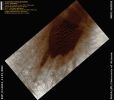
ESP_014041_1145_RED_abrowse.jpgUnusually-looking Dunefield (Natural Colors; credits: Lunexit)68 visitenessun commentoMareKromium
|
|
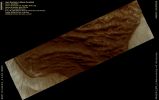
ESP_014291_1120_RED_abrowse.jpgSouthern Dunefield (Natural Colors; credits: Lunexit)64 visitenessun commentoMareKromium
|
|

ESP_022644_1085_RED_abrowse.jpgSouthern Dunefield (Absolute Natural Colors; credits for the additional process. and color.: Dr Paolo C. Fienga - Lunexit Team)191 visitenessun commentoMareKromium
|
|

ESP_023495_1115_RED_abrowse-PCF-LXTT.jpgSouthern Dunefield (Absolute Natural Colors; credits for the additional process. and color.: Dr Paolo C. Fienga - Lunar Explorer Italia)194 visiteMars Local Time: 14:31 (early afternoon)
Coord. (centered): 68,4° South Lat. and 162,7° East Long.
Spacecraft altitude: 249,0 Km (such as about 155,6 miles)
Original image scale range: 49,8 cm/pixel (with 2 x 2 binning) so objects ~ 1 mt and 49 cm across are resolved
Map projected scale: 50 cm/pixel
Map projection: POLAR STEREOGRAPHIC
Emission Angle: 2,7°
Sun-Mars-Spacecraft (or "Phase") Angle: 65,8°
Solar Incidence Angle: 64° (meaning that the Sun is about 26° above the Local Horizon)
Solar Longitude: 337,6° (Northern Winter)
Credits: NASA/JPL/University of Arizona
Additional process. and coloring: Dr Paolo C. Fienga - Lunar Explorer ItaliaMareKromium
|
|
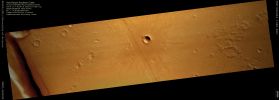
PSP_006681_1580_RED_abrowse~0.jpgFresh Southern Crater (natural colors; credits: Lunexit)106 visiteThis image features a very fresh crater in the Southern Hemisphere. The crater is termed fresh because it is well-preserved with steep walls and obvious small-scale ejecta.
The crater has a set of dark rays extending from it; these rays are ejecta that sprayed out when the crater formed. Boulders ejected during the impact surround the crater.
MareKromium
|
|
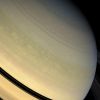
Saturn-PIA10578.jpgThe Northern Hemisphere of Saturn (Natural Colors; credits: NASA/JPL/Space Science Institute)65 visiteCaption NASA:"A chef's bounty of colors is represented in this full color view of Saturn's Northern Hemisphere.
Butternut, peach, and olive hues have replaced the azure blue of Winter. The blue of Saturn's Winter Hemisphere during the early Cassini Prime Mission still remains a puzzle. Over the course of time, the blue color has faded and has been replaced with bands of other hues (see also PIA11141).
This picture is a combination of images taken in red, green and blue light with the Cassini spacecraft wide-angle camera on Jan. 1, 2009. The view was obtained at a distance of approx. 1,1 MKM (such as about 680.000 miles) from Saturn and at a Sun-Saturn-Spacecraft, or Phase, Angle of 28°.
Image scale is roughly 65 Km (about 40 miles) per pixel".MareKromium
|
|
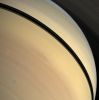
Saturn-PIA10588.jpgJust like an Iris... (Natural Colors; credits: NASA/JPL/Space Science Institute65 visiteCaption NASA:"Rendered in myriad hues, vivid details of Saturn's stormy Atmosphere play out below the shadow of the Rings. A well defined storm swirls through the atmosphere of the southern hemisphere in the lower left of the image, like the tight blue circle of an eye's iris.
This view looks toward the sunlit side of the Rings from about 36° below the Ring-Plane.
Images taken using red, green and blue spectral filters were combined to create this Natural Color view. The images were obtained with the Cassini Spacecraft wide-angle camera on Dec. 29, 2008 at a distance of approx. 1,1 MKM (such as about 680.000 miles) from Saturn and at a Sun-Saturn-Spacecraft, or Phase, Angle of 51°.
Image scale is roughly 60 Km (about 37 miles) per pixel".MareKromium
|
|
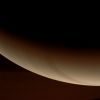
Saturn-PIA10591.jpgHigh Southern Latitudes (Natural Colors; credits: Lunar Explorer Italia)64 visiteCaption NASA:"Intricate curlicues and circular patterns of storms swirl through the High Latitudes near Saturn's South Pole in this image from the Cassini Spacecraft.
The view was obtained at a distance of approx. 588.000 Km (such as abpout 365.000 miles) from Saturn and at a Sun-Saturn-Spacecraft, or Phase, Angle of 140°. At this High Phase Angle, the Sun is illuminating the limb of the Planet from almost the opposite side of Saturn from the Spacecraft.The image was taken with the Cassini Spacecraft wide-angle camera on Jan. 5, 2009 using a spectral filter sensitive to wavelengths of near-InfraRed Light centered at 752 nanometers.
Image scale is roughly 32 Km (about 20 miles) per pixel".MareKromium
|
|

Saturn-PIA10596.jpgSouthern Turbulence (Natural Colors; credits: Lunar Explorer Italia)79 visiteCaption NASA:"Through the Atmosphere of the Southern Hemisphere of Saturn rolls a large storm, seen here as a tight dark circle in the lower left of this image. Horizontal strands of other atmospheric formations give the image the fibrous look of travertine stone.
Prometheus (about 86 Km, or 53 miles across) is a small dark dot in the top left part of the image.
The image was taken with the Cassini spacecraft wide-angle camera on Dec. 30, 2008 using a combination of polarized and spectral filters sensitive to wavelengths of near-InfraRed Light centered at 752 nanometers.
The view was acquired at a distance of approx. 1,2 MKM (about 750.000 miles) from Saturn and at a Sun-Saturn-Spacecraft, or Phase, Angle of 27°.
Image scale is roughly 68 Km (approx. 42 miles) per pixel".MareKromium
|
|
|
|
| 10 immagini su 1 pagina(e) |
|








