![Comets-Halley-Giotto-86hc145[1].jpg](albums/userpics/10008/small_Comets-Halley-Giotto-86hc145%5B1%5D.jpg "Nome del file=Comets-Halley-Giotto-86hc145[1].jpg
Dimensione del file=634KiB
Dimensioni=1756x1788
Aggiunta il=Set 17, 2006")
Comets-Halley-Giotto-86hc145[1].jpgThe "Halley Comet", from Giotto66 visitenessun commento
|
|

Comets-Halley-nucleus.jpgThe Nucleus of Halley81 visiteWhat does a Comet Nucleus look like?
Formed from the primordial stuff of the Solar System, Comet Nuclei were thought to resemble to very dirty icebergs. But ground-based telescopes revealed only the surrounding cloud of gas and dust of Active Comets nearing the Sun, clearly resolving only the Comet's Coma, and the characteristic cometary tails.
In 1986, however, the European Spacecraft "Giotto" became one of the first group of spacecrafts which encountered and photographed the Nucleus of a Comet, when it passed and imaged Halley's Nucleus as it approached the Sun.
Data from Giotto's camera were used to generate this enhanced image of the potato shaped Nucleus that measures roughly 15 Km across. Some Surface Features on the dark Nucleus are on the right, while gas and dust flowing into Halley's Coma are on the left.
Every 76 years Comet Halley returns to the Inner Solar System and each time the Nucleus sheds about a 6-meter deep layer of its ice and rock into space. This debris shed from Halley's Nucleus eventually disperses into an orbiting trail responsible for the Orionids Meteor Shower, which occurs in October of every year, and the Eta Aquariids Meteor Shower, that occurs in May.MareKromium
|
|
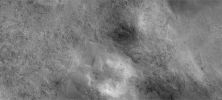
Q-S-HalleyCrater-PIA08048_modest-1.jpgIn the vicinities of Halley Crater (1)72 visiteThis image shows a landscape West of Mars' Argyre impact basin and North-East of Halley Crater. The large but faint circular feature near the center of the image is an unnamed impact crater about 7,5 Km (about 4,7 miles) in diameter. It has been all but erased by geological (and probably ice-related) processes. In fact, the majority of impact craters in this image have been modified from their original shapes, some undoubtedly beyond recognition. Only a few small craters remain pristine. The most prevalent surface type in this image is rough, dissected terrain, which is characterized by a complex pattern of knobs, pits, ridges and valleys. In places the rough terrain has been covered by a younger material that appears flat, smooth and nearly featureless. The smooth material may have been emplaced as muddy or icy debris. It filled low-lying areas (most notably craters) and surrounded higher features, preserving islands of rough terrain. Wind-formed dunes have formed atop some of the smooth material and diagonal streaks on the right side of the image may be due to the winds. Images such as this show the importance of water (liquid and/or ice), wind, and impacts in shaping the surface of Mars.
|
|

Q-S-HalleyCrater-PIA08048_modest-2.jpgIn the vicinities of Halley Crater (2)70 visiteThis image was taken by the High Resolution Imaging Science Experiment (HiRISE) camera onboard NASA's Mars Reconnaissance Orbiter spacecraft on March 24, 2006. The image is centered at 47,14° South Latitude and 302,00° East Longitude. It is oriented such that north is 7° to the left of up. The range to the target was 1.699 Km (such as about 1.056 miles). At this distance the image scale is 1,70 mt (about 5,58 feet) per pixel in the center portion of the image, so objects as small as 5,1 meter (such as 16,7 feet) are resolved. In the side regions the pixels were binned 2x2 to a scale of 3,4 mt (such as 11,2 feet) per pixel. The camera has a total of 10 red-bandpass CCD detectors and in this image the first 4 CCDs on the left and the last 3 on the right were binned 2x2, while 3 in the middle returned data at full resolution. In total this image is 34,08 Km(21,18 miles) or 20.081 pixels wide and 8,50 Km (5,28 miles) or 5.164 pixels high. The image was taken at a MLT of 07:27 and the scene is illuminated from the upper right with a Solar Incidence Angle of 84,5° (this meaning that the Sun, at the time that the picture was taken, was about 5,5° above the local horizon).
|
|








