| Risultati della ricerca nelle immagini - "Hale" |

CometHale-Bopp-970401C_lodriguss.jpgOn the edge of Oblivion...78 visite"...Mi dispiace vedere che gran parte delle persone vivano la loro Vita non secondo un modello personale - magari discutibile, ma proprio -, bensì secondo il modello creato solo ed esclusivamente dalla televisione (o da chi per essa).
Un modello orrendo e della razza peggiore.
Certo, non esiste un modello predefinito di "Vita" e allora ognuno di noi cresce assieme a quello che gli sta attorno, aiutandosi con quanto si trova in giro. Però...
Però vedo sempre più maiali inconsapevoli di viaggiare verso il mattatoio e, anche se dovrei (forse) preoccuparmi più di me stesso, questa visione - un pò - mi duole..."
Giorgio Picciau - "Lettere"MareKromium
|
|

Comets-Hale_Bopp-02.jpgThe "Dust" and "Ion" Tails of Hale-Bopp99 visiteLo splendore e la magnificenza della Cometa Hale-Bopp, durante il suo passaggio del 1997. Nell'immagine, vediamo le due code di Hale-Bopp: la coda ionica (blu intenso), composta da molecole di gas ionizzati - è il monossido di carbonio che, quando viene 'eccitato', risplende di luce azzurra - la quale si crea dall'interazione fra le particelle contenute nel Vento Solare ed i gas presenti in prossimità del nucleo della cometa. La coda ionica, in quanto spinta dal Vento Solare, si muove come una sorta di banderuola e si dirige sempre in posizione diametralmente opposta rispetto al Sole (la sorgente del "Vento"). Anche la coda di polveri (grigio-celeste) segue le leggi della coda ionica, ma essa si orienta in maniera meno netta rispetto al Sole. Questa seconda coda è formata da particelle di roccia e polveri - le cui dimensioni variano dal micron al metro ed oltre - staccatisi dal nucleo della cometa durante - ed a causa - della sua "Corsa verso il Sole".
|
|
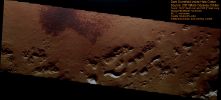
Craters-Hale_Crater-Dunes-20071210a-PCF-LXTT.jpgFeatures of Hale Crater (Darkened Absolute Natural Colors; credits for the additional process. and color: Dr Paolo C. Fienga - Lunexit Team)63 visitenessun commentoMareKromium
|
|
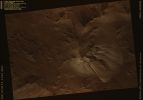
ESP_014153_1430_RED_abrowse.jpgGullies at the Edge of Hale Crater (Natural Colors; credits: Lunexit)65 visiteSeveral years ago, Gullies carved into hill-slopes and the walls of impact craters like the ones pictured here were discovered. Scientists are excited to study these features because, on Earth, they usually form through the action of liquid water - long thought to be absent on the Martian Surface.
Whether Gullies form under today's cold dry conditions is a major question that planetary scientists are trying to answer.
The Gullies pictured here are great examples of what a typical Martian Gully looks like. You can see wide V-shaped channels running downhill (from top to bottom) where the material that carved the Gully flowed. At the bottom of the channel this material empties out onto a fan-shaped mound. Several Gullies are visible here and the fans from each gully overlap one other in complicated ways.
At the tops of the channels, large amphitheater-shaped alcoves are carved in the rock. The material removed from these alcoves likely flowed downhill to the aprons through the Gullies.
Gullies at this site are especially interesting because scientists recently discovered examples at similar locations to be still active. Images separated by several years showed changes in the appearance of some of these Gullies.
Today, planetary scientists are using the HiRISE camera to examine Gullies for ongoing change and investigate what that might mean for the occurrence of liquid water on the Surface of Mars.MareKromium
|
|

ESP_019599_1445_RED_abrowse-00.jpgBright Bedrock inside Hale Crater (Absolute Natural Colors; additional process. and color.: Dr Paolo C. Fienga - Lunexit Team)85 visitenessun commentoMareKromium
|
|

ESP_019599_1445_RED_abrowse-01.jpgBright Bedrock inside Hale Crater (Absolute Natural Colors; additional process. and color.: Dr Paolo C. Fienga - Lunexit Team)76 visitenessun commentoMareKromium
|
|

PIA12194.jpgGullies at the Edge of Hale Crater (Natural Colors; credits: NASA/JPL/Univ. of Arizona)76 visiteThis image from the High Resolution Imaging Science Experiment (HiRISE) camera on NASA's Mars Reconnaissance Orbiter shows Gullies near the edge of Hale Crater on Southern Mars. The view covers an area about 1 Km (0,6 miles) across and was taken on Aug. 3, 2009.
Martian Gullies carved into hill slopes and the walls of impact craters were discovered several years ago. Scientists are excited to study these features because, on Earth, they usually form through the action of liquid water -- long thought to be absent on the Martian Surface. Whether liquid water carves gullies under today's cold and dry conditions on Mars is a major question that planetary scientists are trying to answer.
The Gullies pictured here are examples of what a typical Martian Gully looks like. You can see wide V-shaped channels running downhill (from top to bottom) where the material that carved the gully flowed. At the bottom of the channel this material empties out onto a fan-shaped mound. The fans from each gully overlap one other in complicated ways. At the tops of the channels, large amphitheater-shaped alcoves are carved in the rock. The material removed from these alcoves likely flowed downhill to the aprons through the Gullies.
The terrain in this image is at 36,5° South Latitude and 322,7° East Longitude.
Gullies at this site are especially interesting because scientists recently discovered actively changing examples at similar locations. Images separated by several years showed changes in the appearance of some of these Gullies. Today, planetary scientists are using the HiRISE camera to examine Gullies such as the one in this image for change that might provide a clue about whether liquid water occurs on the Surface of Mars.
Full-frame images, catalogued as ESP_014153_1430, are at http://hirise.lpl.arizona.edu/ESP_014153_1430.
The image was taken at 2:21 p.m. Local Mars Time, with the sun 54° above the horizon (S.I.A. = 36°).
The season was Summer in the Southern Hemisphere of Mars.MareKromium
|
|

PSP_002932_1445_RED_abrowse-00.jpgSection of the Outer Rim of Hale Crater (CTX Frame - Absolute Natural Colors; credits for the additional process. and color.: Dr Paolo C. Fienga - Lunexit Team)115 visiteThis observation shows Hale Crater, a rather large, pristine elliptical crater approximately 125 x 150 Km in diameter. Hale Crater possesses sharp features, impact melt bodies ponded through out the structure and few overprinting Impact Craters. These attributes indicate that it is relatively young and certainly well-preserved - likely the youngest crater of this size on Mars.
Present on the Crater Walls are a large number of Gullies, some with Light-Toned Deposits. The Gullies visible here are very well developed, and many are cut deeply into the Hale's Walls. Several have "Braided Channels" suggestive of repeated flow. Some of the Gullies have Boulders littered throughout their Channels. This could be a result of a fluid preferentially transporting smaller particles and leaving larger rubble behind.
The composition of the Light-Toned Deposits are currently unknown. The CRISM Visible-InfraRed Spectrometer, HiRISE's sister instrument on MRO, may be able to shed some light on the composition of these materials.
In one place along the Crater Rim, Gullies are visible on both sides of the Rim (see the EDM that follows). This has only been seen in a few locations on Mars.MareKromium
|
|

PSP_002932_1445_RED_abrowse-01.jpgSection of the Outer Rim of Hale Crater (EDM - Absolute Natural Colors; credits for the additional process. and color.: Dr Paolo C. Fienga - Lunexit Team)97 visitenessun commentoMareKromium
|
|

PSP_005609_1470_RED_abrowse-00.jpgInside Hale Crater (CTX Frame; Natural Color credits: Lunexit)80 visiteChannels associated with Impact Craters were once thought to be quite rare. Scientists proposed a variety of unusual circumstances to explain them, such as impacts by Comets or precipitation caused by the impact event. As more of Mars is photographed with High-Resolution imagery, more craters surrounded by Channel Systems are being discovered.
The Channels in this HiRISE image are from Hale Crater, an exceptionally well-preserved 125 x 150 Km (approx. 78 x 93 mile) Impact Crater located on the Northern Rim of the Argyre Basin.
Hale Crater is roughly 170 Km (a little more than 100 miles) to the South/East.MareKromium
|
|

PSP_005609_1470_RED_abrowse-01.jpgInside Hale Crater (EDM n.1 - processing by NASA/JPL/Univ. of Arizona; Natural Color credits: Lunexit)75 visitenessun commentoMareKromium
|
|

PSP_005609_1470_RED_abrowse-02.jpgInside Hale Crater (EDM n.2 - processing by: Dr M. Faccin; Natural Color credits: Lunexit)76 visitenessun commentoMareKromium
|
|
| 19 immagini su 2 pagina(e) |
1 |
|








