| Risultati della ricerca nelle immagini - "Gullies" |

Argyre_Planitia-PIA14043-PCF-LXTT.jpgGullies in Argyre Planitia (Natural Colors; credits for the additional process. and color.: Dr Paolo C. Fienga - Lunexit Team)226 visitenessun commentoMareKromium
|
|
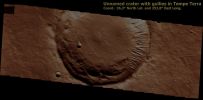
Craters-Unnamed_Crater-TempeTerra-PCF-LXTT.jpgUnnamed Crater in Tempe Terra (Natural Colors; credits for the additional process. and color.: Dr Paolo C. Fienga - Lunexit Team)77 visitenessun commentoMareKromium
|
|

Craters-Unnamed_Crater-Terra_Cimmeria-PIA16266-PCF-LXTT-IPF.jpgUnnamed Crater with Gullies and Dunefield in Terra Cimmeria (Absolute Natural Colors; credits for the additional process. and color.: Dr Paolo C. Fienga/Lunar Explorer Italia/Italian Planetary Foundation)74 visiteIn this frame, taken by the NASA - Mars Odyssey Orbiter during its 49.393rd orbit around the Red Planet, several Gullies of different shapes, depths and sizes located on the Southern Rim of an Unnamed Impact Crater in Terra Cimmeria can be seen. As you may easily notice, there are way more Gullies on the North-facing Inner Rim (such as the Southern Inner Rim) of this Unnamed Crater, and the reason of such a remarkable difference is found, most likely, in the circumstance that the Southern Region of the Crater itself gets more Sun-related warming than the other one, which is corresponding to the South-facing Inner Rim (such as the Northern Inner Rim).
Also well visible towards the top of the picture, right at the base of the Northern Inner Slopes (Wall) of this Unnamed Cimmerian Impact Crater, there is a small and Dark Dunefield (probably formed - once you take into duly consideration the peculiar-looking shapes and surroundings of the Dunes forming it - by "Migrating Dunes". Dunes which may contain, among Dust, Rocky Sands and Volcanic Ashes, also a significant amount of Iron Oxide). It must be said, however, that a Surface Feature like this last one (---> the Dark Dunefield), is really very common, specifically at these Middle (Southern) Latitudes.
Latitude: 48,25° South
Longitude: 129,612° East
Instrument: VIS
Captured: February, 1st, 2013
This frame (which is an Original Mars Odyssey Orbiter b/w frame published on the NASA - Planetary Photojournal with the ID n. PIA 16266) has been additionally processed and then colorized in Absolute Natural Colors (such as the colors that a human eye would actually perceive if someone were onboard the NASA - Mars Odyssey Orbiter and then looked down, towards the Surface of Mars), by using an original technique created - and, in time, dramatically improved - by the Lunar Explorer Italia Team.MareKromium
|
|

Craters-Unnamed_Crater-Terra_Cimmeria.JPGUnnamed Crater with Gullies in Terra Cimmeria (Original NASA/MGS/MSSS b/w Frame)65 visiteCaption NASA originale:"This MGS-MOC image shows an array of gullies in the North-NorthWest wall of a crater in Terra Cimmeria. These features may have been formed through the interaction of several processes including, but not limited to, mass wasting and/or seepage and runoff of groundwater".
Location near: 33,5° South Lat. and 207,2° West Long.
Image width: ~3 Km (~1,9 mi)
Illumination from: upper left
Season: Southern Summer
|
|

Craters-Unnamed_Crater.jpgOn the edge... (Original NASA/MGS/MSSS b/w Frame)77 visiteCaption NASA originale:"This MGS-MOC image shows gullies on the Wall of a Martian South Mid-Latitude Unnamed Impact Crater. The Channels in each Gully head beneath an eroding overhang of layered rock, providing support for the hypothesis that some (if not all) Martian Gullies result from release of groundwater to the Surface".
Location near: 33,0° South Lat. and 213,4° West Long.
Image width: ~3 Km (~1,9 mi)
Illumination from: upper left
Season: Southern Autumn
|
|

Craters-Unnamed_Crater_with_Gullies-MGS-0.jpgUnnamed Crater with Gullies (Original NASA/MGS/MSSS b/w Frame)66 visiteCaption NASA originale:"This MGS-MOC image shows gullies and cracked and stressed gully apron deposits in a South mid-Latitude crater. Gullies can also be seen in the deep shadow on the North wall of the crater. These gullies might have formed by the erosive action of liquid water, sometime in the not-too-distant martian past".
Location near: 36,7° South; 206,2° West
Image width: ~3 Km (~1,9 mi)
Illumination from: upper left
Season: Southern Autumn
Nota: attenzione a quello che la NASA ha scritto in sede di commento: adesso il passato al quale fare riferimento per pensare ad acqua che scorre "allo stato liquido" su Marte non è più remoto (un miliardo di anni o giù di lì); adesso questo passato è "...not too distant..." e cioè "passato prossimo". RicordateVi, in futuro, di quello che stiamo scrivendo da mesi: un frame dopo l'altro ed una parola dopo l'altra, la NASA si sta (lentamente ma) costantemente ridefinendo in chiave possibilista molte delle proprie posizioni (da anni più che consolidate) su molti aspetti/enigmi del Pianeta Rosso.
A quando l'ammissione di una "forma vitale" attuale, magari sotterranea?!?...
|
|

Craters-Unnamed_Crater_with_Gullies-MGS-1-PCF-LXTT.jpgUnnamed Crater with Gullies (Absolute Natural Colors; credits for the additional process. and color.: Dr Paolo C. Fienga - Lunar Explorer Italia)65 visiteCaption NASA originale:"This MGS-MOC image shows Gullies and cracked and stressed Gully-Apron Deposits in a South Mid-Latitude Unnamed Crater. Gullies can also be seen in the deep shadow on the North Wall of the Crater. These Gullies might have formed by the erosive action of liquid water, sometime in the not-too-distant Martian Past".
Location near: 36,7° South; 206,2° West
Image width: ~3 Km (~1,9 mi)
Illumination from: upper left
Season: Southern Autumn
Nota: attenzione a quello che la NASA ha scritto in sede di commento: adesso il passato al quale fare riferimento per pensare ad acqua che scorre "allo stato liquido" su Marte non è più remoto (un miliardo di anni o giù di lì); adesso questo passato è "...not too distant..." e cioè "passato prossimo". RicordateVi, in futuro, di quello che stiamo scrivendo da mesi: un frame dopo l'altro ed una parola dopo l'altra, la NASA si sta (lentamente ma) costantemente ridefinendo in chiave possibilista molte delle proprie posizioni (da anni più che consolidate) su molti aspetti/enigmi del Pianeta Rosso.
A quando l'ammissione di una "forma vitale" attuale, magari sotterranea?!?... MareKromium
|
|

Craters-Unnamed_Crater_with_Gullies-PCF-LXTT.jpgSouthern Crater with Gullies and Dunes (Enhanced and Saturated Natural Colors; credits for the additional process. and color.: Dr Paolo C. Fienga - Lunar Explorer Italia)72 visiteGullies dissect the Crater Rim and Dunes cover part of the floor of the Unnamed Crater located East of Russell Crater.MareKromium
|
|

Craters-Unnamed_Crater_with_Gullies.jpgGullies, from MRO65 visitenessun commentoMareKromium
|
|

ESP_011460_0980_RED_abrowse.jpgMonitor Seasonal Changes at a South Polar Cracked and Gullied Site (Natural Colors; credits: Lunar Explorer Italia)106 visiteMars Local Time: 17:02 (middle afternoon)
Coord. (centered): 81,7° South Lat. and 66,3° East Long.
Spacecraft altitude: 246,5 Km (such as about 154,1 miles)
Original image scale range: 49,3 cm/pixel (with 1 x 1 binning) so objects ~ 1,48 mt across are resolved
Map projected scale: 50 cm/pixel
Map projection: EQUIRECTANGULAR
Emission Angle: 1,2°
Phase Angle: 86,5°
Solar Incidence Angle: 85° (meaning that the Sun is about 5° above the Local Horizon)
Solar Longitude: 186,1° (Northern Autumn)
Credits: NASA/JPL/University of Arizona
Additional process. and coloring: Lunar Explorer ItaliaMareKromium
|
|

ESP_011526_0980_RED_abrowse.jpgMonitor Seasonal Changes at a South Polar Cracked and Gullied Site (Natural Colors; credits: Lunar Explorer Italia)79 visiteMars Local Time: 17:10 (middle afternoon)
Coord. (centered): 81,7° South Lat. and 66,3° East Long.
Spacecraft altitude: 246,5 Km (such as about 154,1 miles)
Original image scale range: 49,3 cm/pixel (with 1 x 1 binning) so objects ~ 1,48 mt across are resolved
Map projected scale: 50 cm/pixel
Map projection: EQUIRECTANGULAR
Emission Angle: 2,6°
Phase Angle: 82,3°
Solar Incidence Angle: 84° (meaning that the Sun is about 6° above the Local Horizon)
Solar Longitude: 189,1° (Northern Autumn)
Credits: NASA/JPL/University of Arizona
Additional process. and coloring: Lunar Explorer ItaliaMareKromium
|
|

ESP_012912_1320_RED_abrowse.jpgGullies in Noachis Terra (Natural Colors; credits: Lunar Explorer Italia)79 visiteGeologically young Gullies are a prime target for the HiRISE camera. Gullies are located in a variety of settings and are found all over Mars.
This "Ring Trough" or "Eroded Pit Crater", is located in the rugged Southern Highland Terrain known as Noachis Terra. The HiRISE image shows the layered, boulder-rich wall rock facing to the North-East and Gullies that are transporting material downslope.
The material collects into debris aprons along the walls, which often exhibit narrow channels along its surface.MareKromium
|
|
| 119 immagini su 10 pagina(e) |
1 |
 |
|
|
|
|
|
|
|








