| Risultati della ricerca nelle immagini - "Ganymede" |
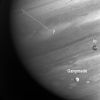
14-vg1_1610104.jpgJupiter, Io, Ganymede and...74 visiteL'oggetto indicato dalla freccia e contraddistinto da un "?" non è un photoartifact (nella maniera più categorica) e non è neppure una delle altre Lune Maggiori (o Galileiane) di Giove - e quindi non si tratta nè di Europa, nè di Callisto.
Abbiamo pensato potesse trattarsi di Amalthea, ma l'oggetto è troppo piccolo e non riusciamo a risolverlo per osservarne i dettagli superficiali e, soprattutto, le fattezze esteriori.
Se qualcuno di Voi avesse delle idee, ci scriva!
|
|
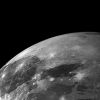
500-PIA02233.jpgGanymede (HR)87 visiteCaption NASA originale:"This picture of Ganymede was taken from a range of about 272.000 Km. The center of the picture lies at 13° Latitude and 359° Longitude. Many bright impact craters are shown that have radial ejecta patterns. These rays lie across and therefore are younger than the bright and dark background material. Many older impact craters are shown that have lost their rays probably by impact erosion. The bright background areas contain grooves and ridges that may be caused by faulting of the surface materials".
|
|
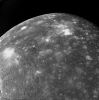
501-vg1_1641854.jpgGanymede (HR)69 visitenessun commento
|
|

502-PIA01515.jpgGanymede (natural colors and HR)70 visiteCaption NASA originale:"This color picture was acquired by Voyager 1 during its approach to Ganymede. At ranges between about 230 to 250.000 Km. The images show detail on the surface with a resolution of 4,5 Km/px. This picture is relevant to a region in the Northern Hemisphere, near the terminator. It shows a variety of impact structures, including both razed and unrazed craters, and the odd, groove-like structures discovered by Voyager in the lighter regions. The most striking features are the bright ray craters which have a distinctly 'bluer' color appearing white against the redder background. Ganymede's surface is known to contain large amounts of surface ice and it appears that these relatively young craters have spread bright fresh ice materials over the surface. Likewise, the lighter color and reflectivity of the grooved areas suggests that here, too, there is cleaner ice".
|
|

504-PIA01516.jpgGanymede (natural colors and HR)63 visiteCaption NASA originale:"This color picture as acquired by Voyager 1 during its approach to Ganymede, at ranges between about 230 to 250.000 Km. The image shows detail on the surface with a resolution of 4,5 Km/px.
This picture shows the two distinctive types of terrain found by Voyager: the darker ungrooved regions and the lighter areas which show the grooves or fractures in abundance. The most striking features are the bright ray craters which have a distinctly "bluer" color appearing white against the redder background. Ganymede's surface is known to contain large amounts of surface ice and it appears that these relatively young craters have spread bright fresh ice materials over the surface. Likewise, the lighter color and reflectivity of the grooved areas suggests that here too, there is cleaner ice. We see ray craters with all sizes of ray patterns, ranging from extensive systems of the crater in the northern part of this picture, which has rays at least 300-500 kilometers long, down to craters which have only faint remnants of bright ejecta patterns".
|
|
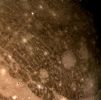
505-PIA00356.jpgGanymede (Enhanced Natural Colors and HR; credits: NASA/JPL)64 visiteCaption NASA originale:"This color reconstruction of part of the Northern Hemisphere of Ganymede was made from pictures taken from a range of about 313.000 Km (approx. 194.000 miles).
The scene is approx. 1.300 Km (about 806 miles) across and it shows part of dark, densely cratered block which is bound on the south by lighter and less cratered, grooved terrain.
The dark blocks are believed to be the oldest parts of Ganymede's surface. Numerous craters are visible, many with central peaks. The large bright circular features have little relief and are probably the remnants of old, large craters that have been annealed by flow of the icy near-surface material.
The closely-spaced arcuate, linear features are probably analogous to similar features on Ganymede which surround a large impact basin.
The linear features here may indicate the former presence of a large impact basin to the South-West".
|
|

505-PIA00357.jpgGanymede (Enhanced Natural Colors and HR; credits: NASA/JPL)70 visiteCaption NASA originale:"This color picture of Ganymede is relevant to a Region located at 30° South Lat. and 180° West Long. It shows features as small as 6 Km (about 3,7 miles) across. Notice here a bright halo impact crater that shows the fresh material thrown out of the crater. In the background it can be seen a bright grooved terrain that may be the result of the shearing of the surface materials along fault planes.
The dark background material is the ancient heavily cratered terrain -- probably the oldest material preserved on the surface of Ganymede".
|
|

507-PIA01517.jpgThe equatorial Region of Ganymede63 visiteCaption NASA originale:"This picture is relevant to a Regione near the Equator of Ganymede, and has relatively subdued colors in the visible part of the spectrum. The most striking features are the bright ray craters which have a distinctly bluer color, appearing white against the redder background.
Ganymede's surface is known to contain large amounts of surface ice and it appears that these relatively young craters have spread bright fresh ice materials over the surface.
Likewise, the lighter color and reflectivity of the grooved areas suggest that here, too, there is cleaner ice. We see ray craters with all sizes of ray patterns, ranging from extensive systems, down to craters which have only faint remnants of bright ejecta patterns.
This variation suggests that, as on the Moon, there are processes which act to darken ray material - probably the so-called "gardening", by micrometeoroid impacts".
|
|

Ganymede and Europa-PIA02574.jpgGanymede and Europa: so different and yet so similar!79 visiteThis frame compares a HR view of Arbela Sulcus on Ganymede (top) with the gray band Thynia Linea on another Jovian moon, Europa (bottom), shown to the same scale. Both images are from NASA's Galileo spacecraft.
Arbela Sulcus is one of the smoothest lanes of bright terrain identified on Ganymede, but subtle striations are apparent here along its length. This section of Arbela contrasts markedly from highly fractured terrain to its west and dark terrain to its east.
On Europa, gray bands such as Thynia Linea have formed by tectonic crustal spreading and renewal. Such bands have sliced through and completely separated pre-existing features in the surrounding bright, ridged plains. The younger prominent double ridge Delphi Flexus cuts across Thynia Linea. The scarcity of craters on Europa attests to the relative youth of its surface compared to Ganymede's.
Unusual for Ganymede, it is possible that Arbela Sulcus has formed by complete separation of Ganymede's icy crust, like bands on Europa. Tests of this idea come from detailed comparisons of their internal shapes and the relationships to the surrounding structures.
In the Ganymede image, north is to the top of the picture and the Sun illuminates the surface from the west. The image, centered at -15degrees latitude and 347 degrees longitude, covers an area approximately 34 by 26 kilometers (21 by 16 miles). The resolution is 34 meters (112 feet) per picture element. The image was taken on May 20, 2000, at a range of 3,370 kilometers (2,094 miles).
In the Europa image, north is to the upper-right of the picture and the Sun illuminates the surface from the northwest. The image, centered at-66 degrees latitude and 161 degrees longitude, covers an area approximately 44 by 46 kilometers (27 by 29 miles). The resolution is 45 meters (147 feet) per picture element. The image was taken on September 26, 1998, at a range of 3,817 kilometers (2,371 miles).
|
|

Ganymede-P-51236218280_1b20779992_o.pngGanymede117 visitenessun commentoMareKromium
|
|

Ganymede-PIA00353~0.jpgGanymede from 2,6 MKM68 visiteThis picture was taken on March 4, 1979 at 2:30 A.M. PST by Voyager 1 from a distance of about 2,6 MKM (such as about 1,6 MMs). Ganymede is Jupiter's largest satellite with a radius of about 2600 Km which means about 1,5 times that of our Moon. Ganymede has a bulk density of only approximately 2,0 g/cc (almost half that of the Moon).
In the light of the above, Ganymede is probably composed of a mixture of rock and ice. The features here, the large dark regions, in the northeast quadrant, and the white spots, resemble features found on the Moon, mare and impact craters respectively. The long white filaments resemble rays associated with impacts on the lunar surface. The various colors of different regions probably represent differing surface materials. There are several dots on the picture of single color (blue, green, and orange) which are the result of markings on the camera used for pointing determinations and are not physical markings.
|
|

Ganymede-PIA00380_modest.jpgGanymede from 250.000 Km68 visiteCaption NASA originale:"This picture of Ganymede, Jupiter's largest satellite, was taken by Voyager 1 on the afternoon of March 5, 1979, from a range of about 250,000 km. The center of the picture is at 60 north latitude and 318 longitude and the distance across the bottom of the photograph is about 1000 km. The smallest features visible in this picture are about 5 km across. This picture shows impact craters many of which display ray systems probably consisting largely of icy material thrown out by the impacts. Peculiar systems of sinuous ridges and grooves traverse the surface and are best seen near the terminator".
|
|
| 33 immagini su 3 pagina(e) |
1 |
|








