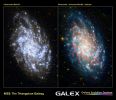
M-033-a.jpgM 33 - The "Triangulum" Spiral Galaxy (a.k.a. NGC 598)70 visiteNASA's Galaxy Evolution Explorer Mission celebrates its sixth anniversary studying galaxies beyond our Milky Way through its sensitive UltraViolet telescope, the only such far-UltraViolet detector in space.
The mission studies the shape, brightness, size and distance of distant galaxies across 10 BY of cosmic history, giving scientists a wealth of data to help us better understand the origins of the universe. One such object is pictured here, the galaxy NGC 598, more commonly known as M 33.
The image shows a map of the recent star formation history of M 33. The bright blue and white areas are where star formation has been extremely active over the past few million years. The patches of yellow and gold are regions where star formation was more active 100 MY ago.
In addition, the UltraViolet image shows the most massive young stars in M 33. These stars burn their large supply of Hydrogen fuel quickly, burning hot and bright while emitting most of their energy at UV wavelengths. Compared with low-mass stars like our Sun, which live for billions of years, these massive stars never reach old age, having a lifespan as short as a few million years.
The California Institute of Technology, in Pasadena, Calif., leads the Galaxy Evolution Explorer Mission and is responsible for science operations and data analysis. NASA's Jet Propulsion Laboratory, also in Pasadena, manages the mission and built the science instrument. The mission was developed under NASA's Explorers Program managed by the Goddard Space Flight Center, Greenbelt, Md. South Korea and France are the mission's international partners.MareKromium
|
|
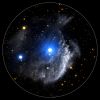
NGC-3242-PIA11968.jpgThe Extended Region around the Planetary Nebula NGC 324270 visiteThe unfortunate name of Planetary Nebula for this class of Celestial Objects is a historical legacy credited to William Herschel during the 18th Century — a time when telescopes where small and objects like these, at least the central region, looked very similar to gas-giant planets such as Saturn and Jupiter. In fact, NGC 3242 has no relation to Jupiter or any other planet.
Telescopes and their detectors have dramatically improved over the past few centuries. Our understanding of what Planetary Nebulae truly are has improved accordingly.
When stars with a mass similar to our Sun approach the end of their lives by exhausting supplies of Hydrogen and Helium fuel in their cores, they swell up into cool red-giant stars. In a last gasp before death, they expel the layers of gas in their Outer Atmosphere. This exposes the core of the dying star, a dense hot ball of Carbon and Oxygen called a "White Dwarf".
The White Dwarf is so hot that it shines very brightly in the UltraViolet Spectrum. The UltraViolet Light from the White Dwarf, in turn, ionizes the gaseous material expelled by the star causing it to glow. A Planetary Nebula is really the death of a low-mass star.
Although low-mass stars like our Sun live for billions of years, Planetary Nebulae only last for about ten thousand years. As the central white dwarf quickly cools and the UltraViolet Light dwindles, the surrounding gas also cools and fades.
In this image of NGC 3242 from the Galaxy Evolution Explorer, the Extended Region around the Planetary Nebula is shown in dramatic detail. The small circular white and blue area at the center of the image is the well-known portion of the famous Planetary Nebula. The precise origin and composition of the extended wispy white features is not known for certain. It is most likely material ejected during the star's red-giant phase before the White Dwarf was exposed.
However, it may be possible that the extended material is simply interstellar gas that, by coincidence, is located close enough to the White Dwarf to be energized by it, and induced to glow with UltraViolet Light.
NGC 3242 is located 1400 to 2500 Light-Years away in the constellation of Hydra. It was discovered by William Herschel in 1785.MareKromium
|
|
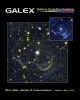
Z-Camelopardalis-PIA09219.jpgZ-Camelopardalis69 visiteThis composite image shows Z Camelopardalis, or Z Cam, a double-star system featuring a collapsed, dead star, called a white dwarf, and a companion star, as well as a ghostly shell around the system. The massive shell provides evidence of lingering material ejected during and swept up by a powerful classical nova explosion that occurred probably a few thousand years ago.
The image combines data gathered from the far-ultraviolet and near-ultraviolet detectors on NASA's Galaxy Evolution Explorer on Jan. 25, 2004. The orbiting observatory first began imaging Z Cam in 2003.
Z Cam is the largest white object in the image, located near the center. Parts of the shell are seen as a lobe-like, wispy, yellowish feature below and to the right of Z Cam, and as two large, whitish, perpendicular lines on the left.
Z Cam was one of the first known recurrent dwarf nova, meaning it erupts in a series of small, "hiccup-like" blasts, unlike classical novae, which undergo a massive explosion. That's why the huge shell around Z Cam caught the eye of astronomer Dr. Mark Seibert of Carnegie Institution of Washington in Pasadena, Calif. - it could only be explained as the remnant of a full-blown classical nova explosion. This finding provides the first evidence that some binary systems undergo both types of explosions. Previously, a link between the two types of novae had been predicted, but there was no evidence to support the theory.
The faint bluish streak in the bottom right corner of the image is ultraviolet light reflected by dust that may or may not be related to Z Cam. Numerous foreground and background stars and galaxies are visible as yellow and white spots. The yellow objects are strong near-ultraviolet emitters; blue features have strong far-ultraviolet emission; and white objects have nearly equal amounts of near-ultraviolet and far-ultraviolet emission.
|
|
|








