| Risultati della ricerca nelle immagini - "G-Ring" |

Rings-PIA07718.jpgArcs in the G-Ring53 visiteOriginal NASA caption:"This sequence of images shows a faint arc of material in Saturn's G-Ring, a tenuous ring outside the main Ring System. These images were each taken about 45' apart. During this time, the arc (slightly brighter than the Ring itself) moves around the outer edge of the Ring. The arc is visible on the lower part of the Ring in the first image, just beneath the ansa (or outer edge). In the second image the arc is easily seen on the outer edge and then faintly just above the outer edge in the third image.
What makes this part of the G-Ring brighter than other parts is not clear. However, the existence of this arc might hold clues about how this ring was formed and where the material which makes up this ring comes from. These 3 images were taken in polarized near-infrared light using the Cassini spacecraft narrow-angle camera on May 24, 2005, at a distance of approx. 1,7 MKM (about 1,1 MMs) from Saturn. Resolution in the original images was about 97 Km per pixel".
|
|
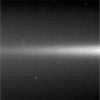
The Rings-GRing-N00055772.jpgN00055772: the motion of Cassini54 visiteData:"N00055772.jpg was taken on March 21, 2006 and received on Earth March 22, 2006. The camera was pointing toward Saturn's G-Ring that, at the time, was approximately 749.522 Km away.
The image was taken using the CL1 and CL2 filters. This image has not been validated or calibrated".
|
|
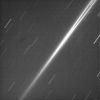
The Rings-PIA06627.jpgThe G-Ring and "Star-Trails"55 visiteCaption NASA originale:"Cassini's ability to remain sharply pointed at its targets allowed this image of Saturn's faint, dusty G-Ring to be made. The thin streaks visible here are "Star-Trails", which are created during long exposures, when the spacecraft remains locked onto a single target. The camera shutter was open for 3 and 1/2 minutes during this particular exposure. A long exposure was required to see details of this quite tenuous Ring.
The feature inside the G-Ring, at upper right, is also a star trail.
The image was taken in polarized visible light with the Cassini spacecraft narrow-angle camera on March 7, 2005, at a distance of approx. 1,2 MKM (such as approx. 750.000 miles) from Saturn. The image scale is approx. 10 Km per pixel".
|
|
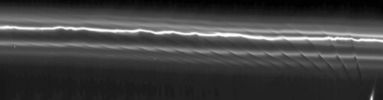
The Rings-PIA07750.jpgSurfing the waves of the F-Ring (from 1,1 MKM)53 visiteOriginal caption:"This mosaic of 15 Cassini images of Saturn's F-Ring shows how the moon Prometheus creates a gore in the Ring once every 14 h and 42', as it approaches and recedes from the F-Ring on its eccentric orbit. The individual images have been processed to make the Ring appear as if it has been straightened, making it easier to see the Ring's structure. The mosaic shows a Region 147.000 Km (about 91.000 miles) along the Ring (horizontal direction in the image); this represents about 60° of Longitude around the Ring. The Region seen here is about 1500 Km (900 miles) across (vertical direction). The first and last images in the mosaic were taken approximately 2,5 hours apart.
Each dark channel, or "gore," is clearly visible across more than 1,000 kilometers (600 miles) of the ring and is due to the gravitational effect of Prometheus (102 kilometers, or 63 miles across), even though the moon does not enter the F ring. The channels have different tilts because the ring particles closer to Prometheus (overexposed, stretched, and just visible at the bottom right of the image) move slower with respect to the moon than those farther away. This causes the channels to shear with time, their slopes becoming greater, and gives the overall visual impression of drapes of ring material. The channels at the right are the youngest and have near-vertical slopes, while those at the left are the oldest and have near-horizontal slopes. This phenomenon has not previously been detected in any other planetary ring system, but computer simulations of the system prove that the disturbance is caused by a simple gravitational interaction. The eccentric orbit of Prometheus is gradually moving so that the moon will eventually come even closer in its closest approach to the eccentric F ring. Scientists calculate that its perturbations of the F ring will reach a maximum in December 2009".
|
|

TheRings-G-Ring-PIA07643.jpgThe G-Ring's "Glow"55 visiteOriginal caption:"Saturn's G-Ring glows like a neon garland in this lovely narrow angle camera image from Cassini. The comparison between the diffuse outer boundary and the sharp inner edge of this Ring, which consists of fine, dust-sized icy particles, is particularly noteworthy. Close Cassini views such as this should provide Ring scientists with clues about how this Ring is produced and confined.
The G-Ring extends from 166.000 to 173.200 Km (about 103.100 to 107.600 miles) from Saturn's center. (remember: Saturn is 120.500 Km [about 74.900 miles] wide at its equator).
The image was taken in visible light with the Cassini narrow-angle camera on Oct. 24, 2005, at a distance of approx. 2,1 MKM (about 1,3 MMs) from Saturn. The image scale is 12 Km (about 8 miles) per pixel".
|
|

The_Rings-AtoG-PIA10505.jpgThe Rings (natural colors; credits: Lunexit)56 visitenessun commentoMareKromium
|
|

The_Rings-PIA10524.jpgFaint Ring Arcs in the G-Ring (possible True Colors; credits: Lunar Explorer Italia)99 visiteCaption NASA:"This low elevation image shows the G-Ring Arc recently discovered by Cassini. This faint arc of material is maintained by a gravitational interaction with the moon Mimas.
The image was taken in Visible Light with the Cassini Spacecraft narrow-angle camera on Oct. 20, 2008 at a distance of approx. 1,2 MKM (about 736.000 miles) from Saturn and at a Sun-Saturn-Spacecraft angle of 23°. Image scale is roughly 7 Km (such as about 4 miles) per pixel".
Nota Lunexit: il chiarore che si percepisce sulla Sx del frame è un effetto dovuto alla luce intensa che proviene da Saturno stesso (per riprendere con simile dettaglio il debole Anello "G", infatti, l'obiettivo di Cassini è - molto probabilmente - stato tenuto aperto per un tempo superiore ai 10 secondi, così leggermente sovraesponendo il frame sul suo lato più prossimo a Saturno; un altro elemento che ci permette di dire che la "posa" è stata pari o superiore alla decina di secondi la potete trovare nelle numerose "star-trails", che costellano il cielo intorno all'Anello "G").MareKromium
|
|
|
| 7 immagini su 1 pagina(e) |
|





