| Risultati della ricerca nelle immagini - "Fractures" |
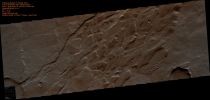
Graben-Tempe_Terra-PIA13345.jpgFractures-System in Tempe Terra (Natural Colors; credits for the additional process. and color.: Dr Paolo C. Fienga - Lunexit Team)101 visitenessun commentoMareKromium
|
|

Hestia_Rupes-PIA00469.jpgComplex Network of Narrow Fractures near Hestia Rupes Region (possible Natural Colors; credits: Dr Paolo C. Fienga - Lunexit Team)77 visiteThis is a Magellan radar image covering an about 105- Km (approx. 63-mile) by 45-Km (approx. 27-mile) Region near Hestia Rupes on the North-Western corner of Aphrodite Terra.
The complex network of narrow (such as <1 Km) Fractures in the center of the image extends for approx. 50 Km (about 31 miles). This network exhibits tributary-like branches similar to those observed in river systems on Earth. However, the angular intersections of the tributaries suggest tectonic control.
These features appear to be due to drainage of lava along preexisting fractures and subsequent collapse of the Surface. The underlying tectonic fabric can be observed in the North-East trending Ridges which predate the Plains.MareKromium
|
|
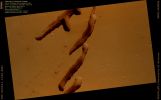
PSP_009913_1910_RED_abrowse-00.jpgFissures in Cerberus Fossae (natural colors; credits: Lunexit)101 visiteThis image shows an example of “en echelon” fractures in the Cerberus Fossae Region.
These fractures formed tectonically, meaning by the movement of Mars’ crust.
En "echelon" means that the fractures are laterally displaced from each other in a way consistent with the lateral displacement of other fractures in the same area.MareKromium
|
|
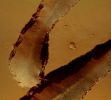
PSP_009913_1910_RED_abrowse-01.jpgFissures in Cerberus Fossae (Enhanced and Saturated Natural Colors; credits: Lunexit)97 visiteThe colors in this frame result from differences in composition of the materials and ALSO represent how the landscape would appear to the human eye. Note that one can make out boulders and small dunes at the bottom of these fractures and layering within the walls. Just visible at the top of the image is some well-preserved impact crater ejecta.
The image is 1,2 Km across.MareKromium
|
|
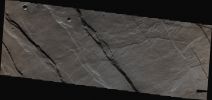
Volcanic_Features-Fractures-AM-PIA16499-PCF-LXTT-IPF.jpgFractures near and around Alba Mons (Absolute Natural Colors; credits for the additional process. and color.: Dr Paolo C. Fienga - Lunar Explorer Italia - Italian Planetary Foundation)86 visiteIn addition to its great size (consider that its Lava Flow Fields extend from over than 1400 Km from the Summit) and relatively low relief (the Summit of the Volcano reaches an elevation of "only" 6,8 Km as to the surrounding Lava Plains), Alba Mons possesses a number of other very distinguishing features. For instance, the central portion of the Volcano is surrounded by an incomplete Ring of Faults (---> Graben) and Fractures (like the ones that we see in today's APOD), called Alba Fossae (the ones located on the Volcano's Western Flank), and Tantalus Fossae (which are found on its Eastern Flank).
Alba Mons also has very long and well preserved Lava Flows that form a Radiating Pattern, starting from its Central Region. The enormous lengths of some individual Flow (something more than 300 Km - such as about 190 miles) implies that the Lavas which formed them were not only very fluid (---> meaning that they possessed very Low Viscosity) at the time of the eruption, but that they also must have been erupted in an extremely high volume (---> quantity). Many of the Flows have distinctive morphologies, consisting of long, sinuous Ridges with discontinuous Central Lava Channels. The low areas between the Ridges (and particularly along the Alba's Northern Flank) show a branching pattern of shallow Gullies and Channels (---> Valley Networks) that likely formed by water runoff. Last, but not least, Alba Mons shows, among other things, some of the oldest, and most extensively exposed Deposits that can be found in the whole Volcanic District of Tharsis.
Orbit Number: 47503
Latitude: 45,2558° North
Longitude: 248,587° East
Instrument: VIS
Captured: August, 29th, 2012
This frame (which is an Original Mars Odyssey Orbiter b/w frame published on the NASA - Planetary Photojournal with the ID n. PIA 16499) has been additionally processed and then colorized in Absolute Natural Colors (such as the colors that a human eye would actually perceive if someone were onboard the NASA - Mars Odyssey Orbiter and then looked down, towards the Surface of Mars), by using an original technique created - and, in time, dramatically improved - by the Lunar Explorer Italia Team.MareKromium
|
|
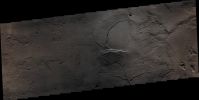
Volcanic_Features-Fractures-Echus_Montes-PIA15165-PCF-LXTT.jpgFractures in Echus Montes (Absolute Natural Colors; credits for the additional process. and color.: Dr Paolo C. Fienga - Lunexit Team)147 visiteOrbit Number: 43744
Latitude: 9,035° North
Longitude: 283,246° East
Instrument: VIS
Captured: October, 25th, 2011MareKromium
|
|
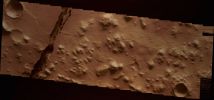
Volcanic_and_Tectonic_Features-Fissures-Cerberus_Fossae-20090213a-PCF-LXTT.jpgFeatures of Cerberus Fossae: Fissures (Saturated Natural Colors; credits for the additional process. and color.: Dr Paolo C. Fienga - Lunar Explorer Italia)64 visiteCaption NASA:"The depression seen in this image is part of the fracture system called Cerberus Fossae. The Fossae cut through hills as well as plains materials".
Coord.: 10,4° North Lat. and 159,9° East Long.MareKromium
|
|
|
| 7 immagini su 1 pagina(e) |
|








